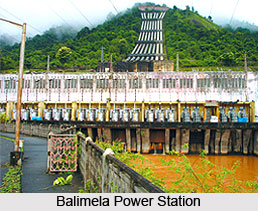
 The water of Balimela Reservoir is utilized to carry out the functions of the Balimela Power Station, located in Orissa, India. Balimela Reservoir and the power station are connected through a 4 K.Ms. long Pressure Tunnel, which ends in a Surge Shaft of 20 Meters diameter and 79 Meters high. The equipments inside the Balimela Power Station include four Steel Penstocks of 3.7 Meters diameter and 183 Meters long take-off from the Surge Shaft to Butter Fly Valve House. Each of the Penstocks in Tunnel is divided into two, thus providing eight Penstocks, for eight Generating Units. These generating units also include the two Units under construction in the second stage. Eight Butter Fly Valves with 2.6 Meters diameter are also included.
In the first stage of development of the Balimela Reservoir, six Penstocks each of 2.5 Meters average diameter and 548 Meters long take-off to the Power House. Thus, in the first stage, the Power House has six Generating Units of 60 M.W., each providing an installed power of 360 M.W. Two more matching Units 75 M.W., each will be added at a later stage and the installed capacity is planned to rise to 510 M.W. The present structure of the Power House provides for fixing of two more identical Units. The Civil works are working hard on the project and majority of it have been completed to a considerable extent.
Sileru River is marked with the second stage of the Balimela Power Project. The first stage development was the Machkund Project. The water released from Machkund Power House and the inflow from intermediate catchment between Machkund-Balimela Dam is confiscated by earth - rock fill at Chitrakonda known as Balimela Dam.
Balimela Dam is known as a joint project of Orissa and Andhra Pradesh Governments and the inflow into Balimela Reservoir is shared between the two States equally. The original estimates planned in the year 1962 for the reason of accord between the two States of Orissa and Andhra Pradesh was for 24 Crore rupees. Eventually, with the progress of the project, this estimate was revised in the year 1972 for 46.30 Crore rupees. Again the estimate was later increased in 1975 for 52.14 Crore rupees. The revision of the estimate at different phases of investigation and construction of the Project was made mandatory for diverse reasons, which include the increasing costs of diverse spares, consumables and the wages of diverse categories of Workmen and Employees.