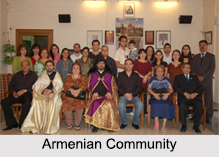
Armenian Community

Armenian Communities made their way to India to trade and to escape religious persecution from the Turks and later, Persians and gradually made India their home.

Armenian Community, Christianity, Indian CommunityArmenian people came to India as traders and established themselves as a community on the Indian soil. Today, their community is a small one, countable in hundreds. They are deeply religious and their life centres round their church. There is very little evidence of Armenian settlements in India before 16th century.

Origin of Armenian Community
Armenians trace their origin to 3,000 BC and at one time Armenia covered nearly the whole of Asia Minor. Armenia lies between the Black and Caspian Seas and is now one-tenth of what it used to be.
History of Armenian Community
The Armenians came to India in the 16th century as peaceful traders and here they found religious and secular freedom, property and peace and India became a second home to them. They settled down in Surat, Agra, Mumbai, Chennai and West Bengal, which were important trading centres. They consolidated themselves from the times of the Mughal reign. Their main centre of activity was initially located at Surat, Gujarat. Later they shifted to Mumbai and Kolkata. In Bengal, Armenians played both sides of the fence with the Indians and the East India Company.

Society of Armenian Community
The Armenian presence can still be felt today. There is an Armenian Church in every major city in India. The architectural legacy stands visible across the city. The modern branches of Christianity celebrate Armenian Christmas according to the Julian calendar on the 25th of December.

Religion of Armenian Community
Armenian Communities are Aryans by race, Christian by religion. The Armenians were the first to bring Christianity to India. In fact, they claim to be the first Christian nation in the world.

Profession of Armenian Community
In the early period Armenians were mostly merchants. The Armenians were among the pioneers of the jute trade in Dacca in the last century. There were Armenians in the coal industry also. The Armenians were among the first to deal in shellac. They owned factories and exported shellac to all parts of the world. J.C. Galstaun who started out in shellac and then went into real estate, was the richest Calcutta Armenian in his time.

Today, Armenians have wandered off the path. Their culture and religion have been abandoned by most. Many mistakenly identify them as Anglo-Indians.

Recently updated articles in Religion in India

Maheswara
Maheswara Thumbnail

Maheswara

Maheswara, meaning “the Great Lord,” is a revered name of Lord Shiva in Hindu tradition. It represents Shiva’s supreme authority over creation, preser...

Anganyasa and Karanyasa
Anganyasa and Karanyasa Thumbnail

Anganyasa and Karanyasa

Anganyasa and Karanyasa are preparatory rituals in Hindu worship that sanctify the body and hands through the recitation of sacred mantras and symboli...

Kumbhakar / Kumhar Caste
Kumbhakar / Kumhar Caste Thumbnail

Kumbhakar / Kumhar Caste

Kumbhakar or Kumhar caste is a traditional artisan community in India known for pottery making. Derived from Sanskrit word Kumbhakar, meaning potter,...

Dhimar Caste
Dhimar Caste Thumbnail

Dhimar Caste

The Dhimar caste, predominantly residing in the Central Provinces of India, is a distinct Hindu community with a rich heritage and diverse occupationa...

Barhai Caste
Barhai Caste Thumbnail

Barhai Caste

Barhai Caste is a traditional Hindu artisan community historically associated with carpentry in India. Known for their craftsmanship, Barhais contribu...