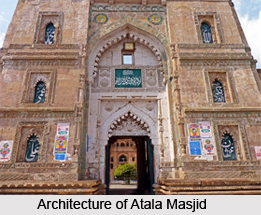
 Architecture of Atala Masjid is amongst the most renowned manifestations of `Sharqi` or Jaunpur architecture, which is a beautiful type of Indo-Islamic style of architecture. Atala Masjid is named in the honour of the nearby Atala Temple, located in Jaunpur District of Uttar Pradesh. Sharqi architecture is characterised by that of the Tughlaqs and comprises minarets, bastions and the utilization of arch-and-beam combination. The most impressive feature of this form of architecture is the outlook of the mosque in terms of the large `propylons` equipped with sloped sides. The construction of the Atala Masjid commenced during 1377 and was finally completed in the year 1408. Sultan Ibrahim Sharqi has been credited for the erection of Atala Masjid.
Hindu architectural features have been employed while creating the Atala Masjid despite being a completely Islamic religious monument. Some people are of the view that the presence of Hindu motifs on the surfaces of this square-shaped mosque can be attributed to the existence of a Hindu temple named Atala Devi Temple which is situated near the mosque. The style of architecture of Begumpur Mosque, Delhi has also inspired the architecture of the mosque. The sloping niches, walls, artistic beams of Atala Masjid bears a sharp resemblance to that of the numerous mosques, tombs and other structures built by Muhammad Shah Tughlaq and Firoz Shah Tughlaq.
The central portico of the Atala Masjid possesses a very large arch and the main prayer hall is actually the gigantic hall of the mosque. The three domes of Atala Masjid differ in their sizes and the niche or `mihrab` existent in a wall is used to symbolise the direction of Mecca. Atala Mosque consists of decorated double-tiered corridors and the main prayer chamber, and several other spectacular structures. Within the bracketed opening of Atala Masjid, one will notice Hindu architectural patterns and also a huge arch separating the two pylons. In the centre of the `liwan` is present some rectangular pylons, which represents the tapering, circular turrets exclusive to the Tughlaq style of architecture. Three gateways are installed in the eastern, southern and northern liwan. Magnificent walls adorned with beautiful galleries are impressive, and the height of the mosque measures 100 feet. The perimeter of Atala Masjid is about 248 feet.