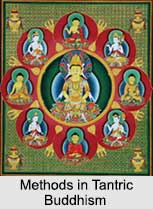
 Methods in Tantric Buddhism are in fact the fundamental instruments of Vajrayanic practice. The most important tools of Tantric Buddhism are Mandala, Deity, Mantra and Guru. They are tools in the sense that they are instrumental to the process of re-integration of the sadhaka. These tools may also be viewed as visual and sonic embodiments of the essential doctrines of Vajrayana. They aid the sadhaka on his spiritual journey towards the realisation of the ultimate goal of reintegration, Buddhahood.
The essential methods in Tantric Buddhism are discussed below:
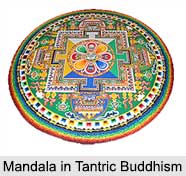
Mandala: Mandala is a harmonious and symmetrical network of archetypal forms placed in a circle around one central figure, generally a Dhyani Buddha. It represents the dynamic totality of the enlightened mind in all its various dimensions and is at the same time an aid in the meditative process of re-integration. According to Tantric Buddhism, mandala bears the essence or the Great Bliss of Enlightened Consciousness. Mandala also signifies the body of the deity as well as the body of the yogi. However, it can be said that mandala is the centre of sovereignty and power, which is indicated by the presentation of the mandala as a fortified royal palace with walls and gates. Rather, it can be said that Mandala is the road map for the reintegration of the sadhaka from the state of disintegration.
 Deity: A number of deities in Buddhism have been borrowed from the Bon faith of Tibet. They have also grown out of the shamanistic beliefs of pre-Buddhist era and were accommodated as Dhammapada. In Tantric Buddhism, it has been explained that deities work as a focus aid to individuals in times of meditation and transformation. In some cases, deities also function as protectors of the dharma. The deities are understood as ways of liberation and enlightenment. They are important milestones in the spiritual journey of an individual.
Mantra: Mantra in Tantric Buddhism is not a mere sound. It protects the mind from all kind of darkness and takes the mind towards enlightenment. Mantras are eternal truths, which revealed themselves to sages in the form of sound representations. The subtle aspect is the mantra and the coarse aspect is the image. Mantra is heard from the heart. In fact, mantra provides the concentration and the constancy to pursue the goal.
Guru: Guru acts as the constant companion and the preceptor. The Guru brings to light gradually that is hidden in the depths of the disciple"s consciousness. As a result, truth reveals itself to the disciple. Tantric Buddhism has claimed that nothing can be gained without the help of the Guru. The Ultimate Truth can only be explained with the aid of a Guru.
Thus the fundamental tantric tools, namely, the Mandala, the Deity, the Mantra and the Guru are essential for the Tantric Sadhana. These tools or instruments aid in the process of re-integration and emancipation and hence are provisional aids to discover one. Once the bi-polar nature of the Ultimate Reality is discovered within oneself and they are united emulating the matrix of the Mandala, the sadhaka with the help of these instruments realises his own innate nature as Bliss.