 The word, "mandala" means a circle, wheel, circumference, a totality, assembly, or literary corpus. It may be analysed as `manda` which means an inner content held secure by an enclosing element `la`.
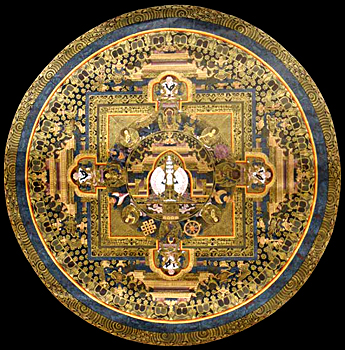
The mandala is an intricate work of geometric designs, symbols, figures and objects arrayed in a definite pattern. The external mandala is made either of powdered colours upon a purified surface consecrated with appropriate rites, or painted on cloth. The drawing of a mandala is a laborious and meticulous task, because an error or omission would render the whole exercise useless.
The mandala is visualized in space which is depicted as blue sky. It is encircled by a concentric circle or circles. The first circle is the circle of fire which represents consciousness that burns away ignorance. Then there is a circle of vajra which symbolises the Absolute Essence or cosmic consciousness. This is followed, especially in the mandalas dedicated to the wrathful deities, by a circle containing eight grave yards which represents the eight aspects of the individual and individuating cognitions which have been destroyed. After the circle containing the graveyards, there is a circle of lotus leaves signifying spiritual rebirth.
The proper mandala consists of a palace within the square courtyard. The square enclosure is cut by transversal lines, which start from the centre and reach the four corners dividing the square into four triangles. In the centre of the square there is the figure of the principal deity of the mandala. The actual mandala contains many designs and figures replete with precise meanings.
The circle of fire in the mandala represents the transformation of every particle of our being. The circle of diamond represents the fierce determination and unshakeable commitment to realise the goal. The circle of lotus suggests the growth from the grosser to a finer level that is purification and spiritual rebirth. The vimana symbolises knowledge or consciousness. The four outer corners signify sameness of knowledge. The four lines signify the mind of maitri that is friendliness, compassion, sympathetic joy and impartiality. The four gates of the mandala stand for the excellence by way of mindfulness and faculty. The four arches are the four dhyanas. The fluttering banners of eight different colours, the tinkling bells which are collectively called the nine-fold miscellany stand for the nine divisions of the scripture. The net, the half-net, the mirror and the garlands represent seven ancillaries of enlightenment.
The eight decorated posts, two at each gate stand for the purity of the eight liberations. The eight flasks are the eight siddhis. The birds on the various arches stand for purity of passions. The five offerings, flowers, incense, lamp, perfume and represent the dharmadhatu. These interpretations show that the various parts of the mandala symbolise the various aspects of the Mahayana tradition.
Mandala illustrates the structure of existence. It is the map of the cosmos, the essential plan of the universe in its process of emanation and reabsorption and with the help of this scheme an individual is able to experience a liberating psychological state.
The mandala is an idealized representation of existence and the identity of Nirvana and Samsara. This identity is represented through the stylized form of different divinities which are the various aspects of the Absolute as well as the different categories of phenomenal existence. Thus Mandala is not only a paradigm of cosmic evolution and involution but also plan to attain undiverted and unified consciousness. It is not an arbitrary construction but a presentation of personal intutions coloured by cosmological conceptions in an appropriate paradigm.
Mandala is born of interior impulses, of archaic motifs or patterns of the `unconscious mind`, which also serves as the source of dreams, fantasies and psychoses and even mythological motifs. It becomes a psychic tool that projects the forces governing existence into a form which can be visualized by the sadhaka and then to reverse the same energy in a process of reintegration.
Hence it can be concluded saying serves as an external instrument to provoke and procure such visions in quiet concentration and meditation. And it is by concentrating his mind upon these visions delineated in the mandala that the sadhaka rediscovers the way to reach his secret reality.