 The 3rd Skinner`s Horse, also known as the 3rd Regiment of Bengal Cavalry, was a cavalry regiment which existed from the year 1903 to 1922. The army unit was a part of the Bengal Army under the British Indian Army. The Bengal Army was the armed forces of Bengal Presidency and was amongst the 3 main Presidency Armies in British India. The British Presidency Armies belonged to the British East India Company until the Sepoy Mutiny of 1857. In 1903, the 3 separate presidency armies were united to form the combined British Indian Army. After the Indian independence, Skinner`s Horse has become a part of the modern Indian Army.
History of 3rd Skinner`s Horse
The military regiment was formed by James Skinner as 2nd Regiment of Skinner`s Horse at Hansi in 1814. Colonel James Skinner raised the military unit of Skinner`s Horse in the year 1803 as an irregular cavalry regiment which provided service to the British East India Company. Later the army unit became one of the most senior cavalry regiments of the Armoured Corps of the modern Indian Army. Colonel Skinner initially raised 2 regiments of cavalry in the year 1803. Later these units became the 3rd Skinner`s Horse and the 1st Bengal Lancers. During the simplification of the British Indian Army, the units were joined together to establish the regiment of 1st Duke of York`s Own Skinner`s Horse, also known as 1st Duke of York`s Own Cavalry.
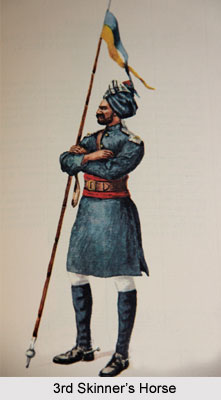
The 3rd Skinner`s Horse had blue attire. The army unit included the full-dress mounted long shirt or Kurta that was worn out with cummerbund and a turban. The uniform also included a full-dress or levee dress. The uniform was not utilised after the year 1914; however the officers of the regiments could use the uniforms on special assignments.
After the country gained freedom from the supremacy of the British Empire in India on 15th August 1947, the nation was divided into the Union of India and the Dominion of Pakistan with the Partition of India. The British Indian Army was separated amongst the 2 newly independent nations of Indian and Pakistan. The 3rd Skinner`s Horse regiment was assigned to India and was known as 3rd Cavalry. In September 1965, it participated in the Battle of Asal Uttar (Khem Karan) during the Indo-Pakistani War (Indo Pak War) of 1965.
Designations of 3rd Skinner`s Horse
The 3rd Skinner`s Horse of the British Indian Army held various designations through out its existence. These are listed as follows-
* 2nd Regiment of Skinner`s Horse - 1814
* Baddeley`s Frontier Horse - 1821
* 4th (Baddeley`s) Local Horse - 1823
* 4th Irregular Cavalry - 1840
* 3rd Regiment of Bengal Cavalry - 1861
* 3rd Bengal Cavalry (Skinner`s Horse) - 1901
* 3rd Skinner`s Horse - 1903
* 1st Duke of York`s Own Skinner`s Horse - 1922