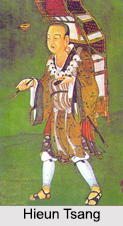
 Hieun Tsang was the famous Chinese traveller who visited India in prehistoric times. He was a Chinese Buddhist monk, scholar, traveller, and translator as well. He became famous for his seventeen-year overland journey to India which is recorded in detail in the classic Chinese text.
Birth of Hieun Tsang
Hieun Tsang was born in what is at this time Henan province, about 602 in Chenhe Village, Goushi Town, Luozhou. From boyhood, he took to reading spiritual books, including the Chinese classics and the writings of ancient sages.
Legends of Hieun Tsang
Hieun Tsang had a dream once that swayed him to journey to India. At Gandhara (Pakistan), he took part in a religious debate and showed his knowledge of several Buddhist schools. There he also met the first Jains and Hindu of his journey. He went to Adinapur (Jalalabad) after that.
He then visited a number of stupas around Peshawar, notably the "Kanishka Stupa". He then visited "Taxila" which was half ruined and found most of its "sangharamas". He then went to Kashmir in 631 and met a monk Samghayasas. In Kashmir, he found himself in another centre of Buddhist culture and explained that there were over 100 monasteries and over 5,000 monks living there. He studied with different monks between 632 and early 633. He then visited Chiniot and Lahore. He went east to Jalandhar in 634, in eastern Punjab, and turning southward again to Bairat and then Mathura, on the Yamuna river. He travelled to Shrughna River and also mentioned in the works of Udyotakara, crossing the river Ganges in 635. From there, he headed south to Sankasya.
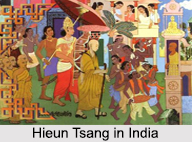 In 637, Hieun Tsang set out from Lumbini to Kusinagara, before heading southwest to the deer park at Sarnath where Buddha gave his first sermon, and where Hieun Tsang found 1,500 monks. He then went to Vaisali, Pataliputra (Patna) and Bodh Gaya via Varanasi. From Nalanda, Hieun Tsang travelled through several kingdoms. Hieun Tsang found 20 monasteries there with over 3,000 monks studying both the Hinayana and the Mahayana.
From there, he went to southward and travelled to Amaravati and Nagarjunakonda and stayed at Amaravati. He continued travelling to Nasik, Ajanta, Malwa, from there he went to Multan and Pravata before returning to Nalanda again. He then went east to the ancient city of Pragjyotishpura and King Harsha invited Hieun Tsang to Kumbh Mela in Prayag. After visiting Prayag, he returned to Kannauj. Hieun Tsang passed through Kashgar, Khotan, and Dunhuang on his way back to China by travelling through the Khyber Pass of the Hindu Kush.
Death of Hieun Tsang
Hieun Tsang died on 5 February 664 in Yuhua Palace in present-day Tongchuan.