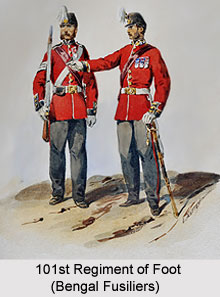
 The 101st Regiment of Foot (Bengal Fusiliers) was one of the infantry regiments of the British Indian Army. The battalion provided service in existence from the year 1862 to 1881. The battalion was a part of the Bengal Army and was developed by the British East India Company during 1652. Later the regiment was merged with the 104th Regiment of Foot (Royal Bengal Fusiliers) unit in order to create The Royal Munster Fusiliers regiment. The army of the province of Bengal was the armed forces of Bengal Presidency and was amongst the 3 main Presidency Armies in British India. The British Presidency Armies belonged to the British East India Company until the Sepoy Mutiny of 1857. The Government of India Act 1858, which was authorized after the Sepoy Mutiny in the year 1857, re-assigned the authority of the 3 Presidency Armies to the British Empire in India. In the year 1903, the 3 separate presidency armies were amalgamated to form the combined British Indian Army.
History of 101st Regiment of Foot (Bengal Fusiliers)
The 101st Regiment of Foot (Bengal Fusiliers) was raised as a Guard of Honour unit as a part of the Honourable British East India Company in the year 1652. The unit became a Bengal European Regiment by the year 1756. The use of the term "European" in the title suggested that the army unit was commanded by British soldiers instead of Indian Sowars, who were the cavalry troops of the Presidency Armies. The battalion was divided in the year 1765 and it was re-designated as the 1st European Bengal Fusiliers. The regiment held the title till the British Empire in India took charge of the British East India Company after the Sepoy Mutiny in the year 1857.
The term European was substituted by Royal and the unit was renamed as the 1st Royal Bengal Fusiliers in 1861. Later it was re-assigned to the British Army and revaluated as the 101st Regiment of Foot and also continued to hold the name Royal Bengal. The 101st Regiment of Foot (Bengal Fusiliers) was amalgamated with the unit of 104th Regiment of Foot (Royal Bengal Fusiliers) to raise the regiment of The Royal Munster Fusiliers regiment in the year 1881, as part of the Childers Reforms. The Royal Munster Fusiliers was a regular infantry regiment of the British Army.
Battle Honours of 101st Regiment of Foot (Bengal Fusiliers)
The 101st Regiment of Foot (Bengal Fusiliers) served in several operations under the British Indian Army. The unit was awarded with battle honours for Buxar, Condore, Plassey, Rohilkhand (1741), Lucknow, Pegu, Ferozeshah, Delhi 1857, Sobraon, Afghanistan (1839), Ghuznee (1839), Deig, Bhurtpore (Bharatpur), Guzerat (Gujarat) and Sholinghur.