 Indian Sea Turtles belong to the families namely, Cheloniidae and Dermochelidae. They possess paddle-shaped limbs (flippers), which may span twelve feet in Leatherback Sea Turtle (Deemochelys Coriacea). Sea turtles are large animals. This can be comprehended from the length and weight of a Leatherback. A Leatherback grows to over 2.5 meters in length and 700 kilograms in weight. Sea turtles are also capable of forming large populations. A sea turtle comes ashore voluntarily, only briefly to nest and very rarely to bask. Out of seven, five species of sea turtles representing each of the five existing genera are known to be from the Indian Ocean.
Sea turtles have survived and have changed little over the millennia, during which many other reptile species have become extinct.
Indian Sea Turtles belong to the families namely, Cheloniidae and Dermochelidae. They possess paddle-shaped limbs (flippers), which may span twelve feet in Leatherback Sea Turtle (Deemochelys Coriacea). Sea turtles are large animals. This can be comprehended from the length and weight of a Leatherback. A Leatherback grows to over 2.5 meters in length and 700 kilograms in weight. Sea turtles are also capable of forming large populations. A sea turtle comes ashore voluntarily, only briefly to nest and very rarely to bask. Out of seven, five species of sea turtles representing each of the five existing genera are known to be from the Indian Ocean.
Sea turtles have survived and have changed little over the millennia, during which many other reptile species have become extinct.
Nesting by Sea Turtles
The nesting female turtle laboriously hauls herself on a sandy beach where the eggs, usually 50 to 200 in number, are deposited in a roughly half-meter deep chamber, which she excavates. Viscous tears that she sheds remove excess salt dried from the turtle`s ability to drink sea water. This process is a marine adaptation of a sea turtle. The nest site is leveled or camouflaged by the turtle, who then returns to the sea where she may mate again. The female takes no further interest in her eggs, which hatch roughly two months later. Most species nest every two or three years. Up to eight clutches (representing a total of about 700 golf ball sized eggs) may also be laid by a female turtle at two weeks interval among the laying of clutches during a nesting year.
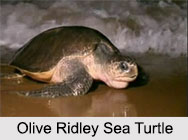
Some species like Green Turtle or Chelonia Mydas (named after its greenish fat) navigate with precision for 100 of miles in the ocean between specific feeding grounds and breeding areas. Renesting often occurs at sites lying within yards of nests the turtle had made six or more years earlier. The Olive Ridley Sea Turtle (Lepidochelys Olivacea) nests on most of the mainland shores of India. Arribada (a Spanish word for mass nesting activity) takes place each February in the Bhitarkanika Wildlife Sanctuary in the Indian state of Odisha. The spectacular yearly arribada is one of the largest in the world, with over 200,000 nesters utilizing a ten kilometers stretch of a beach for a period of about two weeks. During this period, the nesting density is so high that turtles accidentally dig up each other`s eggs while laying their own. This is indicative of the fact that there has not been much diminution in the local breeding population of sea turtles. 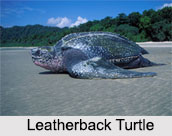
Despite the throngs of people who enjoy the beaches at weekends and have constructed concrete beach huts on the shore line, hundreds of sea turtles still come ashore to lay their eggs between the months of July and November.
Reproduction in Sea Turtles
Females of some sea turtle species have the ability to store viable sperm within their bodies for years. Copulation occurs in the sea near the nesting beach to discourage males, who are promiscuous. In this case, the female may assume a `refusal position`. With body held vertical in the water and the limbs outstretched, the female turtle faces the male. Incubation temperatures that are too low (24 degrees to 26 degrees Centigrade) and too high (30 degrees to 32 degrees Centigrade ) will slow down and speed up hatching, respectively and may result in all-male hatchlings (in the former case) and all-female hatchlings (in the latter case). Intermediate temperatures produce both males and females.
The hatchlings take two or more days to dig their way out to the sand surface. They emerge in a group usually at night, thus evading avian predators and lethal surface-sand temperatures. Braving ghost crabs and other enemies, the hatchlings rush to the sea, which they usually locate unerringly. Even if the sea is invisible, the hatchlings will move towards the brightest horizon by scampering - a tendency which may also draw hatchlings landward at beaches such as the Marina Beach in Chennai, where disorienting lights exist.
Significance of Sea Turtles
Sea turtles are valuable sources of tortoiseshell (a beautiful horny shell material obtained from the Hawksbill Sea Turtle and used in curio industry), calipee (the cartilaginous tissue which is the main ingredient of the widely-relished turtle soup), oil, skin, eggs and meat. Thousands of sea turtles are consumed annually in the Indian states of West Bengal and Tamil Nadu. But it is important to note that the flesh of Hawksbill Sea Turtle may be seasonally poisonous. Therefore, it would be an aesthetic and economic loss, if sea turtles become extinct.
Threats to Sea Turtles
The list of animals that prey on sea turtle eggs and their young ones are dogs, jackals, monitor lizards, wild and domestic pigs, leopards, hyena, estuarine crocodiles, ghost crabs, hermit crabs, coconut crab, ants, rats, seagulls, crows, sharks and many more. But it is mainly man`s activities that have decimated many sea turtle population and necessitated urgent international action to reverse the trend towards extinction. The depletory activities include unrestricted egg collection, killing of adult turtles for commerce in meat, skin and calipee, accidental drowning of sea turtles in trawl nets and land development, which destroys nesting habitats. As per estimations, only 1 in 1,000 hatchlings will survive to adulthood.
Conservation of Sea Turtles
Considering serious threats to the population of sea turtles in India, the Sind Government in collaboration with the World Wildlife Fund (WWF) has set up a protected turtle-hatching zone. The Sind Wildlife Management Board has posted warders along the beaches to protect this endangered species.