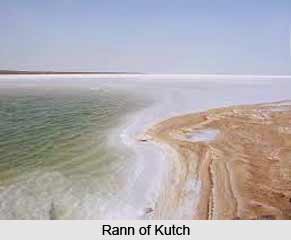
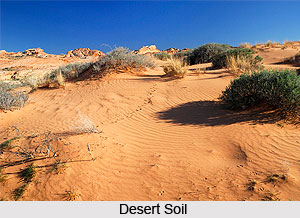
 Desert soils are basically of sandy texture. This type of soil has poor clay content and also lacks in moisture content. Desert soils are generally of brown, light brown or reddish colour. Due to the arid conditions, leaching of soil is almost absent in the desert soils and thus evaporation is quite rapid. Therefore, these soils are in general saline. Further, in some low level areas, the salt content in the desert soils is really high. In fact, it is so high that common salt is obtained by evaporating the saline water collect from such areas.
However, salt content in some desert soils is not that high and thus in such cases they support vegetation in the sufficient availability of water. Moreover, in some areas, land is rocky and is surrounded by gravel. A desert is actually a region or landscape that gets extremely low level of rainfall and the level of precipitation is also low to sustain the growth of most plants. Deserts are defined as areas with an average annual precipitation of less than 250 millimetres (10 in) per year. Desert soils are basically poor in nitrogen, which is an important nutrient required for the plantation purpose. These soils when irrigated properly produce rich crops. The soils of the arid zone actually are sandy to sandy loamy in texture. The depth and consistency vary according to the topographical features. The low lying loams are heavy and have a hard pan. Some of the desert soils contain high percentage of soluble salts in the lower horizons turning water in the wells poisonous.
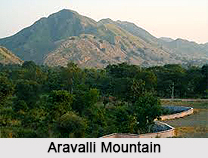
Rajasthan Desert is covered with sand at most of the places. Moreover, small mounds of sand and fine dust particles also occur in some districts of states like Punjab and Haryana that are very close to Rajasthan. The desert soils or sandy soils are also called as `bhur`. They also grow along the river courses and coast. In Rajasthan Desert, south-west monsoon is relatively strong during summer season. These strong dust storms and winds carry fine dust and leave behind bigger sand particles. As a result, the soils in the west of the Aravalli Mountain Ranges become more and more sandy and thus are infertile.