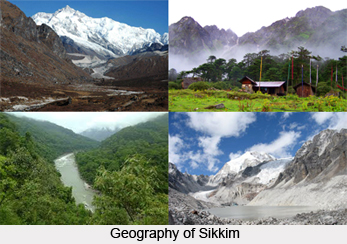
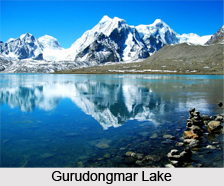
 The Gurudongmar Lake is situated in northern Sikkim in India. More specifically, this lake lies in the north side of Khangchengyao Range. It is also known by the name Gurudogmar Lake. It not only boasts of being one of the highest lakes in the world but is also labeled the second highest lake in Sikkim as well as in India, the first being Cholamu Lake at a height of about 18000 ft, also situated in Sikkim. This lake is named after Guru Padmasambhava, also known as Guru Rinpoche by the Tibetan Buddhists. Characteristically, this lake is a high altitude fresh-water lake and a tourism product of Sikkim. This is because this lake is considered sacred by both Buddhist and Sikh devotees. During the winters this lake freezes, except at one spot. This spot is considered to be specially blessed or sacred by the devotees.
History of Gurudongmar Lake
The Pilgrim`s Guide to The Hidden Land of Sikkim or Denjong Nye-Yig by Jigme Pawo and the Nay-Sol texts highlight, that the Gurudongmar Lake is one of the 108 "Tso-Chen" or major holy lakes of Denjong or Sikkim. These holy lakes are believed to be abodes of local guardian deities, and Gurudongmar Lake is one of them. He is known to visit the lake in the 8th century.
History highlights that Guru Padmasambhava receiving an invitation from Chogyal (Tibetan emperor) Trisong Deutsen, started his journey to Tibet and made the Tibetans familiar with the practice of Tantric Buddhism. It is believed that the Guru even visited Sikkim, on his way back from Tibet. As he stepped into Sikkim, Gurudongmar Lake probably became the first major landmark that Padmasambhava came across. His visit to this place is known by the word "Dongmar Shab Chakpa". He perceived the lake as a part of Dorje Nyima or Chorten Nyima, a sacred place of worship in northern Sikkim. He came across a status quo, when the local residents approached him with an appeal. The Gurudongmar Lake used to freeze in winter, creating a paucity of drinking water. In order to resolve this problem for the needy, Guru Padmasambhava placed his hands on a section of lake to miraculously prevent it from freezing during winters. It is the belief in these historical facts which draws devotees and tourists to this lake. The water of this lake is believed to have curative properties. It is also believed that one can be blessed with the birth of a child or children, by offering prayers at this sacred lake.
It is also believed that even Guru Nanak had visited Sikkim, on his way back from Tibet. He too came across the Gurudongmar Lake and was pleaded by the locals to make the lake a source of drinking water during winters. Nanak granted the wish of the Gurudongmar villagers and touched a part of the lake with his stick, which did not freeze after this sacred contact, throughout the year. These villagers also intimated Nanak with the fact that their virility had been affected by the high altitude. After hearing this Nanak responded by blessing this lake with the power to bestow virility and strength to anyone who would take the water of this lake. Since then both the lake and the surrounding hills came to be known as Gurudongmar.
Geography of Gurudongmar Lake
The Gurudongmar Lake is located at an altitude of about 17,800 ft (near about 5,430 m). At this height there is dearth of oxygen. It is therefore recommended to tourists not to stay at this height for more than an hour. The lake has an area of about 118 hectares (290 acres) and its peripheral length is about 5.34 kilometers (3.32 mi). It is the hilly topography which only permits partial view of the lake, thus making it appear small. Glaciers form the water source of this lake. Also, this lake is one of the sources of River Teesta, which flows through Sikkim, West Bengal and Bangladesh to finally merge with the Bay of Bengal. This lake is adorned by it"s surrounding which comprises of snow-covered mountains. Sarva Dharma Sthal, a place of worship for all religions, is also located close to the lake. The surrounding area of the lake is also called Gurudongmar, which is a home to high altitude wildlife. The lake is known to remain frozen in the winter months, which extends from November to Mid-May.
Threat to Gurudongmar Lake
The Gurudongmar Lake once had luculent icy water, with even the bed of the lake being visible from the surface. Unfortunately, local pollution has resulted in white colour appearance of the lake.
Visiting Information
It is important to note that a permit is required when one is on a tour to Gurudongmar Lake. This is because this lake is close to the Indo-Tibet border. November to June is generally considered to be the best time to visit the Gurudongmar Lake.
The nearest airport to Gurudongmar Lake is Bagdogra near Siliguri, which is at a distance of 124 km from Gangtok. International travelers can get connecting flights from Kolkata or Delhi, as this airport is connected to Kolkata, Delhi and Guwahati. Only once during the day helicopter services are available from Bagdogra to Gangtok. New Jalpaiguri is the nearest railhead, which is well connected to most of the major cities in India. Lachen, a small town in North Sikkim at an altitude of about 10000 ft, is the base for the trip to Gurudongmar. It can be reached by driving through snow clad peaks and mountains from Gangtok. Another viable option is Thangu. It is located at an altitude of about 14000 ft and is the closest village from Gurdongmar Lake. Roads leading to Gurdongmar Lake are motorable via bus, taxi and jeep, which are frequently available to visit this lake.
Related Article:
Lakes of India
Khecheopalri Lake
Lake Menmecho
Water Projects in India
Indian Ports