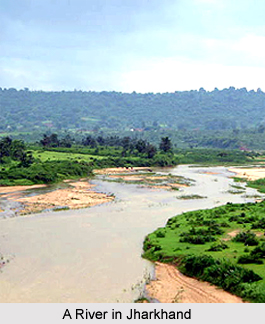
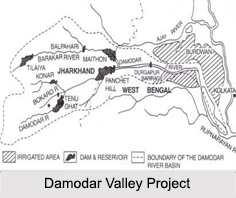
 Damodar Valley Project is the first multipurpose river valley project of independent India. This project is handled by Damodar Valley Corporation. It was launched on Damodar River. Damodar Valley Project covers an area of about 24,235 square kilometers and benefits two states that are Bihar and West Bengal. It is 692 metres long and 11.6 metres high barrage that was constructed across Damodar River. The right and the left bank canal that are starting off from this barrage are mainly used for irrigation and navigation purposes.
Damodar Valley Corporation
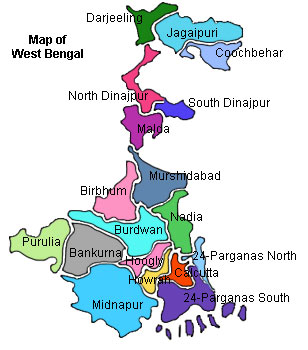
The Damodar Valley Corporation or DVC as it is commonly known is considered to be the first independent and versatile river valley project of the country. It started to function on 7th of July, 1948 with the help of an Act of the Constituent Assembly of India. The project to build a Dam across the Damodar Valley was the joint venture between the Government of India and the states Government of West Bengal and Bihar. The regions covered by the Damodar Valley include Hazaribagh, Koderma, Giridih, Dhanbad and Bokaro districts of Jharkhand and Bardhaman and Hooghly district of West Bengal.
 Objectives of Damodar Valley Project
In the beginning, the main focus of Damodar Valley Corporation was to prevent flood, assist irrigation and production, transmission and supply of electricity, afforestation and eco-conservation as well as to provide job for the social and economic well being of people living in and around the places affected by the formation of the projects. The project has given much priority to generation of power and the rest of the objectives of this project still remain as a part of its principal responsibility.
Damodar Valley Corporation"s network of four dams, one barrage and a canal, checks floods and facilitates irrigation. Activities like watershed managing and other allied tasks are performed occasionally. Watershed management chiefly constitutes controlling soil erosion and augmenting the life span of DVC reservoirs by curtailing the flow of debris that lead to silt deposition. Planting trees, building check dams, rehabilitating denuded forests, managing the soil, protecting or reviving the land are some of the main tasks of Damodar Valley Corporation.
Dams of Damodar Valley Project
Damodar Valley Project is currently heading the operations of three thermal power stations, 3 hydel power stations and 1 gas turbine station. The 3 thermal power houses are at Durgapur, Bokaro and Chandrapur district. The 3 Hydel stations are appended to Tilaiya, Maithon and Panchet Dams and 1 Gas Turbine unit at Maithon. Four multipurpose dams on River Damodar were constructed during the period 1948 to 1959. They are:
Tilaiya Dam: The Tilaiya dam is a part of this project which was constructed across the river Barakar. River Barakar is the main tributary of the River Damodar. This dam is 30 metres in height and 366 metres long.
Konar Dam: Another dam by the name of Konar dam is also an integral part of this project which is situated in the district of Hazaribagh district across Konar River, a tributary of Damodar River. This dam has a height of 49 metres and a length of 3548 metres.
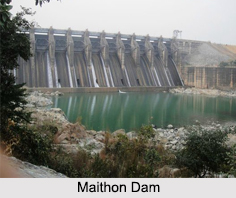
Maithon Dam: Maithon dam is also a part of Damodar Valley Project and was constructed over River Barakar. The aim of this dam is to control flood. It is 94 metres in height and 144 metres in length.
Panchet Hill Dam: Another dam, which is also a part of the Damodar valley project, is the Panchet Hill dam. This dam is 2545 metres in length and the height of this dam is 45 metres. The Panchet Hill dam is built over the River Damodar in Dhanbad district.
Benefits of Damodar Valley Project
There are several benefits from the Damodar valley project. The project constructed dams and thermal power stations which help in controlling flood and providing electricity respectively. Large hectares of land are irrigated in the districts of Hooghly, Howrah District, Bardhaman and Bankura District of West Bengal as a result of the construction of dams by the Damodar valley project. The project has also opened doors for transportation through canals. Soil erosion is also being checked by this corporation and it also works in the direction of plantation. Anti-malaria drive is also undertaken by the Damodar Valley Project, so that the people living close to the project are not affected by this disease.