Factors Governing Maritime Strategies in India, Geography of India - Informative & researched article on Factors Governing Maritime Strategies in India, Geography of India
  Indianetzone: Largest Free Encyclopedia of India with thousand of articles Geography of India


in  
Art & Culture | Entertainment | Health | Reference | Sports | Society | Travel
Forum  | Free E-magazine
Geography of India : Indian Climate l Indian Mountains l Indian Forests l Indian Soil l Indian Vegetation l Animal Husbandry in India l Resources in India l Indian Demography l Indian Natural History l Indian Astronomy l Indian Industries l Indian Islands l Indian Airports l Zoos in India l Indian Mines and Minerals l Indian Physiography l Indian Transport l Indian Geology l Communication in India l Indian Trade l Indian Astronomers l Indian Telecommunications
Home > Reference > Geography of India > Resources in India > Water Resources in India > Indian Maritime Trade > Factors Governing Maritime Strategies in India
Factors Governing Maritime Strategies in India, Geography of India
Several key domains are looked into while governing factors in maritime strategies in India.

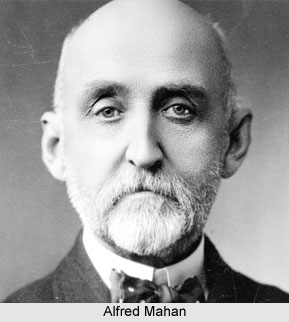
Alfred Mahan"Whoever controls the Indian Ocean dominates Asia. This Ocean is the key to the seven seas. In the twenty first century, the destiny of the world will be decided in its waters". -Alfred Mahan

The importance of the Indian Ocean was well understood by Alfred Mahan, one of the leading thinkers on maritime affairs in the world. With a host of countries, both regional and extra-regional having their presence in these waters, India felt necessary to adopt a maritime policy to certify that it is in a position to influence events in the region. Factors governing Indian maritime strategies were hence focussed on the entire spectrum of issues encompassing foreign policy, port infrastructure, labour laws, ship building industry, shipping industry, coastal and inland shipping, maritime forces, security arrangements with other powers in the region.

Infrastructure
The magnitude of the development of infrastructure, for attaining high growth rates, has successfully been grasped by the country. Presently, infrastructural supremacy is counted as the prime factor in governing maritime strategies of India. The major thrust is on the development of roads, power generation and telecommunication.

Ports: India has 12 major ports and 185 minor ports spread on India`s extensive coastline, with the bulk of the overseas trade being handled in the major ports. When it comes to ports, shipping and ship building in colossal dimension are some of the key factors governing maritime strategies of India.

Economic Activity

Off Shore Exploration: The oil exploration sector has received a boost in the recent past with the entry of private players in this field. ONGC (Oil and Natural Gas Corporation) has also unveiled major plans for exploration in the Indian EEZ (Exclusive Economic Zone) and other foreign oil fields. India has made a headway in the field of deep sea-bed mining. Being a technology intensive field, the country is working towards making a successful policy in maritime strategies.

Non Conventional Energy: The oceans afford India with an opportunity to develop energy through non-conventional means like tides and waves. The Gulfs of Kachchh and Cambay are ideal for production of electricity by harnessing the gigantic tidal variations. The long coastline provides many ideal locations to harness the energy of the waves to produce electricity.

Fishing Industry: The Indian fishing industry has terrific potential for growth. Most local fishermen exploit sections in the coastal waters. Hence, looking seawards, Indian maritime strategies assimilate several governing factors.

(Last Updated on : 19/10/2010)
  More Articles in Indian Maritime Trade
 
Factors Governing Maritime Strategies in India Maritime Interests of India Maritime Security of India
Ship Building In India    
Recently Updated Articles in Geography of India
  • Multi-purpose River Valley Projects in India
    Multi-purpose River Valley Projects provide water resources that have been systematically and successfully collected into several regions that are affected by water shortage.
  •  
  • Non-Conventional Sources of Energy in India
    Non-Conventional Sources of Energy in India mainly include wind, tidal energy or solar energy that are very much renewable and are widely used.
  •  
     
  • Soil Erosion in India
    Soil Erosion in India or degradation of soil is one of the prime concerns of the nation as agriculture is adversely affected to a great extent.
  •  
  • Soil Conservation in India
    Soil Conservation in India is a prime measure taken to check the ravages of soil erosion in the nation, particularly in Punjab, Maharashtra, Karnataka etc.
  •  
  • Land Resources in India
    Land Resources in India comprises of 1.3 million sq miles and includes the Non-Renewable Energy Reserve which is utilised for several purposes
  •  
    E-mail this Article | Post a Comment
    RSS Feeds
    Forum
    Forum on Geography of India

    Free E-magazine
    Subscribe to Free
    E-Magazine on Indian Crafts
     
     
    Factors Governing Maritime Strategies in India, Geography of India - Informative & researched article on Factors Governing Maritime Strategies in India, Geography of India
    Sitemap
    Contact Us   |   RSS Feeds
    Copyright © 2008 Jupiter Infomedia Pvt. Ltd. All rights reserved including the right to reproduce the contents in whole or in part in any form or medium without the express written permission of Jupiter Infomedia Pvt. Ltd.