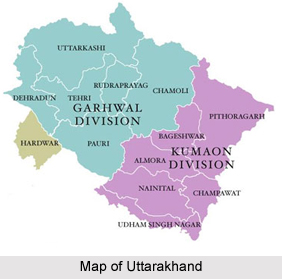
 Uttarakhand is known as the Land of Gods or Dev Bhoomi, as it is the land of enormous beauty and spiritual bliss. It is believed that the peaks and valleys of this state were abodes of gods and goddesses. Ganga River, Yamuna River and scores of other rivers originate in Uttarakhand. It is difficult to describe the beauty of Uttarakhand in words. Historically, Uttarakhand is believed to be the land where the Vedas and the Shastras were composed and the great epic, the Mahabharata, was written. Rishikesh is widely considered the Yoga capital of the world.
History of Uttarakhand
The name of Uttarakhand finds mention even in the early Hindu scriptures as Kedarkhand, Manaskhand and Himavat. Uttarakhand was also the ancient Puranic term for the central stretch of the Indian Himalayas. It is evident from the Ashokan edicts at Kalsi in Western Garhwal Himalaya that Buddhism made inroads in this region. Further, in the year 1791 the growing Gurkha Empire invaded Almora, which was the seat of the Kumaon Kingdom. Later on, in the 19th century, expansion of the Gurkha Empire was brought to an end by British annexation of these regions. In January 1950, the United Province was renamed, as Uttar Pradesh and Uttaranchal remained a part of Uttar Pradesh. It emerged as an individual state on 9th November 2000. It was formed as the 27th state of India.
Geography of Uttarakhand
Uttarakhand is rich in natural resources with many glaciers, dense forests, mountain peaks and a network of mighty rivers, namely, Ganga, Yamuna River, Ramganga River, Kosi River, etc. Bordering Tibet and Nepal on the northeast of Delhi, the mountains of Garhwal and Kumaon ascend from the lush and fertile Sub-Himalayan plains. This state was formed from the hill districts of Uttar Pradesh. The climate of the state varies from subtropical in valleys to temperate on higher slopes. Indian National Parks in Uttarakhand include the Corbett National Park (the oldest national park of India) at Ramnagar in Nainital District, Valley of Flowers National Park and Nanda Devi National Park in Chamoli District, Rajaji National Park in Haridwar District, and Govind Pashu Vihar National Park and Gangotri National Park in Uttarkashi District.
Demography of Uttarakhand
 The population of Uttarakhand is around 8479562 as per 2001 census. Out of which the male population is 4316401 and female population is 4163161 of the total population. In the rural areas the population is about 6309317. Population density is 159 per sq km. The sex ratio is 964 per thousand. The literacy rate of the state is around 72.28 percent. The percentage of literate males is 84.01 percent and the percentage of literate females is 60.26 percent. The decadal literacy rate of the state is 14.47 percent. The current rate is above the national average.
Culture of Uttarakhand
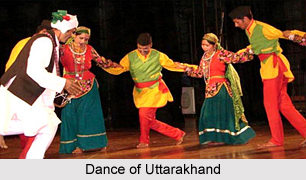
The people of Uttarakhand are called by the name Garhwali or Kumaoni. Some people are also known as Paharis. Majority of the people here are Hindus. Most of the people who reside here belong to the upper castes known as khasi tribe. The other communities of the state are Jadh, Marcha, Tolcha, Shauka, Buksha, Tharu tribe and the Gujjar tribe. The Gujjar`s are mainly cattle herders. Majority of the people speak Hindi language. Kumaoni and Garhwali dialects of Central Pahari are spoken by the people. Several festivals are celebrated here such as Kumbha Mela, Devidhura Mela (Champawat), Purnagiri Mela (Champawat), Nanda Devi Mela (Almora) and Gauchar Mela (Chamoli).
Education in Uttarakhand
Uttarakhand has several educational institutions of major importance. It is home to the oldest engineering college in Asia, the Indian Institute of Technology at Roorkee (formerly University of Roorkee). Other universities and institutes of prime importance include Dehradun Institute of Technology, University of Petroleum and Energy Studies, Dehradun, H.N.B. Garhwal University in Srinagar, Kumaon University in Nainital and Almora, etc. Garhwal and Kumaon Universities were founded in 1973 as part of the upsurge of regional sentiment that led to the Uttarakhand statehood.
Administration of Uttarakhand
The current Chief Minister of Uttarakhand state is Dr. Ramesh Pokhriyal Nishank. The state is divided into two divisions: Kaumaon and Garhwal. These divisions are further divided into districts which are 13 in number.
Economy of Uttarakhand
The state of Uttarakhand is rich in minerals like limestone rock phosphate, dolomite, magnetite, copper graphite, soap stone, gypsum, etc. The number of small-scale industries here are 41,216. There are 191 heavy industries. Economy of Uttarakhand is mostly dependent on agriculture as 90 percent of the population here depends on agriculture and allied activities.
Tourism in Uttarakhand
Leisure, adventure, and religious tourism play a prominent role in Uttarakhand`s economy, with the Corbett National Park and Tiger Reserve and the nearby hill-stations of Nainital, Mussoorie, Almora, Kausani, Bhimtal and Ranikhet being amongst the most frequent destinations of India. Pilgrims have been visiting the region in the hopes of salvation and purification from sin. Gangotri and Yamunotri, the sources of both the Ganges and Yamuna fall in the upper reaches of the state and together with Badrinath (dedicated to Lord Vishnu) and Kedarnath (dedicated to Lord Shiva) form the Chardham of Uttarakhand.