Andhra Brahmin Community, Brahmin Caste - Informative & researched article on Andhra Brahmin Community, Brahmin Caste
 Indianetzone: Largest Free Encyclopedia of India with thousand of articlesIndian Religion


in  
 Art & Culture|Entertainment|Health|Reference|Sports|Society|Travel
Forum  | Free E-magazine  | RSS Feeds  
Indian Religion : Vastu Shastra |Indian Religions |Indian Myths |Indian Mythology |Gods of India |Goddesses Of India |Religious Thinkers of India |Types of Religion in India |History of Indian Religion |Indian Yogis |Ajivikas |Sacred Scriptures in Indian Religion |Tantrism |Shaivism |Indian Communities |Sacred Animals in India |Roman Impact on South Indian Art and Society |Bhattacharyas |Indian Classical Terms
Home > Society > Indian Religion > Indian Communities > Andhra Brahmin Community
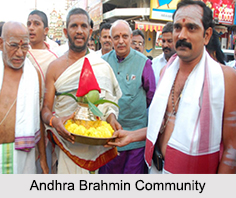
Andhra Brahmin Community, Brahmin Caste
The Andhra Brahmins reflect the traits of both Tamil and Kannada Brahmins.

 The Andhra Brahmins can trace their origin to the time of the Brahmin Satavahana dynasty. It was one of the earliest records in their history, which was a period of prosperity for the region as well as a time of Brahminical achievement.

Andhra Brahmins, born to learning and nurtured in it, were often of invaluable help to their rulers who rewarded them suitably. Copper-plate charters of the Chalukya rulers record the extensive grants made to the members of this community. Their competence led to the rulers appointing them in secular posts.

This also created one of the main subdivisions of the community on the basis of pursuits, the religions being followed by the Vaidikis and the secular by the Niyogis (a word which comes from niyogani, meaning employment). The Vaidikis continued the traditional occupation of priesthood, observing Vedic rituals and vows; officiating at ceremonies; expounding the sacred books and the Mahabharata and the Ramayana to the royal family and the public; and serving as temple priests and astrologers. Since Brahmin tradition had to be perpetuated, some of their time was given to teaching. The Vaidikis were either looked after directly by their royal patrons or were settled in the `agrabarams` (villages) given as sifts for their maintenance. Some lived on alms, which was devoid of stigma, being ordained by the scriptures. The Niyogis also followed Brahmin tradition in their personal lives.

During the Chalukya rule, a number of Brahmin families from Tamil Nadu and Karnataka settled in Andhra. They formed the nucleus of the Dravida sect of the Telugu Brahmin community. The Telugu kingdom under the Vijayanagar rulers extended its sphere of influence as more and more opportunities for important posts came the way of these people. This period also saw the burgeoning of Telugu culture all over south India. A number of Telugu Brahmins migrated and settled in Tamil Nadu and Karnataka and assimilated some of the customs of the Brahmins residing there. The Telugu Brahmins, for their part, produced great musicians, such as, Kshetrajna and Tyagaraja who was also a great saint poet as was Narayana Tirtha and more recently like Visvesvarayya and Radhakrishnan, who was a leading philosopher as well. The only cultural element that suffered in the process was Kannada as when the Telugu Brahmins settled in Karnataka, its language lost its purity and lyrical quality.

Some of the subjects of the Vaidikis, which evolved long ago on a regional basis, are the Velanadu, Mulakanadu, Kasalnadu, Veginadu, Koneseema, Telaganyam, Karnakammulu and Partha-masakis. The subjects of the Niyogis, which are based mostly on distinctions of employment, are Nandavarikulu, Kammalu, Desalavayulu and Pranganadu. In times past the distinctions of each sect were jealously maintained by it and intermarriage was not permitted but these distinctions and restrictions are slowly wearing away.

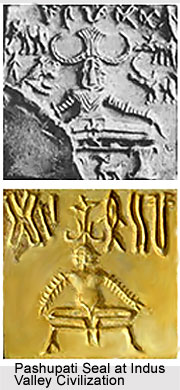
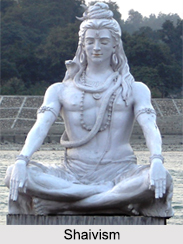
Apart from these divisions based on occupational or regional differences, there are the sects based on faith: the Madhavas, Shaivas (numerically the largest group) comprising the Smartas who worship all the gods of the Hindu pantheon and the Lingayats or Virsaivas who wear lingas on their persons and proclaim the supremacy of Lord Shiva. At one stage during the mediaeval period, the conflict between the Virashaivas and the Vaishnavas was so bitter that it threatened to split the community. This was in the twelfth century when the linga cult was popularised by Basava of Karnataka and his contemporary, Mallikarjuna, a Telugu Brahmin. Calling themselves Aradhyas, the followers of this cult tended to be extremists. A most unusual decree called for a woman to leave her husband if he did not follow the cult and to sacrifice herself to a practising Aradhya.

Vaishnavism was present among Telugu Brahmins as far back as the second century. In the 12th century the stirring lyrics of Jayadeva found their way into Andhra adding a poetic dimension to the Bhakti cult. This inspired a number of artistic works in Andhra, which were suffused, with devotion. Inspired by divine ecstasy, Potana, a Telugu Brahmin poet, wrote the `Bhagavata.` The love of Krishna and the need to seek redemption through divine grace found expression in the creation of two major classical dance styles - Kuchipudi and Bhagavata Mela.

It is believed that during the proselytizing crusades of the Vaishnavas, some Smartas were converted but continued to dominate Telugu Brahmin society and Shaivism continues to remain a pervasive force in the community.

As in the rest of India, the Andhra Brahmin`s confrontation with the modern age has caused many a compromise with tradition and orthodoxy. Within the community there is a definite trend towards modernization but this trend is not very marked. They still cling to certain attitudes, especially, regarding women and though education for girls is acceptable, it is mostly meant to enhance their matrimonial projects. A woman`s role is strictly limited to the home and the family and the dowry system exists in one subtle form or another though forbidden by the law.
The Telugu Brahmin shares many temperamental characteristics of the Andhra natives in general. He is excitable but amiable; quick to take offence at any attempt to belittle his honour or status; frank to the point of bluntness; and emotional, impulsive and gregarious; by and large he is nevertheless, a hearty person.

The Telugu flair for humour is seen in the `chatuvulu` (humorous verses) composed on the spot and based on contemporary events and characters. Srinatha, a colourful character of the 15th century, wrote a number of these, wittily exposing flaws in the social fabric.

The community has not been lacking in pioneers of social reform. The dowry evil, child marriage, the miserable condition of widows, sati - all have been targets of attack. Many Telugu Brahmins rallied to the call for national independence.

(Last Updated on : 12/02/2009)
 
 
Ahir Community Armenian Community Bunt Community
Dawoodi Bohra Community Deshastha Community Ezhava Community
Gujjar Community Jat Sikh Community Khatri Community
Lingayat Community Madhava Community Mahar Community
Maheshwari Community Maithil Community Maratha Community
Memon Community Mohyal Community Moplah Community
Nagar Community of Gujarat Nayar Community Pothohar Community
Rajput Community Ramgarhia Community Reddi Community
Yadava Community Parsi Community Sulaimani Bohra Community
Sonar Saraswat Brahmins Dogras
Kumaonis Sindhis Kashmiri Muslim Community
Anglo-Indian Community Kannada Catholic Community Jewish Community
Burdak Heritage of Caste in South India Nayar
Karhada Community Kashmiri Brahmin Community Religion and Society of the Maithil community
Ardha Brahmans Napita Nau Dharkar
Dhobi Darzi Punul
Kabir Panthis Kumbhakar Kurmis
Lingayits Bari Agrawal Community
Anavil Community Andhra Brahmin Community Ayyangar Brahmin Community
Baidya Community Bania Community Bhatia Community
Christian Communities in India Mehtar Chandraseniya Kayastha Prabhu
Kayasth Chamar Chai
Sikhs Charan Pulayas
Ezhavas Nambudiri Brahmins of Kerala Vishwakarma Caste
Madras Kunjra Community Kuramwar Community
Bahna Caste Balahi Caste Balija Caste
Barai Caste Barhai Caste Basor Caste
Bharbhunja Caste Agharia Caste Beldar Caste
Bhulia Caste Bohra Community Chadar Caste
Chasa Caste Chhipa Caste Chitari Caste
Chitrakathi Caste Dangi Caste Dahait Community
Dangri Caste Dewar Caste Dhakar Caste
Dhanuk Caste Dhimar Caste Dhoba Caste
Dumal Caste Dhuri Caste Nadar Caste
Khattak Community Smarta Sampradaya Chura
Recently Updated Articles in Indian Religion
Lord Subrahmanya
Lord Subrahmanya Swamy is considered to be the universal lord who blesses human beings and helps them get rid of their sins.
Gods of India
Gods of India form an inseparable part of the life of the people. Indian Gods are considered to be mysterious superhuman beings who are worshipped in this country in various forms.
Folk Gods of Kumaon
Folk gods of Kumaon have a rich history and they provide expression to the famous and popular ideas of the people.
Seven Sisters
Seven Sisters are the most famous among Dravidian deities in Southern India. The seven sisters also have a younger brother Potu Eazu.
Savitr
Savitr is a solar deity and off-spring of Vedic deity Aditi. Savitr has been mentioned in eleven hymns of Rig Veda.
E-mail this Article | Post a Comment
Forum
Forum on Indian Religion
Free E-magazine
Subscribe to Free E-Magazine on Society
 
 
Andhra Brahmin Community, Brahmin Caste - Informative & researched article on Andhra Brahmin Community, Brahmin Caste
Sitemap
Contact Us   |   RSS Feeds
Copyright © 2008 Jupiter Infomedia Ltd. All rights reserved including the right to reproduce the contents in whole or in part in any form or medium without the express written permission of
Jupiter Infomedia Ltd.