 Indian ethos owes its evolution and development to the Vedic culture. Time and again it has been mentioned by scholars that the sources for religion, literature, arts, law, philosophy, ritualistic practices, civic conducts, social relations are to be traced back to the Vedic culture. Vedic Culture has been influenced by the Indo-Aryan culture as the civilisation was established by the Aryans in the northern region of the country. The Aryan culture was very dynamic and profound. It was they who gave India the Sanskrit language. No wonder the sources of Vedic culture are embedded in Sanskrit literature.
Philosophy in Vedic Culture
The culture of Vedic period included the development of philosophy as well. It is said that philosophy reached unsurpassable heights under the Aryans. Philosophy of this age reflected the essential nature of the Aryan race: their indomitable spirit, their love for adventure, their breadth of vision and spirit for tolerance. Ideas leading to the Supreme Reality were discovered during this age. Such theories are in details discussed in almost all the Vedic texts. There are theories regarding the evolution and involution, mysteries of life and death and profound questions related to the origin and nature of universe, relation of God with the humans, etc.
Literature in Vedic Culture
Apart from philosophy, literature developed in leaps and bounds. Besides the four Vedas, there were the Samhitas, Brahmanas, Aranyakas and Upanishads. Though these are the further divisions of the Vedas yet they are studied as separate literature as well. These texts enumerate on religion, philosophy, education, social norms and economic conditions. A study of Vedic culture, thus, reveals how much Indian civilisation is indebted to the Aryans for the bases of life and thought.
Role of Ethics in Vedic Culture
Among the human qualities, uprightness, liberality and benevolence are praised in the Vedas while crookedness and miserliness are denounced. There are, however, tendencies among people to crave for money. The accumulation of money, as the sole aim of life, has been condemned. Too avid usurers, who count interest day by day, instead of performing sacrifices, have been denounced. Deceitful addictions to intoxicating drinks have been condemned. Listening to the advice of experienced persons appears to have been a virtue.
Inadvertence, intoxication, anger, gambling with dice and lack of discrimination between the good and the evil were regarded as some of the causes of sin. Vedic texts also state seven misdeeds of a sinful nature without naming them. The effect of sin was believed to be removed by salutation to gods and sprinkling water on the head. Prayers for non-involvement in feuds are also found. Common causes of fear among the people were wolves and wells; fall into the latter of not only men, but also of cattle was dreaded.
Impact of Vedic Culture
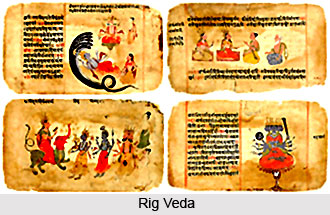
The impact of Vedic culture is apparent from its society as well. Some astonishing customs are noticeable in connection with the disposal of the dead body. The sinners were believed to be consigned to a dark and bottomless deep hole beneath the three regions. Among the means of transport were horses and chariots drawn by horses or asses. Elephants and Camels appear to have been used for carrying fighters in war. Besides mules, camels also were used as beasts of burden. Boats propelled by oars are frequently mentioned in the Rig Veda. Further in the Rig Veda, the prayers reveal a desire for worldly happiness consisting of long life, success, wealth of cattle, brave sons, freedom from diseases, victory over enemies and spacious houses. So far as civil law is concerned it is mentioned in details in the Vedic texts.
Thus, the Vedas serve as the basis for Indian culture.