 Swaraj Party was established to fight the mighty force of British rule in India. It was formed on 1st January 1923 by Chittaranjan Das and Motilal Nehru. This party was at first known as the "Congress-Khilafat Swaraj Party" and later simply the "Swarajya" or "Swaraj Party". The party"s name is taken from the term "Swaraj" meaning “self-rule†which was broadly applied to the movement to gain Independence from British rule.
Formation of Swaraj Party
Mahatma Gandhi was released from jail in 1924. He and his close followers, such as Chakravarti Rajagopalachari and Rajendra Prasad, occupied themselves with the constructive programme, such as hand-spinning on the charkha, uplifting of the harijans or members of the depressed class. But not all the congress-men were willing to abandon political action. In 1922 a group had formed around Motilal Nehru and C. R. Das that wished to enter the government`s legislative councils and wreck them front within. They were opposed by the `no-changers` who insisted that the 1920 programme, which called for the boycott of council elections, should not be altered. At the Gaya congress in December 1922, matters came to a head. The `no-changers` prevailed, but early the next year the `pro-changers` formed their own party.
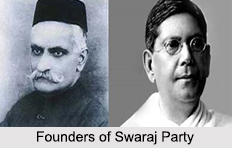 Chittaranjan Das and Motilal Nehru decided that the way to combat the British was to enter the provincial legislative councils. Central legislative assembly carries out a policy of uniform, continuous and consistent obstruction, with a view to make government through the assembly and councils impossible would force the British to grant real reforms. In a special session of congress held in Delhi in September 1923, a compromise between no-changers and pro-changers was reached. The former would continue with the constructive programme, whereas the latter could contest the upcoming elections.
Aims of Swaraj Party
The aims of Swaraj Party were to wreck the Government of India Act 1919. The following are the aims of Swaraj Party:
Attaining dominion status.
Obtaining the right to frame a constitution.
Establishing control over the bureaucracy.
Obtaining full provincial autonomy.
Attaining Swarajya or self-rule.
Getting people the right to control government machinery.
Organising industrial and agricultural labour.
Controlling the local and municipal bodies.
Having an agency for propaganda outside the country.
Establishing a federation of Asian countries to promote trade and commerce.
Engaging in the constructive programmes of the Congress.
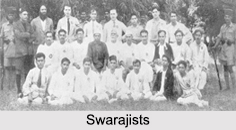 Works of Swaraj Party
Although they had little time for campaigning, the Swarajists did well in the elections. They became the largest party in the central assembly and the dominant party in two provinces. For the next few years Swarajist politicians obstructed official business in the assembly and the councils as well. But there were positive gains too. In 1925, Swarajist leader Vithalbhai Patel was elected president of the central legislative assembly. C. R. Das, who had refused to form a ministry in Bengal, was elected as the mayor of Calcutta (now Kolkata).
The tragic death of C. R. Das in 1925 removed a great patriot from the scene at a critical moment that further weakened the party. The Swaraj Party, which had already begun to break up, disintegrated quickly. Communal-minded Muslims isolated themselves, while the so-called social activist began to co-operate with the government with a desire to safeguard Hindu interests. By 1927, the Swaraj Party had disbanded.