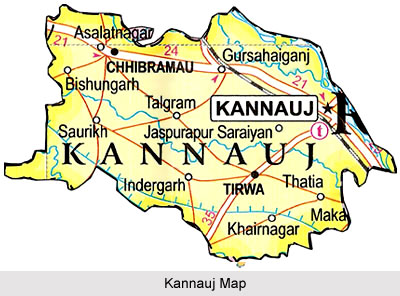
 Tripartite struggle is one of the most important events in the history of Kannauj. After the death of Harshavardhan, his empire collapsed. Kannauj always remained a focal point for almost all rulers. The tripartite struggle continued from the end of eighth century to middle of tenth century. Yashovarman was defeated by Lalitaditya. None of the successors of Yashovarman proved capable and Kannauj was captured by Ayudha dynasty. Vajrayudh became the ruler of Kannauj. After his death his sons Indrayudh took over. But there was constant fight between him and his brother Chakrayudh for the glorious Kannauj. By that time three dynasties had become powerful in India. These were the Gurjara-Pratiharas of Rajasthan, the Rashtrakutas of Maharashtra and the Palas of Bengal. Different rulers of these dynasties fought against each other to capture Kannauj thereby, trying to gain the glory of being the emperor of India. This contest between these three dynasties to capture Kannauj has been called Tripartite struggle.
The Pratihara ruler, Vatsraja wanted to capture Kannauj. Indrayudha was the ruler of Kannauj at that time. He accepted Vatsraja`s supremacy. However at that time, the Pala ruler, Dharmapala and the Rashtrakuta ruler, Dhruva equally wanted to capture Kannauj. Vatsraja defeated Dharmapala in a battle. Simultaneously, Dhruva entered North India and attacked Vatsaraja and conquered him. Besides he also attacked the Pala ruler, Dharmapala and incarcerated Kannauj. Since he was unable to stay for long in North he went back to south. Dharmapala placed his brother, Chakrayudh on the throne of Kannauj under his domination.
Vatsraja was succeeded his son Nagabhatta II. He consolidated his power in nearby territories, and then attacked Kannauj by defeating Kannauj. He defeated Chakrayudh and captured Kannauj. He even attacked Dharmapala, defeated him and entered in his territory up to Munger in Bihar. The then Rashtrakuta ruler, Govinda III was also an ambitious ruler. He with the help of Chakrayudh and Dharmapala defeated Nagabhatta II. Chakrayudh and Dharmpala accepted his suzerainty and Kannauj was taken over by Govinda III.
Govinda III soon retired to the South which again created a ground for the Pratiharas and the Palas to fight against each other for capturing Kannauj. Probably, thereafter Kannauj was occupied by Nagabhatta II. Dharmapala was succeeded by Devapala in Bengal. He established his supremacy in north India and defeated the new Pratihara ruler, Mihirbhoja
However, Devapala`s successor`s proved weak The Pratihara ruler Mihirbhoja succeeded in capturing Kannauj and Bihar also. Mihirabhoja succeeded in creating a widespread empire in the North.
The Rashtrakuta ruler, Indra III defeated the Pratihara ruler Mahipala and looted Kannauj. The Rashtrakutas departed to South India. The Pratiharas yet again recaptured their lost position in north India. Therefore in this tripartite contest between the Pratiharas, Palas and Rashtrakutas, the Pratiharas enjoyed undisputed victory.
But the Pratihara power began to decline when Rashtrakuta king, Indra III, defeated Mahipala Pratihara. After the decline of the Pratihara power the vassal chiefs became powerful. They began to unfurl their flag of independence. Ultimately due to the absence of any great power the tripartite struggle ended