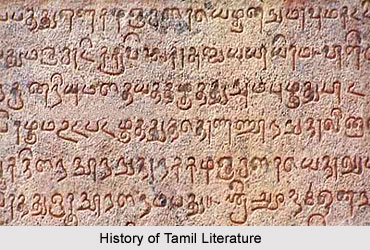
 Puranuru or Purananooru is an ancient Tamil literary work of Sangam literature and customarily the last of the eight anthologies of same. It is an assemblage of four hundred heroic poems about Wars, Kings and Public life fragments of both lost and survivors into the modern age. The assembled poems were written by 157 poets out of which 10 were poetess and 14 were anonymous. The anthology dates from around 1st century BCE to 5th century CE along with Kamil Zvelebil, who is a literature scholar dating all poems between 2nd to 5th century CE.
The Purananuru is beyond its importance for understanding the development of South Asia`s history, culture, religion, and linguistics as it has a universal appeal. It faces the world as a great and unsolved mystery, delving into living and dying, despair, love, poverty and the changing nature of existence. Several attempts have been made to assign an earlier date to some poems of the Purananuru, based on the events it records. For example, poem two in the Purananuru describes a Chera king sending food supplies to the warring sides in the Mahabharata war`s Kurukshetra battlefield (c.900 B.C.). It also mentions an invasion of a Magadha king successfully driven back (c.480 B.C.), and an unbeatable alliance of Tamil kings which stopped the Mauryan attack in 272-271 B.C. (king Kharavela of Kalinga mentions in a stone inscription of 157 B.C. that he broke that alliance which had lasted for 113 years). These early dates are, however, generally not accepted by critical scholars.
History of Purananuru
Each of the Puranuru poem has got one colophon stick to it giving subject matter and authorship of the poem, name of the chieftain or king and the occasion that called for the eulogy are found too. Rarely from the texts of poem and colophons, names of many kings are found along with the poetesses and poets those were patronised from time to time. A keen study of synchronisation between poets, chieftains and kings suggested by the colophons indicates that the literature body reflects occurrences of a time span within a continuous period of four to five generations mostly which were more than a period of 120 years ago. The systematic data and chronology extracted after studying these poems gives awareness of the casual nature of poems and wide differences amongst the purpose of the anthologist who had collected these. It also gives out a notion of the historian"s arriving searching attempts at one continuous history.
 `Puram` Poetry
There is some ` arruppatai` or guide-songs in the two anthologies, Purananuru and Patir-ruppattu. In these, the poet, either a musician or dancer or actor (panan, virali or kuttan) who has received gifts from a generous patron guides another poet suffering from poverty and directs him to the same patron for help. Descriptions of the way to the city of the patron and praises of his endearing qualities abound in such guide-songs. In Purananuru, there are seven poems as guide-songs of the musicians, four of the women dancers, and three of the literary artists. Patitrruppattu contains one guide-song of the musician and five of the women dancers. All of them are in accordance with the exposition of Tolkappiyanar regarding the form of such songs.
The laments in Purananuru are frankly personal and are high tributes to the dead patrons and friends. A few of them extended to be poems of some philosophical significance. They are the outpourings of the emotions of the poets who were very attached to the patrons. The historical evidence furnished by the poems of Purananuru tallies with that of the inscriptional records and hence is valuable. It provided ample reference to the Pandya king, Palyagasalai Mudukudumi Peruvaluthi, authenticating the possibility of Pandya connection with North India at the same time being the pioneering patrons of Tamil. It sheds light on battle of Talayalankanam and Puram and also refers to the duties of various people and that of a son in a family.
The expression vilunirveli nadu kilavone occurring in Purananuru depicts agricultural prosperity in Sangam times. Homage is paid to the art of weaving in Puram 383 and reference is made to carded cotton of fine variety in Puram 125. Knowledge of six-system philosophy, the emphasis on dharma and justice and awareness of Buddhist and Jain philosophy is evident in Puram 28 and 358. Purananuru is very valuable not only as a great literary work but as a mirror to Tamil society, reflecting its rich traditions.
Publishing Purananuru at modern times
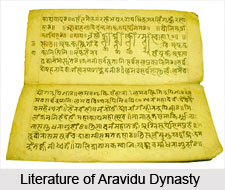
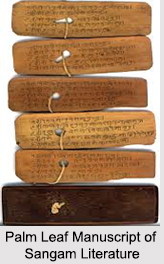
The resurrection of first three epics of the Sangam Literature from wantan and neglected destruction of centuries was done by U.V. Swaminatha Iyer. He had reprinted the present literature from palm leaf form to the paper books form. It was published in 1894 for the first time. A Tamil Scholar known as Ramaswami Mudaliar first gave the former palm leaves of Civaka Cinhtamani to observe and study. At first he encountered various difficulties in terms of textual errors, interpreting, finding missed out leaves and some unfamiliar terms. He took over a tiring journey of travelling to villages in remote areas to search missing manuscripts. After a toil of years, Civaka Cintamani was published in the form of a book in 1887 CE followed by the Silappatikaram in 1892 CE and the Puranuru in 1894 CE. However, along with some text, he also made an addition of explanatory notes and abundant commentary of textual variations, terms and approaches towards explanation of the context.