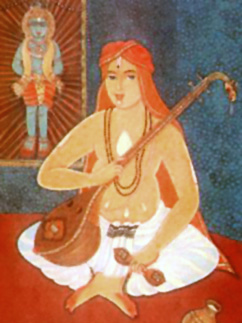
 History of Indian music has its origins in divine tradition. The rich history of Indian music unveils the fact that the divine sage Narada introduced the art of music to the Earth from heaven. This is how music is said to have commenced on earth. According to Hindu mythology, the first ever sound to have been heard in the universe is the Naadbrahma or Om mantra. This sound pervades the entire universe. Since it is a manifestation of the divine power (Brahma), it is the purest sound to be heard. It is believed that the musician attempts to achieve this very purity in his `sadhana` or dedicated pursuit. History of Indian music unfolds the verity that music gradually changed in shape and form. In the beginning the music was devotional in content and was restricted to religious and ritualistic purposes and was purely used in temples only. Indian music developed from the ritualistic music in association with folk music and other musical forms of India and gradually derived its own musical characteristics.
Music in Ancient India
The earliest history of music in India can be traced back to the Vedic ages, over two thousand years back. The concept of Naadbrahma is seen being manifest in the Vedic ages. All organised music traces its origins back to the Sama veda which contains the earliest known form of organised music. The earliest raga owes its origin to the Sama veda. The first reference to music was made by Panini in 500 BC and the first reference to musical theory was found in `Rikpratisakhya` in 400 BC. Bharata Natyashastra, which was written on 4th century AD, contains several chapters on music, which was probably the first clear written work on music that has divided music into octaves and twenty-two keys. The next important work on music was `Dathilan` that also mentions the existence of twenty-two srutis per octave. According to ancient notion, these twenty-two srutis are the only keys that can be made by the human being. Other works written during this period include `Brihaddesi` written by Matanga on 9th AD, which attempts to define Raga; `Sangeeta Makaranda; written by Narada on eleventh century AD, which enumerates ninety-three Raagas and classifies them into masculine and feminine species; `Swaramela Kalanidhi` written by Ramamatya in the sixteenth century AD and `Chaturdandi Prakssika` written by Venkata Makhhi in the seventeenth century AD.
During the late Vedic Period i.e. from three thousand to twelve hundred B.C., music prevailed in the form called Samgana, which was purely a chanting of the verses in musical patterns. After that music changed its course a little bit. The epics were narrated in musical tones called `Jatigan.` Between the second to the seventh century AD, a form of music called `Prabandh Sangeet`, written in Sanskrit language became very popular. This form gave rise to a simpler form called Dhruvapad, which used Hindi language as the medium. The Gupta period is considered as the golden era in the development of Indian Music.
Music in Medieval India
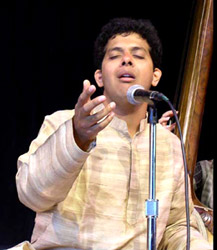
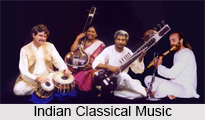
In the medieval period, the nature of Indian music underwent a change due as a result of the impact of the Muslim invasion. At this time, Indian music slowly started branching off into the two distinct forms of Hindustani and Carnatic music. This two traditions of music started to diverge only around 14th century AD. The Persian influence brought a substantial change in the Northern style of Indian music. In the fifteenth century AD, the devotional Dhruvapad transformed into the Dhrupad or classical form of singing. The Khayal developed as a new form of singing in the eighteenth century AD. Carnatic classical or kriti is mainly based on the Saahitya or lyric oriented, while Hindustani music emphasizes on the musical structure. Hindustani music adopted a scale of Shudha Swara Saptaka or Octave of natural notes while Carnatic music retains the style of traditional octave. Both Hindustani and Carnatic music express great assimilative power, also absorbing folk tunes and regional characteristics as well as elevating many of these tunes to the status of ragas. Thus, these two systems of music have mutually influenced each other.
Music in Modern India
With the advent of the British in India, the court arts underwent a decline. Since most of the nawabs and noblemen no longer had lost their wealth and did not have the rewards to lavish on performers, most of the musicians had to move over to other occupations. A few gharanas did however manage to survive the ravages of time and continued strong after independence. However, on the whole, Indian music took a backseat and interest and resources to sustain this art started to fade. A parallel development that gradually started forming at this time was that newer forms of media were now emerging in a fast modernising country. Thus, with the advent of television, radio etc western influences started creeping into Indian music. There was increasingly seen the spread of popular music or `pop` music as it is called, and this trend increased with the spread of cinema. Classical music too started being exported out of the country in the 60`s, and an experiment of combining western music with the Indian Classical form. This gave rise to what is popularly referred to as fusion music. In the 70`s and 80`s disco and pop music entered the Indian musical scene with a bang. The 90`s further popularised the pop trend among the Indian audiences. With the further spread of information technology and an increasingly global world, we see a host of musical forms existing in contemporary India- rock music, R and B, Hip-hop, jazz etc. Apart from these western forms of music, traditional forms of Indian music, such as Khayal, Ghazal, Geet, Thumri, Qawwali etc. also find place in the contemporary musical scenario. Bhajans and Kirtans, which form a separate stream of religious songs, are also quite widely sung across the country.
Folk Music in India
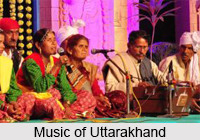
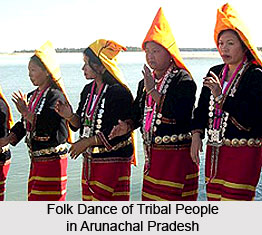
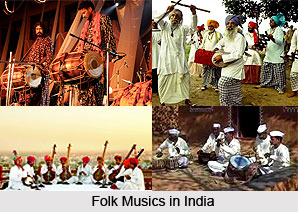
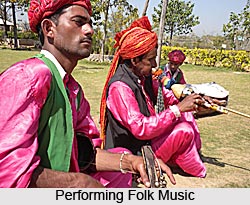
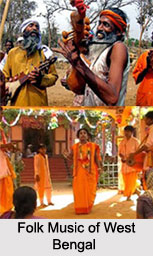
Folk music in India has seen a long and continuous journey down the ages. It has been around since ancient times, and continued its existence right down till the modern time.
In India, the theoretical writings of the learned Pundits are not very different from the oral tradition of recounting historical vignettes of folk life in ballad. The Mahabharata and the Ramayana, the two great Indian epics composed in the earliest centuries of Aryan India, were oral lore. They continue to exist in this form for the majority of the population, being retold in the different forms of drama, dance, and song. Many cultural ideas, heroic ideals, and patterns of daily life are reinforced through these epics. In part, this is due to the close relationship that existed between the learned and the unlettered. The courts, the centres of education, and the residences of the pundits have always been close to the villages, the cities, and the towns. Pundits and populace together revere and share a respect for tradition. In this way, as in others, the classical is the folk and the folk is the classical. Folk music, thus, continued to lead its own existence down the ages, unaffected by the upheavals and turmoil of history.
Evolution of Indian Musical Instruments
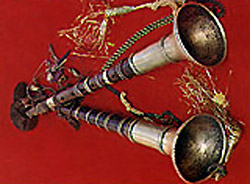
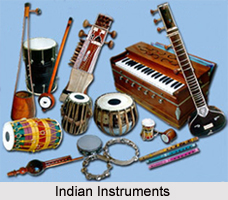
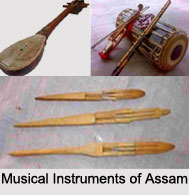
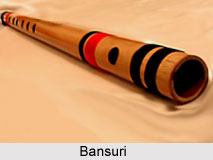
Musical instruments in India too have great antiquity and can also be said to have a divine origin. Most of the Gods and Goddesses are depicted with an instrument. Such as Lord Ganesha holds the conch, Lord Vishnu holds the damru and Lord Krishna is well known for his flute-playing. The classical texts of the Mahabharata and Ramayana also mention many musical instruments. Several skilled musicians were said to have performed when Lord Rama performed the Aswamedha Yaga. Instruments such as veena, dundhubi, mridangam, bheri, ghata, panava, pataha and dindima have been mentioned in the Ramayana. Thus musical instruments have seen a long history themselves. Traditional instruments used in India music include the sarangi, veena, mridangam, sitar, tambura, nadaswaram, shehnai, flute, ghatam etc. With western influence and the increasing trend of globalisation, newer musical instruments started spreading onto the Indian scene. Thus instruments prevalent on the Indian scene now include a wide plethora of string, wind and percussion instruments. Some of the most common instruments are piano, guitar, drums, violin, trumpet, mouth organ etc. These instruments are widely used in Classical music, such as the use of violin in Carnatic music, as well as in other popular musical forms such as the use of the drums in film music.
The history of Indian music, thus, murmurs the rich saga of the journey of changing ritualism in India.