Tantra in Hinduism - Informative & researched article on Tantra in Hinduism
  Indianetzone: Largest Free Encyclopedia of India with thousand of articles Indian Religion


in  
Art & Culture | Entertainment | Health | Reference | Sports | Society | Travel
Forum  | RSS Feeds  | Free E-magazine
Indian Religion : Vastu Shastra l Indian Religions l Indian Myths l Indian Mythology l Gods of India l Goddesses Of India l Religious Thinkers of India l Types of Religion in India l History of Indian Religion l Indian Yogis l Ajivikas l Sacred Scriptures in Indian Religion l Tantra l Shaivism l Indian Communities l Sacred Animals in India l Roman Impact on South Indian Art and Society l Bhattacharyas l Indian Classical Terms
Home > Society > Indian Religion > Tantra > Tantra in Hinduism
Tantra in Hinduism
The Tantra is closely associated with the ancient Hindu scriptures like Veda and is a procedure of invoking the deities.

Tantra is the systematic use of the body and mind as the physical instrument of divine relization. The body and mind constitute the lower self and together they aim to indulge the interaction of the triple gunas namely sattva, rajas and tamas.

Primarily these are the chief ingredients of the divine prakriti , which is otherwise called Maya that maintains to keep the ordeal of births and deaths by the law of karma. Quite ideally therefore the concept of Tantra is thus closely associated with that of the concept of Hinduism.

Tantra aims to bring the hidden self in tune with the inner self and so as to make the individual in progress. The Tantra is closely associated with the Vedic concept of Hinduism. Hindu scriptures declare that transformation of the body. So Tantra in Hindusim has become an inseparable concept. The left hand Tantric rites are often rejected as unsafe by most orthodox Hindus. The Tantra is considered the short cut method to self realization and spiritual enlightenment. The popular perception of Tantra among Hindus equate with black magic. Apart from Tantra in Hinduism, tantra, as a concept also exists in Vaishnava, Shaiva and Shakta forms.

Some Tantric aspirants feel that the union is accomplished internally and with spiritual entities of various kinds. As a result all tantric literature has a gross, higher and subtle meaning. This tripartite system of understanding prevents the entry to the deeper zone crucial to Tantra. Thus, an union could mean the act of sexual congregation, ritual uniting of concepts through chanting and sacrifice, or understanding one`s true self in the cosmic joining with the divine power. This equals to divine principles of Shiva and Shakti in Para Shiva.

Hinduism is typically related to Vedic concept but the Tantras are not a part of orthodox Hindu or Vedic scriptures. The Vedas of orthodox Hinduism lie on one side while the Agamas of Tantra on the other. However the practices,mantras and the ideas of Atharva Veda are typically different from the other three Vedas and Atharva Veda has powerful nonAryan influence. The Atharva Veda is cited by many tantra texts as the ancient source of knowledge. The Vedas progress throughout the Tantras such as Mahanirvana Tantra. Tantra exists for spiritual seekers at `Kaliyuga`, when Vedic practices are not applicable in our daily lives. Tantra is the most direct means to realize the spiritualism. The tantric thought according to Hindu Tantra worship Lord Shiva and divine mother Kali.

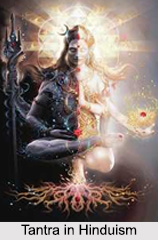
In Hinduism, the Tantra typically takes the form of a dialogue between the God Shiva and goddess Shakti or Parvati.Shiva is known as Yogiraj or Yogeshwara, the king of Yoga or the god of Yoga, while Shakti, his consort is considered as the feminine equal of shiva. There is a particular group of techniques or philosophy to attain Moksha (liberation/ enlightenment) or for attaining a certain practical result.Agamas mean Shiva to Shakti and Nigamas are Shakti to Shiva.

An extraction from the beginning of Yoni Tantra is like this " seated upon the peak of Mount Kailasha the God of Gods, the Guru of all creation was questined by Durga-of-the-smiling-face, Naganandini. Sixty-four Tantras have been created O Lord, tell me, O Ocean of Compassion, about the chief of these". Mahadeva or Shiva says in reply, "Listen, Parvati, to this highly secret one, Dearest. Ten million times have you wanted to hear this. Beauteous One, it is from your feminine nature that you continually ask me. You should conceal this by every effort. Parvati, there is Mantra-Pitha, Yantra-Pitha and Yoni-Pitha. Of these, the chief is certainly the Yoni Pitha, revealed to you from affection."

As in all of Hindu yogas, Mantra play an important part in Tantra for focussing the mind often through the involvement of specific Hindu gods like Shiva, Ma kali(another form of Shakti) and even Ganesh, the elephant-headed god of wisdom. The reference of Ganesha is found in Ganesha Upanishad. Similary the Tantra Puja in Hinduism often concentrates on a Yantra or Mandala.

Tantra in Hinduism is the manifestation of early Hindu-Vedic thought and thus it embraces the Hindu gods and goddesses, especially Shiva and Shakti.It is also connected with Advaita philosophy or non-dualist Vedic philosophy that represents the ultimate aspect of Para Shiva or Brahman. These deities may be worshipped externally with flowers, incense etc. These deities are more importantly used as the object of meditation, where the Tantric practitioner imagines the god or goddesses and experience the Vision. The ancient tradition of Devadasi or the sacred temple dance that is found in the contemporary Bharata Natyam is an example of such meditation in movement. The divine love is expressed in Sringara and Bhakti.

Tantra in Hinduism thus stands as a unique form of "Puja " where the deties invoked in a matchless way.

(Last Updated on : 28/01/2009)
  More on Tantra...
 
Method of Tantra Tantra in Buddhism Tantra in Hinduism
Tantra in Shaivism Tantra Concept Shiva in yogic practice
Vamachara    
Recently Updated Articles in Indian Religion
  • Dhammapada
    Dhammapada, the core of Buddhist teaching in Pali language, is considered the gospel of Buddhism even today
  •  
  • Brahma Nirvana
    Brahma Nirvana is the ultimate communion with the eternal Reality of life that is the Brahma.
  •  
  • Ahmadiyya Sect,
    Ahmadiyya Sect is an Islamic sect founded in India by Mirza Ghulam Ahmad of Qadian.
  •  
  • Arahant
    Arhant according to the philosophy of Dhammapada is an individual who has attained the highest degree.
  •  
E-mail this Article | Post a Comment
Free E-magazine
Subscribe to Free
E-Magazine on Indian Religion

 
Tantra in Hinduism - Informative & researched article on Tantra in Hinduism
Sitemap
Contact Us   |   RSS Feeds
Copyright © 2008 Jupiter Infomedia Pvt. Ltd. All rights reserved including the right to reproduce the contents in whole or in part in any form or medium without the express written permission of Jupiter Infomedia Pvt. Ltd.