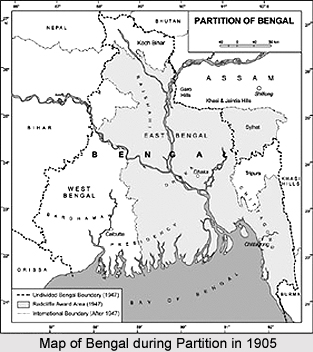
 Partition of Bengal in 1905 during the British Rule in India is structured by Lord Curzon, the Viceroy of India. This brought a mass agitation in Bengal and through out India. This is known as Swadeshi Movement. Swadeshi movement was one of the most momentous events in Indian Freedom Struggle in History of India. The presidency of Bengal was the most populous province in British India. It included not only the western and eastern parts, but also Bihar, Assam and most part of Orissa.
The Bengal province had an area of one hundred and eighty nine thousand square miles and seventy-eight and half million population. The eastern part of Bengal was geographically isolated from the Western part of Bengal. In 1836, the upper provinces of Bengal were placed under a Lieutenant Governor. In 1854 the Governor-General-in-Council was alleviated of the direct administration of Bengal.
The idea of partitioning Bengal first came in 1903. There were also proposals to separate Chittagong and the districts of Dhaka and Mymensingh from the province of Bengal and attaching them to the province of Assam and in the similar way Chhota Nagpur Region was attached to Central Provinces.
Lord Curzon sent the proposal of partitioning Bengal to London in February 1905. The Secretary of State for India St. John Brodrich sanctioned the proposal in the month of June. The Government of India proclaimed their final decision in a resolution on July 19, 1905 and the proclamation of formation of the new province was issued in the month of September. The Partition of Bengal was finally put into effect on October 16 of the same year.
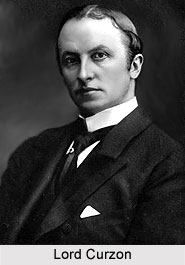 The Government officially published the idea of partitioning Bengal in the month of January, 1904 and in the next month; Lord Curzon himself went on an official tour to East Bengal to get an assessment of public opinion on Partition of Bengal. He discussed with leading political personalities of Bengal of that time like Surendranath Banerjee, Bipin Chandra Pal, Aurobindo Ghosh, Bal Gangadhar Tilak and Abdul Rasul. There also Lord Curzon delivered speeches explicating Government`s position and stand on partition at Dhaka, Mymensingh and Chittagong.
The British Government`s idea was that the new province would include the state of Hill of Tripura, divisions of Chittagong, Dhaka, Rajshahi (excluding Darjeeling) and Malda district would be incorporated with Assam province. Bengal had to surrender also five Hindi-speaking states to the Central Provinces besides giving up this large territory. On the West side Sambalpur and five minor Oriya speaking states from Central Provinces were offered to be incorporated with Bengal. After this reconstruction, Bengal would be left with an area of one hundred and forty one thousand and five hundred eighty square miles and a population of only fifty four million. Among this population forty two million would be Hindus and nine million would be Muslims.
The new Province would have thirty one million population of which twelve million Hindus and eighteen million would be Muslims and hundred and six thousand and five hundred and forty square miles. The new province was named as `Eastern Bengal and Assam and Dhaka with its capital while subsidiary headquarters were at Chittagong. The administration would include Legislative Council; a Board of Revenue of two members but the jurisdiction of Calcutta High Court was left undisturbed. The Government also mentioned that the state of Eastern Bengal and Assam would have a clearly demarcated western boundary and well defined geographical, linguistic, ethnological and social characteristics.
The Muslim population found the partition effective for them. Before the partition it was western Bengal, mainly Kolkata and its adjacent area came under the British influence first and enjoyed the facility of education, development and industrialization. On the other hand the Eastern part of Bengal, due to lack of communication could not have the benefits of development. The socio-economic condition of the Muslim population was poor and they suffered under the rule of Hindu Landlords or Zamindars.
The Muslim populations outnumbered the Hindu population in Eastern Bengal. Muslims had feelings of alleviation in the partitioning of Bengal as they thought that they would enjoy more freedom and opportunity for education, employment, politics and economy etc. But this caused an extensive agitation among the Bengali Hindus. They averred Lord Curzon that he had deliberately divided the Hindus and Muslims by creating a border line between them. They branded him as the sustainers of devilish `Divide and Rule` policy as he had struck Bengal nationality with a tricky policy that created a religious and social difference between Hindus and Muslims.
The Muslims of Bengal welcomed Bengal Partition in 1905 but the Hindus strongly opposed it. They started a mass movement, declaring October 16 as the "day of mourning" in Kolkata. The Hindus raised the Vande Mataram slogan as the national cry and put Shivaji as their national hero. This anarchist movement also turned into terrorism and political sabotage, which finally resulted in communal riots.
This whole situation created a political anarchy. Sir Henry Cotton, the Chief Commissioner of Assam, led the opposition by Indian National Congress. But this could not move Lord Curzon. In 1906, Rabindranath Tagore wrote "Amar Sonar Bangla" as a cry against the Partition of Bengal. Cotton coordinated a successful campaign to expel the first Lieutenant Governor of East Bengal, Sir Bampfylde Fuller.
As a result of this political protest, the British decided to undo their earlier decision to partition Bengal and two parts of Bengal were reunited in 1911. This act saddened the Muslim community. New provinces were made depending on the linguistic ground rather than religious grounds. The states were formed depending on the Hindi language, Oriya language and Assamese languages. The administrative capital of British India moved from Kolkata to New Delhi. However, conflict between Hindus and Muslims persisted and as a result new laws were passed to satisfy the political needs of both groups.