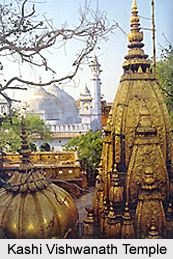
 Kashi Vishwanath temple is one of the holiest Shiva shrines in India. It is situated on the bank of the Ganga River in Varanasi. Uttar Pradesh, thus, is often seen as the ancient seat of Indian religion and culture. The presiding deity at Kashi Vishwanath temple is Lord Shiva. He is worshipped here in the form of a linga. It is said that this is one of the twelve Jyotilingas. The deity in the sanctum sanctorum is addressed as Vishwanatha or Vishweshwara, meaning, the `Lord of the Universe.` The shikhara of Kashi Vishwanath temple is gold plated and hence it is also known as the Golden Temple.
Legend of Kashi Vishwanath Temple
The history of the city encompasses a time period of 3500 years. In earlier times it was known as Kashi. The origin of the temple, too, is steeped in legends and tales. Hence the shrine is often referred to as the Kashi Vishwanath temple. According to legends, this shrine has been mentioned in the Puranas. It is believed that Lord Shiva himself chose Kashi as his holy abode. In order to please his mother-in-law i.e. Goddess Parvati`s mother, he asked Nikhumbha to build a shrine for him. Nikhumbha, on his part, asked Anikumbha to carry on the work and Divodas was engaged in the construction of the temple. Pleased with their work, Lord Shiva blessed all. But Divodas remained devoid of any boons. Enraged he demolished the structure. On the other hand, Nikhumbha cursed the place saying that it will remain uninhabited. On hearing this, the Lord went and dwelled there himself along with his consort, Goddess Parvati. Contended with the place the goddess distributed food with her own hands. This anecdote has been carved out in the temple of Devi Parvati that lies besides the primary shrine. Lord Shiva is seen with a bowl for food with the Goddess.
History further narrates that the Shiva temple had been destroyed and reconstructed a number of times since its inception. Besides the mythological references, Kashi Vishwanath temple had also been at the receiving end of frequent invasions. It was Muhammad Ghori who destroyed the temple in 1194 AD. Though the work for its restoration proceeded soon, it was once again demolished by Qutub-Ud-Din-Aibak. The temple was once again reconstructed and this time to be destroyed by Firuz Shah Tughlaq. Todar Mal, in 1585, rebuilt it under Akbar`s reign. However, once again in 1669 AD it was destroyed by Aurangzeb. In its place the Gyanvapi mosque was constructed. Finally in 1780 Ahilya Bai Holkar of Indore reconstructed the Kashi Vishwanath temple that stands even today.
Architecture of Kashi Vishwanath Temple
Kashi Vishwanath Temple is situated in the midst of a quadrangle that is covered with a roof. A dome has been built in each and at the south-east corner, a temple sacred to Shiva. The temple depicts three distinct divisions. The first is the spire of a temple of Mahadeva; the second is a large gilded dome and the third is the gilded tower of the temple of Visheswar. The domes here are spread over plates of copper overlaying the stones beneath. A high pole has been fastened with the tower that bears a small flag and tipped with a trident. The temple of Visheswar, including the tower, is fifty-one feet in height.
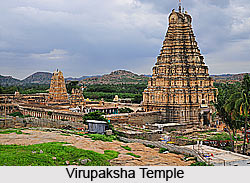
There are other smaller temples within the Kashi Vishwanath temple complex. These are the Mahakala temple, Dhandapani temple, Avimukteshwara temple, Vishnu temple, Vinayaka temple, Sanishwara temple, Virupaksha temple and Virupaksha Gauri temple. There is a well within the temple complex, Gyan Bapi. It is believed that during the times of invasion, the Jyotirlinga was hidden here.
Extensive remains of this ancient temple are still visible. They were used to build a large portion of the western wall of the Mohammedan mosque, which was built upon its site. A close view of the pattern of the ruins of the temple reveals to be of mixed character, and composed both of Jain and Hindu orders.
By far the Kashi Vishwanath temple is one of the most significant Shiva temples in India. It is an ancient belief that if one spends the last day of his or her life here, then the person is certain to achieve salvation.