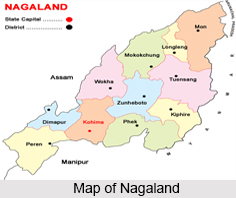
 The north eastern state of Nagaland was formally inaugurated on 1st December, 1963. The state is bounded by Assam in the west, Myanmar on the east, Arunachal Pradesh and part of Assam on the north and Manipur in the south. Before the arrival of European colonialism in South Asia, there had been many wars, persecution and raids from Myanmar on Naga tribes, Meitei people and others in northeast India.
In the year 1816, the state of Assam was invaded by Myanmar and the region came under their reign from 1819 to 1826. But with the arrival of the British East India Company, eventually the entire of north east came under the British rule. The British rule brought an end to the massive bloodshed and inter regional conflicts. The history of Nagaland is incomplete without the mention of the Battle of Kohima. Nagaland played a central role in one of the many battles of World War II, as its capital city of Kohima served as one of the final points where the British and Indian forces were able to turn back the Japanese movement into South Asia. The Indian National Army lost half their numbers, many through starvation and was forced to withdraw through Myanmar.
Post- Independence History of Nagaland
After Indian independence in 1947, the area remained a part of the province of Assam. During this period, the Naga tribes began to demand a political union of their ancestral and native groups. They focused their efforts on damaging government and civil infrastructure as well as attacking government officials and Indians from other states. The Union government sent the Indian Army into the area in 1955, to attempt and restore order. In 1957, the Government began diplomatic talks with representatives of Naga tribes, and the Naga Hills district of Assam and the Tuensang frontier were united into a single political entity that became a Union territory directly administered by the Central government with a large degree of autonomy.
In July 1960, a further political accord was reached at the Naga People"s Convention which stated that Nagaland should become a constituent and self governing state in the Indian union. Statehood was officially granted to the area in 1963 and the first state level democratic elections were held in 1964. While resistance still remained at this point, most of the insurgencies were quelled in the early 1980s.
However, violence re-erupted in the late 1990s, creating conflict between rebel group factions. On 25th July, 1997, the then Prime Minister, Mr. I. K.Gujral announced that the national Government had declared a ceasefire after talks with the Nationalist Socialist Council of Nagaland (NSCN). The group had agreed on a cessation of operations starting from 1st August, 1997, and lasting for a period of 3 months. Since that point, the ceasefire has been extended, but there is still resistance related conflict going on in the region, largely due to the belief by the tribal groups that they are under the dominion of "Indian imperialism."