


 Indian rock cut sculpture involves a dexterous sculptural art which is derived after cutting out the solid rocks to produce mythological scenes, fanaticism and eroticism mainly found in the states of Bihar, Orissa, Maharashtra, Madhya Pradesh and some states of south India. The rock cut art is more similar to sculpture than architecture as cutting out solid rocks produced structures. Some of the finest rocks cut structures are found in Bihar and Maharashtra. 'Chaityas' and 'viharas' are rock cut structures made for Buddhist and Jain monks as their residence and worshipping zones. Indian rock cut sculpture involves a dexterous sculptural art which is derived after cutting out the solid rocks to produce mythological scenes, fanaticism and eroticism mainly found in the states of Bihar, Orissa, Maharashtra, Madhya Pradesh and some states of south India. The rock cut art is more similar to sculpture than architecture as cutting out solid rocks produced structures. Some of the finest rocks cut structures are found in Bihar and Maharashtra. 'Chaityas' and 'viharas' are rock cut structures made for Buddhist and Jain monks as their residence and worshipping zones.
Earliest Rock-Cut Cave Sculptures In the olden days, ancient caves were utilized as shelters by the local inhabitants which consist of hanging rocks adorned with rock sculptures especially during the Mesolithic age dating back to 6000 BC. The sculptures present inside such old caves like Bhimbetka are suggestive of human settlements at this part of the country. Rock-Cut Sculptures of Cave Temples Some of the oldest Indian cave temples including Ajanta Caves, Ellora Caves, Bhaja Caves, Barabar Caves in Bihar dating back to 3rd century BC, Kanhari Caves, Karla Caves, Bedse Caves, etc., which possess creative sculptures of various kinds. 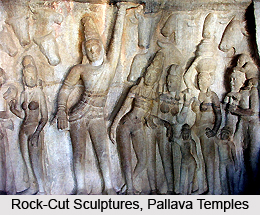 Some of them are Buddhist shrines. Complex carvings, wall paintings and reliefs are present inside the caves. Jain and Buddhist monasteries, temples and 'basadi' possess numerous 'chandrashalas'. There are about 1200 cave temples in the nation. Some of them are Buddhist shrines. Complex carvings, wall paintings and reliefs are present inside the caves. Jain and Buddhist monasteries, temples and 'basadi' possess numerous 'chandrashalas'. There are about 1200 cave temples in the nation.
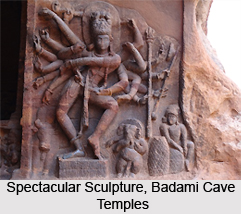
'Chaityas' boast of exceptional rock-cut sculpture which served as residences of Indian monks. They contain rock cut garbhagriha consisting of spherical hall equipped with pillars situated around a circumambulatory pathway near the stupa. Badami Cave Temples at Badami contain carved architectural elements such as decorative pillars and brackets as well as finely carved sculpture and richly etched ceiling panels. Carved cave temple architecture, along with presence of brackets and ornamental pillars are the special sculptural features of the cave temples. They can be traced to the 6th century. Rock-Cut Sculptures of Monolithic Temples Classical rock cut Indian sculpture is exhibited in the temple carvings of the structural temples built by the Pallavas who were based at Aragandanallur. The sculpture of Pancha Rathas of the 7th century, at Mahabalipuram is very impressive. Carved onto the summit of a hill, the Kailash Temple of the Ellora Caves is yet another sculptural marvel, built out of a singular piece of cliff rock. 34 caves were created at the site of Ellora Caves which contained Jain and Hindu caves. Wonderful images inspired by Hindu Puranas exist in the caves of Kailash Temple, besides the figurines of mystical beings like musicians, nymphs, images symbolising good fate also exist here. Rock-Cut Sculptures of Free Standing Temples Free standing temples were erected during the 5th century and excavations of rock cut temples were conducted till the 12th century, for instance the Shore Temple at Mahabalipuram. It belongs to the 8th century and is embellished with carved granite rock-cut like bricks. 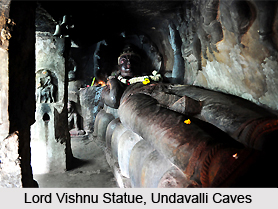
Rock-Cut Sculptures of Rock Cut Monuments The rock cut monuments of India are charming instances of rock-cut sculpture. The Stupa at Sanchi in Madhya Pradesh is another masterpiece in this regard. The rock cut shrine at Udayagiri in Bhopal, belonging to the age of the Guptas, Dashavatara Temple, Devgarh near Jhansi which boast of 'Nagara style of architecture', Jain and Brahamanical Temples at Aihole, Karnataka, Undavalli Caves, Andhra Pradesh, Bagh Caves, Madhya Pradesh, Konark Temple, Odisha, Pandavleni Caves, Maharashtra are some of the many rock cut monuments with excellent rock cut sculptural designs. |
| |||



Indian Rock Cut Sculpture
| Indian rock cut sculpture is another unique specimen of Indian art. Basically these rock-cut structures were related to various religious communities. |
| ||||||||||||||||||||||||||||

