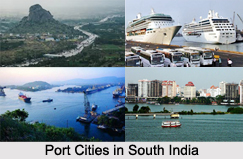
 Mahabalipuram was an ancient port city of the Pallava rulers of South India and also the secondary capital of them. The city was also known as Mamallapuram and Mallai. The Greek and Roman merchants also visited the place even in the pre-Christian era.
Earlier, Mahabalipuram was ruled by the Sangam Chola dynasty or one of the chiefdoms under this dynasty. The Pallavas ruled here from the 4th century AD to the 9th centuries A.D.
Narasimhavarman I, one of the well-known Pallava kings was ruling Mahabalipuram in the 7th century. He was also known as `Mahamalla`, which means `great wrestler`. He decorated Mahabalipuram with numerous sculptures and monuments. He built several cave temples and monolithic shrines cut out of natural rock. He also constructed the sculptures in the famous bas-relief panel called `Arjuna`s Penance` or `Bhagiratha`s Penance`, which shows a person who may be either Arjuna or Bhagiratha.
The monumental remnants of Mahabalipuram can be categorized into four main types. There are `monoliths` that are freestanding temples cut out of solid rock from top downwards. These are locally known as the `rathas` or `chariots`. There are five such rathas seen close to each other and these are together known as `Pancha rathas` or `Panchapandava rathas`. Four of these five rathas were named after the five Pandava brothers and the fifth one was named after Draupadi, the single wife of the five brothers, according to the Hindu epic Mahabharata.
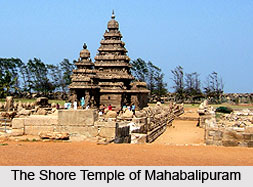
There are many other temples excavated in hill scarps of Mahabalipuram, which are locally called `mandapas`. One of such famous five-cave temple is the one at Trimurti. There are also few other stonework temples or structural temples built of blocks of stone can be seen here. The Shore Temple of Mahabalipuram is one of the most important structural temples here. It was mostly built by Narasimhavarman II or Rajasimha, one of the successors of Mahamalla.
There are various sculptured scenes carved on the rock hills of Mahabalipuram. One of the sculptures represents a sage performing penance in a village on the banks of a river. According to some scholars, this sage is Arjuna, the hero of the epic Mahabharata. Again others depict this sage as Bhagiratha, who brought the river Ganga from the heavens to the earth.
The stone sculpture tradition of the Pallavas is still surviving in Mahabalipuram. The tradition is continued by a prestigious Government college of sculpture. There are many stone sculpture making centres and many shops selling stone sculptures and other objects made of stone available in Mahabalipuram city.