The festival of Vijayadashami is celebrated on the tenth day of Navaratri, which is held on the tenth day of the month of Ashvin of the Hindu calendar. Also known as Dusshera, the Hindu festival of Vijayadashami usually marks the end of Durga Puja or Ramlila. This festival basically signifies the victory of good over evil.
Etymology of Vijayadashami
The word Vijayadashami is a combination of 2 words, Vijaya meaning victory and Dashami meaning tenth. This connotes that the festival is held on the tenth day celebrating the triumph of good over evil.
Legend of Vijayadashami
In various versions, the festival of Vijayadashami has mentions in Hindu epics like the Ramayana and Mahabharata. In Ramayana, celebration of the victory of Lord Rama of him rescuing his wife, Sita and destroying Ravana, in a fierce battle serves to be the back story behind Vijayadashami or Dussehra. Ravana had 10 heads, which represented the 10 evil facets of his character.
In Mahabharata, the Pandavas were exiled for 12 years and then one more year in disguises. After completing the 12 year banishment, they decided to remain in the kingdom of Virata under disguises. Before going to Virata, they hung their celestial weapons in a Shami tree for safekeeping for a year. It was on the day of Vijayadashami that the Pandavas successfully completed the remaining one year. Arjuna collected the weapons from the Shami tree and defeated the Kauravas who attempted to steal the cattle of King Virata. Since that day, shami trees and weapons have been worshiped on the ninth day of Navaratri, which symbolises this particular incident in the Mahabharata.
Another legend commemorates the victory of Goddess Durga over Mahishasura, the demon king after a nine-day long battle, and also marks the end of Durga Puja celebrations.
 Significance of Vijayadashami
Vijayadashami signifies enlightenment and marks the end of the Maha Navaratri or the 9 days of Durga Puja. It is a celebration of righteousness over evil and according to legends the day is marked by several other such victories of good and other factors. Hindus celebrate this festival worldwide by observing social gatherings and offering sweets and gifts to relatives, friends and neighbours. The festivity also marks the beginning of the harvest season. Prayers and rituals are observed to invoke blessings from Mother Earth for a good harvest, peace and prosperity to all.
Celebration of Vijayadashami in different parts of India
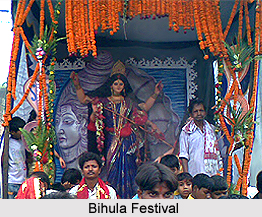
In West Bengal, the day of Vijayadashami is the one when Goddess Durga is believed to retreat to Kailash. This occasion is celebrated despondently amidst Bengal with "Sindur Khela", which is the act of smearing forehead with vermillion and spreading mouthful of sweets ultimately ending with the immersion of the Durga idol. The idol is immersed in the River Ganga on this day and the festivities of greeting each other and distributing sweets begin. The young seek the blessings of the elders on this occasion.
 In Kullu, Himachal Pradesh Dussehra awaits the celebration 3 days later. The reason for this dates back to the time of Maharaja Ranjit Singh, the ruler of Punjab. The hill states of Punjab, now in Himachal Pradesh, were under the court at Lahore. The Maharaja expected the less powerful kings to be present at his court during the Dussehra celebrations. After the celebrations at Lahore, the rulers would speed back to their hill kingdoms to celebrate Dussehra there. It took them 3 days to reach their states and since then, the custom has continued.
In the south Indian states like Karnataka, the people place lemons on the road in front of the wheels of cars, buses, scooters, and drive their vehicles over them, since it symbolizes sacrifice. Goddess Durga is worshipped in the form of Devi Chamundeshwari during this phase. Mother Goddess is being worshipped as the epitome of "Fight against Evil". It is believed that one worships weapons, to remember to use them in a wise manner.
In the 14th century Vijaynagar Empire, the festival of Vijayadashami played a historical role and was known as Mahanavami. Another significant and notable tradition of several South Indian regions has been the dedication of this festival to Goddess Saraswati, the Hindu Goddess of knowledge, learning, music and arts.
 In Gujarat, both Goddess Durga and Lord Rama are revered for their victory over evil. Fasting and prayers at temples are common. Dandiya Raas and Garba are a part of the festivities through the night.
The fundamental nature of the festival of Vijayadashami is the same and is celebrated all over India as a symbol of victory over the evil and promotes social bonding. Apart from the Hindus, people from all religions become a part of the festivities as sweets are distributed to one and all and gifts are exchanged. People pray for peace and prosperity and celebrate the commencement of a fruitful harvest season.