William Blunt
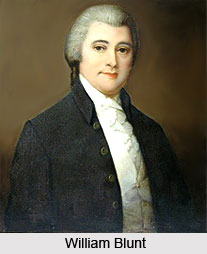
William Blunt served as one of the Governors of Agra Province in undivided India under the rule of the British. He was also a member of the British Indian Civil Servant.

Share this Article:

William Blunt, Governor of Agra ProvinceWilliam Blunt served as one of the Governors of Agra Province in the year 1835, in undivided India under the rule of the British East India Company. The Agra Province was one of the earlier provinces of British India which was under the direct rule of the British Empire in India. The province was incorporated as a part of the United Provinces of Agra and Oudh. The territory of Agra Province existed from the year 1904 until the Indian independence in 1947. He also served as a member of the British Indian Civil Servant. The Indian Civil Service (ICS) was the civil service of the Government of India during the era of the rule of British Empire in India. The members of the civil service were appointed under Section XXXII of the Government of India Act, 1858 of the Parliament of the United Kingdom. After the year 1886, the Indian Civil Service was officially known as Imperial Civil Service.

William Blunt studied at Haileybury in Hertfordshire in the year 1846 and achieved good distinction and attained 7th position with 2nd class among students of Bengal. He was appointed as Senior Member of Board of Customs, Salt and Opium in 1797. William Blunt was appointed as the Commissioner in Cuttack in the year 1820 and also became the Superintendent of Tributary Mahals. He was succeeded by George Stockwell as the Superintendent of Tributary Mahals in 1829. During the Burmese War in 1828, Blunt acted as Special Commissioner to David Scott, who was the Political Agent (Resident of British India) to the Governor General on the North East Frontier Agency.

William Blunt became a Member of the council of the Governor General on 11 November 1830 and remained as a member till 20 March 1835. He was appointed as the Governor of the Presidency of Agra on 20 March 1835. He was preceded by Sir Charles Theophilus Metcalfe as the Governor of Agra Province. Blunt served in office for over 8 months till 1 December 1835 and was succeeded by Alexander Ross. Later he acted as the Judge of the Courts of Sadr Diwani Adalat and Sadr Nizamat Adalat at the Bengal Presidency from December 1835 to April 1836. Later Blunt became Officiating Member of Board of Customs, Salt and Opium and Marine Board in Calcutta (now Kolkata) in the year 1841.

William Blunt was married with Eliza Jane on 23 December 1821 at Midnapore. She was the daughter of Lieutenant Colonel Goddard Richards.
Share this Article:

Related Articles

More Articles in History of India


History of Uttar Pradesh
The state was the heart of Mahabharata war and the history of Uttar Pradesh is very much the history of India. The place finds its mentions in Hindu epics Ramayana and Mahabharata.
History Of Archaeology In India
History of archaeology in India contributes a lot to define the past history and the social life of India.
Mughal Architecture during Babur
Mughal architecture during Babur marked the foundation of a new architectural era in India, blending Timurid, Persian, and local influences. His reign emphasized garden design, notably the Charbagh layout, and modest yet elegant structures. As the first Mughal emperor in India who introduced this architecture during 16th century Babur’s creations reflected symmetry, functionality, and a deep appreciation for nature.
Princely State of Patdi
The Princely State of Patdi was one of the many princely states under the British Raj, ruled by local Kadva Patidar leaders under indirect British control. Known for its strategic location near the Little Rann of Kutch, Patdi played an important role in salt production and regional trade. Princely State of Patdi or Patri was incorporated as a part of the Baroda Agency, which was a sub division of Western India States Agency.
Architecture during Sayyid and Lodi Dynasty
Architectures during the Sayyid and Lodi dynasty were mainly the tombs and monuments for the dead rulers. It were carefully designed and meticulously constructed.
Brahmanical Sources of Ancient History
Brahmanical Sources of ancient history are contained in the Vedas and they constitute one of the most important literary sources of information about ancient India.
Female Education In British India
The over brimming enthusiasm among zealous Hindu reformers welcomed female education in British India.
Revenue System of Mauryan Empire
Revenue system of Mauryan Empire can be divided into eight categories. The principal revenue of the state was the land revenue, taxes from traders, artisans and professional taxes were also collected.
Mughal Architecture During Jahangir
Mughal architecture during Jahangir`s period was relative dull in comparison to that of Akbar dynasty.
Princely State of Satlasna
Princely State of Satlasna was amongst the former native states of India that was appointed as one of the Indian princely states during the early 19th century.
Coins of Chola Empire
Coins of Chola Empire were issued in gold, silver and copper and carried the Chola emblem.
Social Life during the Pala Period
Religious toleration and simple living were the characteristics of social life during the Pala period.
Coins of the Chalukya Dynasty
Coins of the Chalukya Dynasty was reintroduced in the South India after a brief break of coinage less period of nearly three century. Chalukyas issued coins only in gold and they exhibit a brilliant artistic skill of the engraver.
Costumes of Indus Valley Civilisation
Costumes of Indus valley Civilization have been considered as the basis for Indian clothes. Sophisticated ornaments and make up were used during that age.
Development of Science under Gupta Empire
Development of Science under Gupta Empire was progressive and it had attained considerable perfection. Mathematics, astronomy, medicine, chemistry, physics and metallurgy were the most prominent of the sciences at that time.
Culture under Delhi Sultanate
Culture under Delhi Sultanate had enduring aspects to it. It included the society, the religious condition, literature and art and architecture of that period.
Princely State of Hapa
Princely State of Hapa was incorporated as a part of the Baroda Agency, which was under the administrative control of the Western India States Agency.
Economy Under Chola Dynasty
Economy under Chola dynasty was strong and well developed. The economic life of the people of the Chola Kingdom was well balanced with their social life.
Coins of Khilji Dynasty
Coins of Khilji Dynasty had an influential feature that was followed by the other dynasties.
Religion During Mauryan Dynasty
Religion during Mauryan dynasty became a considerable episode in Indian history with an esteemed lineage of rulers.