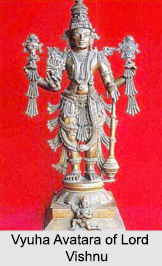
 Vyuha Avatara is one of the incarnations of Lord Vishnu in which the Supreme Being manifests himself in four different forms. These are Vasudeva, Sankarshana, Pradyumna and Aniruddha. Each of the Vyuhas is conceived with certain specific attributes and functions such as creation, sustenance, dissolution of the universe and promulgation of spiritual knowledge.
Scriptures on Vyuha Avatara
The Vyuha doctrine has been developed in detail in the Pancharatra treatises. The Avatara is implicit in the first four hymns of the Purusa Sukta. The Ahirbudhanya Samhita interprets these hymns in terms of the four Vyuhas. There is adequate description of the Vyuhas in the Mahabharata, Vishnu Purana and other Vaishnava Puranas. The Vaishnava theology has adopted it as an important doctrine.
Attributes of Vyuha Avatara
Vasudeva, the first Vyuha is endowed in full measure with all the six qualities. He is, therefore, regarded as almost the same as Para Vasudeva, the Supreme Being. Sankarshana, the second Vyuha, possesses jnana and bala; Pradyumna is endowed with aishwarya and virya, and Aniruddha with shakti and tejas.
Functions of Vyuha Avatara
Further, each Vyuha is assigned with specific cosmic and moral functions. The main purpose of the manifestation as Vyuha Vasudeva is to provide an opportunity to the liberated souls to experience the blissful God and render divine service to Him. Sankarshana is entrusted with the task of dissolution of the universe and promulgation of Shastras. Pradyumna is given the function of creation of the universe and establishment of dharma. Aniruddha is assigned with the work of protection of the universe and imparting of the spiritual knowledge. Each Vyuha, except the first, has thus two functions, a creative and a moral one, that is, one related to the basic functions of creation, sustenance and dissolution of the universe and another one connected with its ethical progress.
The Vyuha Vasudeva, the very Brahman of the Upanishad, is directly in charge of the samasti sristi, sthiti and samhara. He causes the initial process of evolution, dissolution of the universe by His sahkalpa, since He is the Supreme Being and controller of the entire universe. Vasudeva in the form of Pradyumna enters into the body of Brahma and causes the actual creation through him. In the same way, Vasudeva in the form of Sankarshana enters into the body of Rudra through whom the process of devolution of the universe is caused. The task of actual preservation of the universe is, however, performed directly by Vasudeva in the form of Aniruddha. Aniruddha who is an Avatara of Vishnu performs the function of preservation, whereas two separate deities such as Chaturmukha Brahma and Rudra are utilized as media for the task of creation and dissolution of the universe.
Vedanta Desika has provided an explanation for the attribution of a pair of gunas and the allocation of specific functions to each Vyuha. When a devotee undertakes meditation on a Vyuha form of God, he focuses his mind on specific divine qualities and God accordingly reveals to the Upasaka that form with which the latter desires to intuit the former. Similarly, it is the same Vasudeva who performs different functions by assuming three different manifestations as Sankarshana, Pradyumna and Aniruddha because He is the presiding deity of the Vyuhas and the controller of all activities.