
Nayaka dynasty of Madurai consisted of thirteen rulers. Among them nine of them were kings, two were queens and two were kings jointly. They belonged to Telugu speaking Balija social group. The most notable of these were the king, Tirumalai Nayaka and the queen, Rani Mangammal.
After Vishwanatha Nayaka took over it was held by the Nayak dynasty for two centuries, until Muslims took it in 1736 for a brief period before the British took it during the 1780s.
In 1538 AD, the commander of Vijayanagara Empire Kotikam Nagama Nayaka defeated Veerasekara Chola who occupied the Pandyan region. However he declared independence from the Vijayanagar dynasty. In order to check the rebellion of Nagama Nayaka, Emperor Krishnadeva Raya of Tuluva dynasty sent a large force under Viswanatha Nayak. Vishwanatha Nayaka was the son of Nagama Nayaka who eventually defeated and imprisoned his father.
Nayaka Dynasty of Madurai
Nayaka Dynasty of Madurai were rulers of a region comprising most of modern-day Tamil Nadu. Madurai was the capital.
About Nayaka Dynasty
Viswanatha Nayaka
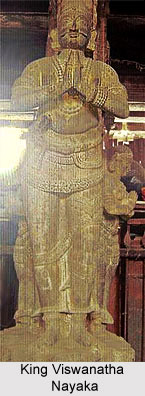 The founder of Nayakship in Madurai was Viswanatha Nayaka. He was the son of Nagama Nayaka, a supervisor of the administration of the southern districts under the well known ruler of Vijayanagar, Krishnadeva Raya.
Viswanatha entered the service of Krishnadeva Raya as his betel-bearer. Owing to loyalty and bravery, he soon, became one of his personal attendants. Viswanatha accompanied Krishnadeva Raya in his expedition against the king of Orissa. Looking at Viswanatha`s valor Krishnadeva Raya appointed him as the commander of a battalion. Viswanatha then captured Raichur in 1520. Nagama Nayaka disobeyed Krishnadeva Raya and Viswanatha was sent to control his own father. Nagama was defeated and was taken to Vijayanagar as a captive, but was pardoned by Krishnadeva.
Later, Viswanatha was appointed as viceroy of the south with the titles `Chief of Pandya Country` and `Lord of the Southern Throne`. Viswanatha Nayaka was a good administrator and was ably assisted in his work by Ariyanatha, his Dalavay and Pradhani, and Kesavappa Nayaka. Viswanatha with great tact improved the defense of the cities of Madurai and Tiruchi. He renovated the great temple of God Sundareshwara (Siva) and Goddesses Minakshi at Madurai. One of Viswanatha`s memorable works was the organization of the Madurai country into palaiyams and the chiefs of these divisions were called palayakkarar or poligar. It is said that 72 such palaiyams were created and that each palaiyajjar was left in charge of one of the 72 bastions of the Madurai fort. Ariyanatha suppressed a rising of five Pandyas in the region of Kaitar in Tirunelveli and restored order. Viswanatha ruled till 1564 and remained loyal and subordinate to Vijayanagar rulers.
Kumara Krishnappa (1563-1573)
In 1538 AD, the commander of Vijayanagara Empire Kotikam Nagama Nayaka defeated Veerasekara Chola who occupied the Pandyan region. However he declared independence from the Vijayanagar dynasty. In order to check the rebellion of Nagama Nayaka, Emperor Krishnadeva Raya of Tuluva dynasty sent a large force under Viswanatha Nayak. Vishwanatha Nayaka was the son of Nagama Nayaka who eventually defeated and imprisoned his father.
Joint rulers
Kumara Krishnappa was succeeded in 1573 by his two sons Muttu krishnappa and muttu Veerapa, who ruled jointly and uneventfully until 1595.
Joint rulers
Kumara Krishnappa was succeeded in 1573 by his two sons Muttu krishnappa and muttu Veerapa, who ruled jointly and uneventfully until 1595.
Muttu Krishnappa (1602-1609)
He had given the Setupatis of Ramnad in the Maravar region, on condition that they suppress crime and protect pilgrims journeying to Rameshwaram.
Muttu Virappa (1609-1623)
He was succeeded by his eldest son, Muttu Virappa. He constructed the fort of Dindigul at Dindigul on the Hill, along with the Temple on it, which later was completed by Tirumalai Nayak. However it is considered that his rule was not praiseworthy.
Tirumalai Nayaka
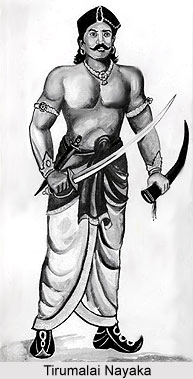 One of the well-known rulers of the Nayaka dynasty of Madurai, Tirumalai Nayak was very apt in administration activities. Son of Muttu Krishnappa, Tirumalai Nayaka succeeded his brother Muttu Virappa Nayaka on the throne. Muttu Virappa had changed his capital from Madurai to Tiruchirapalli. But, Tirumalai Nayak shifted his capital from Tiruchirapalli back to Madurai, and carefully organised the defenses of the kingdom.
Tirumalai`s reign was marked by a large number of military campaigns. He was successful in his wars with Mysore. He undertook a successful expedition against Travancore in about 1634-35 A.D. He settled the dispute for throne between Sadaika Deva and Tambi in the Ramanth region. Finally, Raghunatha Deva became the ruler and he remained loyal to Tirumala who rewarded him liberally when he crushed the poligar rising at Ettaiyapuram. Till about 1634 Tirumala was loyal to Vijayanagar, though it was only a normal subordination. Then he planned an alliance with the Nayaks of Gingee and Tanjavur, to oppose Sriranga III, the Vijayanagar emperor. His plans were betrayed by the Nayak of Tanjavur. Then Tirumala requested the Golconda Sultan to help him against the emperor.
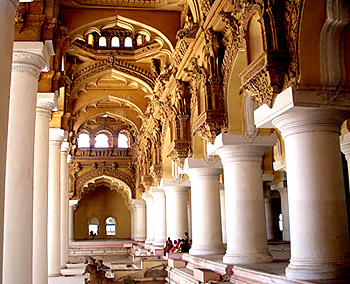
After defeating Sriranga, the Sultan turned against the other South Indian kingdoms. So Tirumala was forced to ask the Sultan of Bijapur for help. But all this led to expansion of Muslim rule in the south. He remained neutral in the contests between the Dutch and the Portuguese in the south. Tirumala made significant contributions in the realms of art and architecture. He built the Pudu mandapa, dug the Uppakula (tank), carried out many repairs and renovations to the Madurai temple and began the unfinished Raya gopura in Madurai. He also built an extensive palace to the south-east of the temple. Tirumala is credited with the building of many structures - both religious and civilians in his realm- at Madurai, Tirupparan-kunram, Alagarkoyil, Srivilliputtur, etc.
Muttu Alakadri (1659-1662)
Tirumalai Nayak was succeeded by his son Muttu Alakadri. He tried to persuade the Nayak of Tanjore to join the enterprise. The Muslim invaders moved against Trichinopoly and Madurai thereby spreading chaos. However due to several difficulties faced by the locals they had to withdraw. However Muttu Alakadri gave himself to dissipation.
Chokkanatha Nayaka (1662-1682)
Chokkanatha Nayaka succeeded Muthu Alakadri Nayak.
Rangakrishna Muthu Virappa (1682-1689)
Chokkanatha Nayaka was succeeded by Rangakrishna Muthu Virappa who was a spirited boy of fifteen. He tried to revive the fortunes of the kingdom. He possessed a sound sense and ability which evoked the admiration of his ministers. Eventually he recovered his capital in 1685 and he gradually recaptured large parts of the ancient kingdom of his forefathers thereby restoring the powers of the Nayaks of Madurai. He died at an early age of 22.
Rani Mangammal (1689-1704)
Rani Mangammal, the mother of the late Nayak was the Queen-Regent on behalf of her grandson. She was the most popular among all her rulers. She was a skilled administrator and is remembered as a maker of roads and avenues, and a builder of temples, tanks. She is known for her diplomatic and political skills and successful military campaigns.
Vijaya Ranga Chokkanatha (1704-1731)
She was succeeded by her grandson Vijaya Ranga Chokkanatha, He ruled for 26 dull years thereby leading to the decline of the dynasty. He was weak-minded. He was generous with the Brahmins and distributed gifts to them and religious institutions.
Rani Meenakshi
Vijaya Ranga Chokkanatha died in 1731. He was succeeded by his widow Meenakshi, who acted as Queen-Regent on behalf of a young boy she had adopted as the heir of her dead husband. She ruled probably for a year as a revolt was raised by Vangaru Tirumala, the father of her adopted son, who claimed the throne of Madurai. The Mughals played a major role at this juncture.
Decline of Nayaka dynasty of Madurai
 In 1734 Meenakshi and Vangaru Thirumala were fighting for the crown. An expedition was sent by Nawab of Arcot in order to exact tribute and compliance from the kingdoms of the south. The invaders took Tanjore and left Trichinopoly untouched. While returning from their voyage they took part in the quarrel between Meenakshi and Vangaru Tirumala. Vangaru Tirumala approached Safdar Ali Khan with an offer of three million rupees if he would oust the queen. He declared Vangaru Thirumala to be king and took the bond for the three millions.
Queen Meenakshi made him swear on the Koran that he would adhere to his engagement. He was admitted into the Trichinopoly fort and Vangaru went off to Madurai to rule. Chanda Sahib accepted the crore of rupees and headed off to Arcot. In 1736 he returned and was admitted into the fort and acted as master of the kingdom. Meenakshi fell in love with Chanda Sahib and so never interrupted him. He defeated Vangaru Thirumala at Ammaya Nayakkanur and Dindigul and forced him to take shelter in Sivaganga and occupied the southern provinces of the Madurai kingdom. Now he was the master of Meenakshi`s kingdom he threw off the mask and locked her up in her palace and was declared as the ruler of her kingdom. She ended her life by consuming poison.
Recently updated articles in History of India
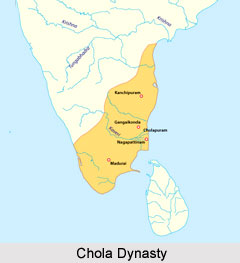
Chola Dynasty
Chola Dynasty is a Tamil dynasty and had longest duration of ruling in parts of South India. Chola dynasty had ruled South India successfully for a ex...
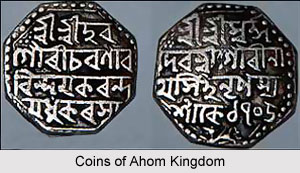
Suhungmung
Suhungmung was the fourteenth ruler of the Ahom dynasty who ruled from the period 1497 to 1539 AD. His reign was significant in terms of expansion of...
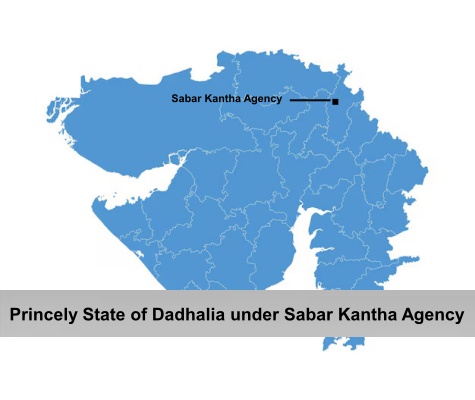
Princely State of Dadhalia
Princely State of Dadhalia was located in the present state of Gujarat. The state covered a total area of 28 sq miles and comprised of 15 villages. Th...
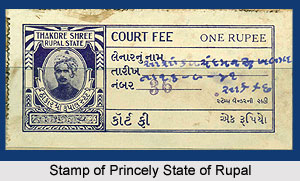
Princely State of Rupal
Princely State of Rupal was a part of the Baroda Agency, a sub division of Western India States Agency. It was under the administrative control of the...
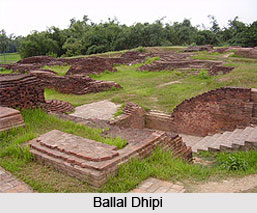
Archaeological Sites of West Bengal
Archaeological sites of West Bengal reveal several aspects of ancient India. Excavations by the Archaeological Survey of India have furnished artefact...
Related articles in History of India

Mughal Architecture during Babur
Mughal architecture during Babur marked the foundation of a new architectural era in India, blending Timurid, Persian, and local influences. His reign...

Architecture during Sayyid and Lodi Dynasty
Architectures during the Sayyid and Lodi dynasty were mainly the tombs and monuments for the dead rulers. It were carefully designed and meticulously...

Brahmanical Sources of Ancient History
Brahmanical Sources of ancient history are contained in the Vedas and they constitute one of the most important literary sources of information about...

Coins of Chola Empire
Coins of Chola Empire were issued in gold, silver and copper and carried the Chola emblem.

Coins of Khilji Dynasty
Coins of Khilji Dynasty had an influential feature that was followed by the other dynasties.