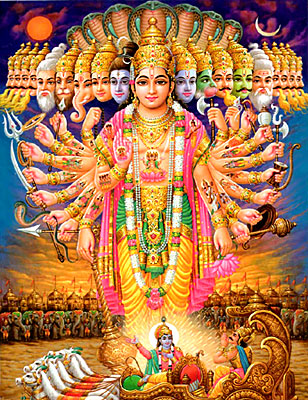
 The contribution of the Indian Puranas in general and Vishnupurana of Sage Parasara in particular is significant in developing the Vaishnava doctrines. The Vishnu Purana is acknowledged as the oldest and the most authoritative Purana. Both Shankara and Ramanuja hold it in high esteem and have accepted it as an authentic sourcebook for determining the philosophical doctrines. It presents all the basic doctrines, both philosophical and theological, of Vaishnavism. This is the earliest text which treats Godhead against the background of Pancharatra system.
Vishnu is held as the Supreme Deity (para-tattva) and is identified with the very Brahman of the Upanishad. At the very outset the Purana asserts that Vishnu is the primary cause of creation, sustenance and dissolution of the universe, reiterating the definition offered by the Taittiriya Upanishad and Vedantasutra for Brahman. The same Vishnu is also spoken of as Bhagavan and Vasudeva. He possesses six attributes (sadguna) and is also free from all defects. The concept of ubhayalihgatva as stated in the Vedantasiitra is thus explicitly brought out in this Purana. The central doctrine of Vaishnavism, i.e., that Vishnu is inseparably associated with Goddess Sri, that the latter is also all-pervasive (vibhu) like God and that She is also the giver of moksha finds a significant expression here. The Vaishnava concept of paramapada, (the eternal abode of Vishnu) is also referred to in this Purana.
The other Puranas are classified into three categories - sattvika, rajasa and tamasa. The Sattvika Puranas are those which emphasise the greatness of Vishnu, rajasa speak about Brahma and tamasa refer to the greatness of Siva and Agni. This classification is made in the Matsya Purana for the purpose of determining the relative validity of the Puranas, whenever conflict arises between their teachings. The Sattvika Puranas are, therefore, regarded as Vaishnava Puranas. These are: Vishnudharmottara, Padma, Garuda, Varaha, Narada and Bhagavata besides Vishnu Purana. All these, therefore, contain material supporting the tenets of Vaishnavism.