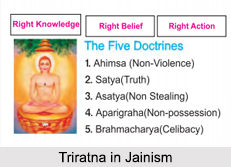
 Triratna in Jainism is the three basic components or the three jewels that together constitute the path to liberation i.e. "Mokshamarga". The Jain philosophy asserts that a person obtains everlasting happiness only when Karma is completely eradicated from the soul. Each soul can attain liberation, a supreme spiritual state, by realizing its intrinsic purity and perfection.
``Tattvartha Sutra``, a sacred text of Jainism by Acharya Umaswami, insistently states a rule of "Samyag Darsana-Jnana-Charitrani Mokshamarga". Hence, the three jewels are:
Triratna in Jainism is the three basic components or the three jewels that together constitute the path to liberation i.e. "Mokshamarga". The Jain philosophy asserts that a person obtains everlasting happiness only when Karma is completely eradicated from the soul. Each soul can attain liberation, a supreme spiritual state, by realizing its intrinsic purity and perfection.
``Tattvartha Sutra``, a sacred text of Jainism by Acharya Umaswami, insistently states a rule of "Samyag Darsana-Jnana-Charitrani Mokshamarga". Hence, the three jewels are:
1. Samyag Darsana (Right Faith or Perception),
2. Samyag Jnana (Right Knowledge) and
3. Samyag Charitra (Right Conduct).
Characteristic Features of Triratna
The ethical code prescribed by Jainism is based on this three-fold path of liberation. Hence, it is necessary to see the appropriate characteristics of the "Triratna" which constitute that path. They are as follows:
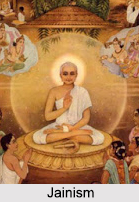 1. Samyag Darsana:
Right Belief forms the basis upon which the other two jewels, viz. Right Knowledge and Right Conduct, rest. Hence it has been laid down that one must, by all possible means, first attain Right Belief. This is the basic conviction in the fundamentals of Jainism because it has been asserted that only on the acquisition of Right Belief, the Knowledge and Conduct become right.
1. Samyag Darsana:
Right Belief forms the basis upon which the other two jewels, viz. Right Knowledge and Right Conduct, rest. Hence it has been laid down that one must, by all possible means, first attain Right Belief. This is the basic conviction in the fundamentals of Jainism because it has been asserted that only on the acquisition of Right Belief, the Knowledge and Conduct become right.
2. Samyak Jnana: It is considered that on attaining Right Belief, one should strive after Right Knowledge. Right Knowledge has been described in Jain scriptures as "that knowledge which reveals the nature of things neither insufficiently (Naya), nor with exaggeration, nor falsely, but exactly as it is and with certainty (Pramana)". It has also been stated that Right Knowledge consists in having full comprehension of the real nature of soul and matter.
3. Samyak Charitra: After Right Belief and Right Knowledge, the third, but the most important path to the goal or Moksha, is Right Conduct. In Jainism, utmost importance is attached to the Right Conduct. Conduct becomes perfect only when it is in tune with Right Belief and Right Knowledge. It is, therefore, the importance of Right Conduct in the process of self realization consists in the fact that it is only when Right Knowledge based on Right Belief is translated into practical and spiritual discipline that the path of emancipation of soul from the cycle of births and deaths becomes smooth.
Right Faith or Perception creates an awareness of reality or truth, Right Knowledge impels the person to right action, and Right Conduct leads him to the attainment of liberation. They must coexist in a person if he is to make any progress on the path of liberation. The absence of one makes the ascent impossible.