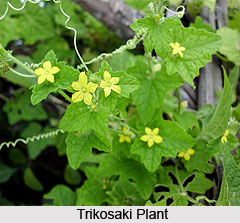
 Trikosaki is a medicinal plant of India, found throughout the regions to an elevation of 1800 m. This medicinal plant is common in village hedges, other open habitats, and disturbed sites in semi-evergreen and deciduous forests. Within India, it is said to be found throughout including Andaman and Nicobar Islands in the open areas. Trikosaki belongs to the "Cucurbitaceae" family. Different organs of this plant are used in Ayurveda, Siddha, Naturopathy and Folkloric traditional medicines of India. The leafy vegetable is reported to exhibit potent anti-oxidant capacity to possess anti hypertensive, vasodialatory, anti-hyperglycaemic, anti-hyperlipidemic, hepatoprotective, immuno-modulatory, anti-inflammatory, anti-rheumatic, anti-ulcer, anxiolytic, antimicrobial and anti-platelet aggregation activities.
Different Names of Trikosaki
The botanical name of Trikosaki is "Mukia Maderaspatana". This medicinal plant has numerous common names which vary according to the different languages of India. Trikosaki is commonly known as "Bilari" and "Gulya Kakri" in Bengali and Hindi, "Mani Tonde" in Kannada, "Chiraati" in Marathi, "Maluram" in Tamil, "Mukkalpiram" in Malayalam and "Kutarubudama" in Telugu. "Trikosaki" is the Sanskrit naming of this medicinal plant.
Characteristic Features of Trikosaki
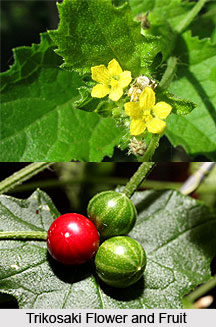 Trikosaki is a prostrate or climbing, much-branched, annual herb with spreading bristly hairs and simple tendrils. The leaves of this medicinal plant are alternate and broadly triangular in outline. These leaves are 5-angled, 3 to 11 cm in length and breadth. Their apex is acute, base deeply cordate, irregularly dentate, dark green colour which are scabrid in the above, paler green and hispid beneath. The petioles of Trikosaki medicinal plant are hairy and 0.6cm to 2.5 cm long. Flowers are small, pale yellow in colour; male flowers fascicled on very short peduncles, female flowers usually solitary and sessile.
Calyx of this medicinal plant is hairy, bear a tube of 2 mm long, narrowly cam-panulate; corolla pubescent, segments ovate-oblong, rounded at the apex, 2 mm long. Fruits of Trikosaki plants are popularly known as berry and are globule-ellipsoid, up to 1.5 cm in diameter. These are pale green in colour with longitudinal cream stripes along with ripening scarlet. The seeds are 4 mm long and 2 mm broad, present in numerous numbers. These are closely arranged, compressed and ellipsoid.
Medicinal Values of Trikosaki
Trikosaki plants are important for its numerous medicinal values. Several medicines are prepared from its different plant parts. The tender shoots and bitter leaves are used as a gentle aperient, and are prescribed for vertigo and biliousness. The root of the plant, when chewed, relieves toothache; a decoction of the root is used to relieve flatulence. A decoction of the seeds is used as a sudorific whereas the crushed seeds are applied externally to relieve body-aches. In Ayurveda practice, the fruits are used in the treatment of dysuria, piles, polyuria and tuberculosis. In Siddha the root and leaf are used to treat fever, dyspnoea, abdominal disorders, cough and vomiting.