
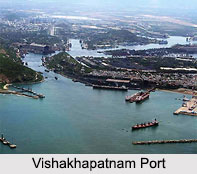
 Visakhapatnam or Vizag is a coastal, port city in the Indian state of Andhra Pradesh, which is also the largest city and financial capital of the state. It is located on the eastern shore of India, nestled among the hills of the Eastern Ghats and facing the Bay of Bengal to the east. This city is also the administrative headquarters of Visakhapatnam District and is the home of the Eastern Naval Command of the Indian Navy. Sometimes Visakhapatnam goes by its presently mostly obsolete colonial British name, Waltair. It is sometimes also referred to as the "City of Destiny". Visakhapatnam is home to several state owned heavy industries; one of the most advanced steel plants and one of the country`s largest ports and its oldest shipyard are among them.
Visakhapatnam City
Visakhapatnam is a coastal, port city in the Indian state of Andhra Pradesh.
Introduction
Visakhapatnam or Vizag is a coastal, port city in the Indian state of Andhra Pradesh, which is also the largest city and financial capital of the state. It is located on the eastern shore of India, nestled among the hills of the Eastern Ghats and facing the Bay of Bengal to the east. This city is also the administrative headquarters of Visakhapatnam District and is the home of the Eastern Naval Command of the Indian Navy. Sometimes Visakhapatnam goes by its presently mostly obsolete colonial British name, Waltair. It is sometimes also referred to as the "City of Destiny". Visakhapatnam is home to several state owned heavy industries; one of the most advanced steel plants and one of the country`s largest ports and its oldest shipyard are among them.Etymology of Visakhapatnam
The name Visakhapatnam has been derived from the temple name "Vaisakha", which was built by a king of 4th century. The king was on a pilgrimage and had to halt at the Lawson"s Bay. There he built the temple, which later got submerged under the sea but the name of the temple has been derived to name the city.
History of Visakhapatnam
 History of Visakhapatnam drifts back to the 3rd Century BC and evidences say that the origin of this city lies in the Buddhist ruins of Thotlakonda. Visakhapatnam is a coastal, port city in the Indian state of Andhra Pradesh, located on the eastern shore of India, amidst the hills of the Eastern Ghats and facing the Bay of Bengal to the east. It is the administrative headquarters of Visakhapatnam District and is also home of the Eastern Naval Command of the Indian Navy.
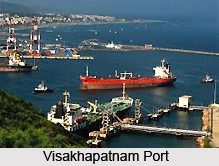
The defunct colonial British name of Visakhapatnam was Waltair. During the colonial era, the city had its hub at the Waltair railway station, and that part of the city is still called as Waltair. Visakhapatnam is sometimes also referred to as the "City of Destiny". According to 2007 population estimates, Visakhapatnam is said to be the 9th largest City in India. The city is home to several state owned heavy industries that is one of the most advanced steel plants in India and has one of the country`s largest ports and its oldest shipyard. Visakhapatnam has the only natural harbour on the eastern coast of India.
History of Visakhapatnam primarily relates it to the origin of its name. Visakhapatnam or the place of Visakha is named after the deity of valor, the second son of Lord Shiva. The other story related to the story of Visakhapatnam is the beauty of the place that was compared to the beauty of Sakhi Visakha. The legend is that Radha and Visakha were born on the same day and were equally beautiful. The city people believe that an Andhra King overwhelmed by the beauty built a temple to pay admiration to his family deity, Visakha. The stories associated with the history of Visakhapatnam are numerous but the fact remains that the unparalleled natural splendor of Visakhapatnam has been intact since its formation.
The Epic City or Visakhapatnam has been mentioned in the Indian epics Ramayana and Mahabharata. The forests of the Eastern Ghats; where the two brothers Rama and Laxman wandered in search of Sita, wife of Lord Rama. Rama formed his army of monkey men in the region with the help of Hanuman and Jambavan. The monkey army of Rama ultimately defeated the demon King Ravana and claimed back his wife Sita. An episode of Mahabharata when Bheema killed the demon Bakasura happened in the village Uppalam, just 25 miles from Visakhapatnam, as said in mythology.
 Buddhist influence in the history of Visakhapatnam has been noticeable. The religious Hindu texts mention that the region of Visakhapatnam in the 5th century BC was part of the enormous Kalinga territory, which extended up to River Godavari. The remnants found in the area also prove the existence of a Buddhist empire in the region. Kalinga later surrendered their territory to King Ashoka in the bloodiest battle of the time, which encouraged him to embrace Buddhism. The territory of Viskahapatnam was then taken over by the Andhra Rulers of Vengi. Then Chalukyas, Pallavas, the Reddy Kings ruled over the placid land and formed a compact history of Visakhapatnam.
The Chola Kings built the temples in Visakhapatnam during the 11-12 century AD as established by Archeological remnants. The Mughals ruled Visakhapatnam under the Hyderabad Nizam in the late 15th and early 16th century. The merchants from Europe, the French, the Dutch and the East India Company also utilised this natural port to export tobacco, ivory, muslin and other important textile products.
Local legend states that an Andhra king, belonging to the 9-11th century, while on his way to Varanasi, rested in Visakhapatnam and was so enchanted with the tranquil beauty of the place, that he ordered a temple to be built in honor of his family deity, Visakha. Archaeological sources however reveal that the temple was possibly built between the 11th and 12th centuries by the Cholas. Sankarayya Chetty, a shipping merchant, built one of the mandapams or the pillared halls of the temple. Although it no longer exists, history of Visakhapatnam says many stories of its glorious past.
In the 18th century, Visakhapatnam was included in the Northern Circars, a region comprising Coastal Andhra and southern costal Orissa that was initially under French control and later the British. Visakhapatnam became a district in the Madras Presidency of British India. After India`s independence, Visakhapatnam was the biggest district in the country and was subsequently divided into the three districts of Srikakulam, Vijayanagaram and Visakhapatnam.
The history of Visakhapatnam has witnessed the growth of the massive industrial sectors, owing to the presence of the Eastern Naval Command, Steel Plant, H.P.C.L. Visakhapatnam has been the home to people from different parts of the country and thus the city has a cosmopolitan texture to it. The history of Visakhapatnam speaks of the city`s growth from a sheer tranquil patch of land to one of the most important harbours and industrial hubs in the nation.
Demography of Visakhapatnam
According to the 2011 census data, population of Vishakhapatnam is almost 1,728,128, out of which males are 873,599 and females 854,529. 164,129 of the total population come under the age of 6 years. Average literacy rate of Vishakhapatnam is 81.79% of which 688,678 are males and 590,459 are females. Vishakhapatnam is the 122th city among the fastest growing cities in the world.
Climate of Visakhapatnam
Language of Vishakhapatnam
 Visakhapatnam is mainly a Telugu speaking city. The Telugu spoken by the middle classes is a standard dialect, while a considerable population who has settled down in the city from neighboring villages and neighbouring districts of East Godavari, Vizianagaram and Srikakulam speak Uttarandhra (North Coastal) Mandalikam dialects.
Largest Harbour in Vishakhapatnam
Vishakhapatnam has the only natural harbour on the eastern coast of India. Its saga began with the expedition of British to find a suitable port that could serve the neighborhood possessing rich mineral wealth. Vizag is the most sheltered natural harbour in Asia. The British started building the harbor in 1927 and in 1933 it was opened to carry out traffic.
Industries in Vishakhapatnam
The most important industry in Vishakhapatnam is setting up of Scindia Steam Navigation Co. that was later known as Hindustan Shipyard Ltd in 1940. In 1950s and 1960s Government and private sector setting up some large-scale basic industries in Visakhapatnam like Bharat Heavy plates and vessels (B.H.P.V.), Hindustan Zinc Ltd., Caltex oil refinery (Later acquired by government as H.P.C.L.), Coramandel fertilizers, Andhra Polymers (Now L.G. Polymers), etc. 1980s saw a major growth with the development of Vizag Steel and other prime industries. Economic liberalization in the 1990s brought a humble growth to the city but not as much as it did to Hyderabad.
Tourist places in Visakhapatnam
 Visakhapatnam is a district of the South Indian states Andhra Pradesh. This is a port city, which is famous for its natural Harbour. Numerous maritime activities also take place here. The place is well known for its ancient temples. The district is said to have nurtured Buddhism in the past, which is obvious from the grand monolithic Stupas, ancient edifices and rock-cut caves at Sankara. Most of these monuments have origin back to the 7th century AD. It is also favourite spot of the picnic makers. The beaches here are very soothing and attract the skiers, surfers and swimmers. There are also vast coffee plantations in Visakhapatnam. Some of the interesting tourist places of Visakhapatnam are given here:
Simhachalam in Visakhapatnam : Simhachalam is a massive hill, about 16 km north of Vishakapatnam. It is situated on 244 meter above sea level. There is a temple dedicated to `Lord Narasimha` here. It is an 11th century temple and is very rich in architecture. Several important historic events are revealed in the stone inscriptions here. The deity here appears like a Shivalinga, who is smeared with fragrant sandalwood paste everyday. The deity can be seen in the `Narasimha` form during the annual festival called the `Chandanayatra`, which is celebrated in a grand way in March-April. Government busses are available between here and Vishakapatnam. The nearest railway station and airport are also at Vishakapatnam, which are at 16 km away.
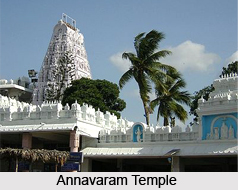
Annavaram in Visakhapatnam : This place is famous for an ancient temple dedicated to Lord `Veeravenkata Sathyanarayana Swamy`. It is situated about 72 km from Rajahmundry, 124 km from Vishakapatnam and 498 km from Hyderabad. The temple forms the crown of the beautiful hill known as `Ratnagiri` on the banks of the tranquil river Pampa. The deity here is one of the forms of Lord Vishnu. The devotees here come to undertake a special vow and perform regular Pujas in praise of the Lord here and get their wishes granted.
Every year, approximately one-lakh devotees undertake vow and offer Pujas here in this temple of Visakhapatnam. Most of these devotees are couples. Marriages and the Holy thread ceremony of the Brahmin community are conducted in this temple. The Bhishma Ekadasi and Kalyanotsavam in January/February and Vysakha Ekadasi in April/May are the important annual festivals of this temple.
Bheemunipatnam Beach in Visakhapatnam :
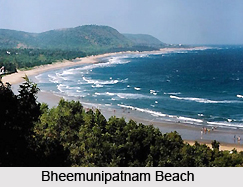 This beach is situated about 24 km from Vishakapatnam. The beauty of this wonderful beach is enhanced by the enchanting estuary of the ravishing river Gosthani. The tourists can have a glance of the ravaged ruins of a 17th century Dutch Fort. The stronghold of the Dutch is proved from this. An ancient Dutch cemetery can also be seen here. This beach has a little dissimilarity with the other beaches along the east coast. The sharks can be seen in the coastline, which visit here often. The road along this beach from Vishakapatnam is very enthralling as the road is undulating all along.
Rishikonda Beach in Visakhapatnam : This is another exciting beach of Visakhapatnam. It is situated about just 8 km from Vishakapatnam. It has lovely settings and interests swimmers, water skiers, wind surfers and layman equally.
Sankara in Visakhapatnam : This place is situated about 3 km from Anakapally and 40 km from Visakhapatnam. The archaeologists and the common man are interested towards this place similarly. The visitors can see the grand Buddhist Stupas here, which are monolithic. There are many ancient structures and serene rock-cut caves here, which are remnants of a grand architecture of past era. A brick clad main stupa can be found here, which was first carved out of rock. All these monuments found here have their origin back to the 7lh century AD.
Araku Valley and Borra Caves : This is a wonderful valley, situated about 127 km from Vishakapatnam. The Ghat road here rises to a height of 1168 meter above the sea level. It again falls down flanked by mighty mountains and fabulous scenery to Araku Valley, which is itself about 975 m above the sea level. The tribal communities can be seen inhabiting the place.
The beautiful Borra village is situated about 90 km from Vishakapatnam. There is a ravishing rivulet found here. It becomes a deluge during heavy downpour and disappears into the limestone caves only to emerge again about 100 meter below in a stunning gorge. During the Shivaratri festivals, a large number of local people gather here. The journey from Borra to Araku valley is exciting, which is 30 km of sheer pleasure. The entire region is rich in flora and fauna and also in fertile and pasture lands. The Anantagiri slopes near here are full of sweet fragrance of the rich coffee plantations.
Visakhapatnam Airport
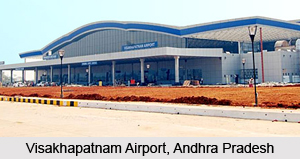 Vakhapatnam Airport is located in Andhra Pradesh, India. The Indian Navy controls the air traffic of the airport. They also provide support to the flying operations for both the military and the civil aviations. From July 2007, Visakhapatnam inducted the night landing facility with the Dornier of the Indian Navy lifting off from the new landing installation. The airport authority has a plan to make this airport an international one by the end of 2008. It was Minister of State for Civil Aviation, Mr. Praful Patel who had announced that, `the Visakhapatnam airport would be improved to international standards with new runway, night landing and modern facilities like instrument landing system, distance measuring equipment, by 2008`. Indian Airlines (Mumbai, Delhi, Chennai, Hyderabad, Raipur); Air Deccan (Kolkata, Bangalore, Hyderabad, Chennai, Bhubaneshwar, Tirupathi); Jet Lite (Mumbai, Hyderabad); Kingfisher Airlines (Hyderabad, Chennai); Paramount Airways (Hyderabad, Chennai, Bangalore) are some of the airlines flying by the Visakhapatnam Airport.
Recently updated articles in Cities of India
Places of Interest in Deogarh Uttar Pradesh
A place of historical and archaeological significance, Deogarh is a site with few popular places of interest.
Deoghar in Jharkhand
Deoghar is the divisional headquarters of Santhal Parganas located in Jharkhand and is popular for the famous Baidyanath temple and Shiva Temples.
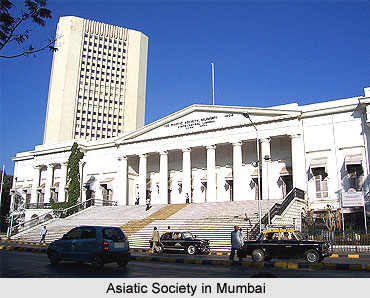
The Asiatic Society of Mumbai
Asiatic Society in Mumbai is the temple of Asian Studies from the time of British rule in India.
Vasco da Gama / Vasco City
Vasco da Gama / Vasco is the biggest city of Goa and is one of the most visited for its perfect amalgamation of business as well as leisure options.

Agriculture of Ladakh
Agriculture in Ladakh is primarily practiced in the short summer season due to its cold desert climate. Farmers grow hardy crops like barley, wheat, p...
Related articles in Cities of India
Holy Cities of North India
Holy Cities of North India are having the rich history of Hinduism and the entire civilization was grown up with the hands of beliefs, rituals and the...
Holy Cities of South India
Holy Cities of South India gives the detailed cultural formation of Dravidians from the early era, which later developed to the world by the Pallavas...
Holy Cities of West India
Holy Cities in West India were established by the rulers of Rajputs and the Satvahana Dynasty and the medieval rulers of Junagadh.
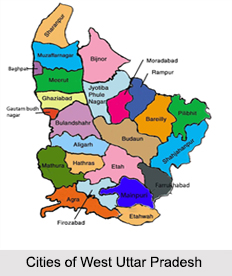
Cities of West Uttar Pradesh
Cities of West Uttar Pradesh include Meerut, Bulandshahr, Ghaziabad, Saharanpur, Muzaffarnagar, Bijnor, Bareilly, Rampur, Agra, Aligarh, Mathura and m...
Port Cities of South India
Port Cities of South India are developed from the early phase of colonial era when the Portuguese and the French traders came to India