
 Raipur District is situated in the fertile plains of Chhattisgarh. This District is situated between 22 degree 33 minutes north to 21 degree 14 minutes north latitude and 82 degree 6 minutes to 81 degree 38 minutes east longitude. Raipur District is surrounded by Bilaspur District in north, Bastar District and part of Orissa in south, Raigarh District and part of Orissa in east and Durg District in west. The district occupies the south eastern part of the upper Mahanadi valley and the bordering hills in the south and the east. Thus, the district is divided into two major physical divisions, namely the Chhattisgarh plain and the Hilly Areas. As per Census 2001, total population of the district is 3,016,930.
Raipur District
Raipur District in Chhattisgarh is located in the prolific plain region of the state. This district has several popular tourist attractions like wild life sanctuaries and temples. Raipur District is abundantly rich in mineral resources.
Introduction
Raipur District is situated in the fertile plains of Chhattisgarh. This District is situated between 22 degree 33 minutes north to 21 degree 14 minutes north latitude and 82 degree 6 minutes to 81 degree 38 minutes east longitude. Raipur District is surrounded by Bilaspur District in north, Bastar District and part of Orissa in south, Raigarh District and part of Orissa in east and Durg District in west. The district occupies the south eastern part of the upper Mahanadi valley and the bordering hills in the south and the east. Thus, the district is divided into two major physical divisions, namely the Chhattisgarh plain and the Hilly Areas. As per Census 2001, total population of the district is 3,016,930.History of Raipur District
 History of Raipur District makes it clear that this district was once a part of southern Kosal and considered to be under Maurya Empire. Raipur city had been the capital of the Haihaya Kings, controlling the traditional forts of Chhattisgarh for a long time. The town of Raipur has been in existence since the 9th century AD, several old site and ruins of the fort can be seen in the southern part of the city. Satawahana Kings ruled this part till the 2nd and 3rd centuries AD. Further, in 4th century AD king Samudragupta had conquered this region and established his domination till 5th and 6th centuries AD when this part had come under the rule of Sarabhpuri Kings. For some time Nala kings dominated this area. Later on Somvanshi kings had taken the control over this region and ruled the region with Sirpur as their capital city.
Moreover, according to the historical evidences of Raipur District, Mahashivgupt Balarjun was the mightiest emperor of Somvanshi Dynasty. The Kalachuri Kings of Tumman ruled this part for a long time with Ratanpur as their capital. The old inscriptions of Ratanpur, Rajim and Khallari refer to the reign of Kalachuri kings. It is believed that King Ramachandra of Kalachuri dynasty established the city of Raipur and subsequently made it the capital of his kingdom.
Another legend about Raipur says that King Ramachandra`s son Brahmdeo Rai had established Raipur. His capital was Khalwatika. The newly constructed city was named after Brahmdeo Rai as `Raipur`. It was during his time in 1402 A.D. that Hajiraj Naik, the temple of Hatkeshwar Mahadev was constructed in the banks of Kharun River. The fall of this dynasty`s rule came with the death of King Amarsingh Deo. This region had become the domain of Bhonsle kings after the death of Amarsingh Deo. With the death of Raghuji III Bhonsle, the territory came under the British Government from Bhonsle`s of Nagpur and eventually Chhattisgarh was declared a separate commissionery with its headquarters at Raipur in 1854. After independence of the country, Raipur District was included in the central provinces and Berar.
Thus, it can be said that Raipur District is important in historical and archeological point of view.
Geography of Raipur District
Mahanadi River is the principal river of this district and its tributaries are Sendur, Pairy, Sondur, Joan, Kharun and Shivnath. The fertility of lands of Raipur District can be attributed to the presence of these rivers. Mahanadi originating in the hills of Sihava flows in the direction of east into the Bay of Bengal. Mahanadi crosses the district diagonally from its south western corner to its northern boundaries. The area to the west of the river comprising the north eastern part of Dhamtari District (now separated from Raipur District), the whole of Raipur, Rajim Tehsil and the western part of Baloda Bazar Tehsil is a part of the Chhattisgarh plain, gently sloping, thickly populated and closely cultivated and almost devoid of forests. 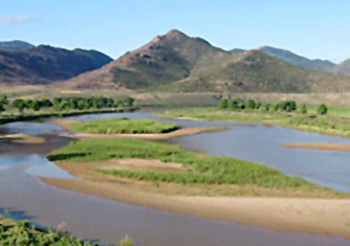 The plain also extends in a belt of about 13 to 15 kms east of Mahanadi, except between Sirpur and Kasdol where the hills are much closed. The southern part of Mahanadi plain is about 305 metres above the mean sea level whereas the northern part is about 244 metres above the mean sea level.
The plain also extends in a belt of about 13 to 15 kms east of Mahanadi, except between Sirpur and Kasdol where the hills are much closed. The southern part of Mahanadi plain is about 305 metres above the mean sea level whereas the northern part is about 244 metres above the mean sea level.Culture of Raipur District
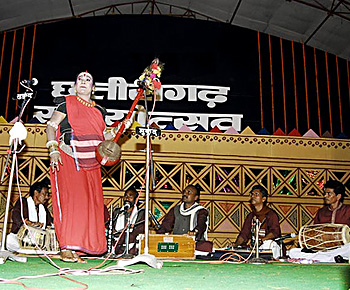 Culture of Raipur District is vibrant and unique. Chhattisgarhi is the local language that most of the people in this area uses. The culture of this district of Chhattisgarh in itself is very rich and interesting. `Baigas` (traditional medical practitioners) apply their own methods (called Jhad phook) to cure diseases and snake bites etc. However, known for their modesty, kindness and adjustable nature people of this area are fond of variety in dressing, entertainment and way of living. Culture of Raipur District has unique styles of music and dance. Raut Nacha, Dewar Nacha, Panthi and Soowa, Padki and Pandwani are some of the popular musical styles and dance dramas. Pandwani is a famous musical way of narrating Mahabharata in this region. Colourful dresses and variety of ornaments are worn by women and men of this region.
Various decorative items used by women are Baandha, Suta, Phuli, Bali and Khunti, Ainthi, Patta, Choora, Kardhani on waist, Pounchhi a ring for upper arm and Bichhiya on toes. Men also decorate themselves with Koundhi and Kadhah for occasions like dances. Gouri-Goura, Surti, Hareli, Pola and Teeja are the main festivals of this area. Celebrated in the month of `Sawan` hareli is a mark of greenery. Farmers worship farm equipments and cows on this occasion. They place branches and leaves of `Bhelwa` (a tree resembling cashew tree and found in the forests of this district) in the fields and pray for good crop. People also hang small Neem Tree branches at the main entrance of houses on this occasion to prevent occurrence of seasonal diseases.
Children play `Gedi` (walking on bamboo) from the festival of Hareli to Pola. They also participate in Gedi race. Hareli is also beginning of festivals in this region. Pola and Teeja follow Hareli. People celebrate Pola by worshipping bullocks. Bull race is also a major event of the festival. Children play with Nandia-Bail (Nandi the Vahan of Lord Shiva) idols made of clay and fitted with clay wheels. Teeja is the festival of women. All married women pray for the welfare of their husbands on this occasion. According to the customs, women perform this prayer at their parent`s place. The feeling of togetherness and social harmony is filled in every festival and art of culture of Raipur District.
Tourism in Raipur District
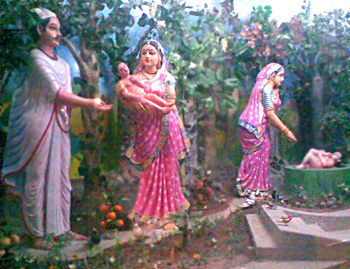 Tourism in Raipur District comprises visits to its several places of interest. This beautiful district of Chhattisgarh offers the visitors a tranquil and an enriching experience. There is no scarcity of attractive tourist spots in Raipur District. The popular places of interest of this region attract the attention of the people from various parts of the world.
Here are some of the tourism attractions of Raipur District -
Raipur: Raipur was founded by the Kalchuri King Ram Chandra in the 14th century AD. Now, Raipur is the headquarters of this district. It is centrally located in Chhattisgarh. Raipur is the biggest city of the region and a fast developing important industrial centre.
Champaran (Champajhar): The village is identified with Champaranya, the birth place of the Saint Vallabhacharya, the reformer and founder of the Vallabh Sect for whom this place has religious sanctity. A temple was constructed in honour of Guru Swamy Vallabhacharya. Near to this temple, there is the temple of Champakeshwara Mahadeva. An annual fair is held every year in the month of Magha (January - February). Birth anniversary of Vallabhacharya is celebrated every year on the eleventh bright day of Baisakh (April-May) and a large number of followers of the sect assemble here to pay homage.
Sirpur: Sirpur or Shripur the city of wealth has been mentioned in ancient epigraphic records and dates back to a periods ranging between 5th and 8th centuries AD. It was then the capital of the Sarbhapuriya and Somvanshi Kings of Dakshin Kosala or Chhattisgarh. It was an important centre of Buddhism from 6th and 10th centuries AD and was visited by Hieun Tsang, Chinese Scholar. Excavations in and around the village have yielded scores of temple sites constructed of bricks, stone pillars and sculptures such as the Shiva Temple of Panchayatan style and the beautiful sculpture of Mahishasura Mardini. Two Buddhist monasteries have also been found here.
The Laxman Temple found here is a brick temple dedicated to Lord Vishnu. The temple is the only brick temple of its size still standing in this state. Another temple is the Gandhesheshwara Temple (formerly Gandharveshvara) and is interesting because of the epigraphic records and descents of the kings of the Somvansh. The most interesting feature of the Sirpur site is the archeological pieces connected with the Saivism, Vaishnavism, Jainism and Buddhism that have been found side by side. The ruins are seen on the banks of numerous tanks existing within a radius of about 6 kms around Sirpur. A large religious fair is annually held here for three days on the beginning on Shivaratri (January / February) near the Chandheshvara Temple.
Turturiya: Village Turturiya of Raipur District is popular for its Buddhist remains of 8th century AD and the Brahmanical remains of later period. The site yielded numerous exquisitely sculptured pillars, remains of Stupa made of fine bricks, traces of bathing Ghats, Lingams figures of four armed Vishnu, Ganesha, a man hunting a lion with sword and a man wrestling with an animal. The place is of a great archaeological and anthropological interest.
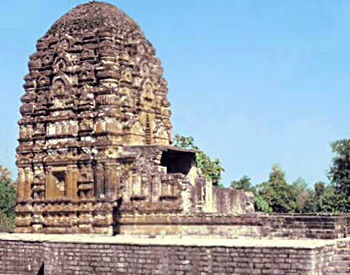 Rajim: Situated on the right bank of Mahanadi River was one of the important urban centres in the Mahakoshal region. It is famous for its fine group of temples. The main temple is dedicated to Lord Vishnu known as Rajivalochana Temple. The twelve pillars of the temple have tall single figures sculptured on the face like Goddess Durga with eight arms, Ganga River and Yamuna River and exquisitely carved incarnation of Lord Vishnu, Lord Rama, Varaha (boar) and Narasimha (Man-cum-Lion), etc. There is also a black stone statue of Lord Buddha meditating under the Bodhi Tree. There are other temples around the main temple of Rajivalochana dedicated to different incarnations of Vishnu such as Vamana Avatar, Narasimha (Man-cum-Lion), Badrinath and Jagannath. Of the ruins of numerous temples found nearby the most remarkable is that of Kuleshvara
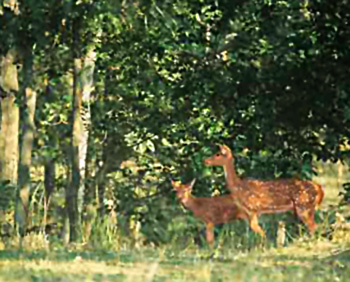
Further, Raipur District possesses three wild life sanctuaries and these are Barnawapara Sanctuary, Sita Nadi Sanctuary and Udanti Sanctuary. The sanctuaries are open throughout the year. With a varied terrain of wooded hills abounding with evergreen sal forests, precious timber procuring, natural and planted teak forests and mixed forests of higher and medium quality, the sanctuaries offer abundant opportunities of exploring a variety of wild life. The predominant species in the sanctuaries are deer and the most easily sighted are the graceful little chinkara, the Indian gazelle and spotted deer. Other species that have their habitat in the sanctuaries are Sambar, Kotri, barking deer, four horned antelope, sloth bear, wild boar, wild dog, jackal, wolf, hyena and bison. Tiger and leopards/panthers can also be spotted in the sanctuaries, but they are certainly in limited numbers. The sanctuary`s fauna includes peacock, jungle fowl, pigeon, green pigeon, quail, gray-partridge, parrot, stork etc. Artificial water holes have been developed in the area to attract migratory birds which are good sites for bird-watchers in winter and for general tourists in summer.
The other tourism attractions of Raipur District are Radha Krishna Temple, Chandi Temple, Ram Temple, Swastik Vihar Monastery and Anand Premkuti Vihar (Monastery). The visitors can have a complete rejuvenating experience in this district.
Recently updated articles in States of India
Bandare Waterfalls, Meghalaya
Bandare Waterfalls in South Garo Hills, Meghalaya, is a secluded natural attraction surrounded by dense subtropical forests and rugged mountain terrai...
History of Thissur District
Early History of Thissur District explains flourishing of the port cities. Now these port cities are transformed into archaeological sites.
Tippi Orchid Research Centre, Arunachal Pradesh
Tippi Orchid Research Centre in Arunachal Pradesh is renowned for its rich collection of exotic and endangered orchids. Surrounded by lush rainforest...
Tourism in Nashik District
Pilgrimage tourism in Nashik district involves visiting the various places of Hindu and Jain worship located here. Some of the holiest sites for Hind...
Mangadu, Kerala
Mangadu in Kerala’s Kollam district is a significant megalithic site known for its urn burials, cist burials, menhirs, and stone circles. Excavations...
Related articles in States of India
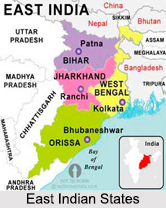
East Indian States
East Indian States comprises of Bihar, Jharkhand, West Bengal, Odisha and also the Union Territory of Andaman and Nicobar Islands. It defines the cult...
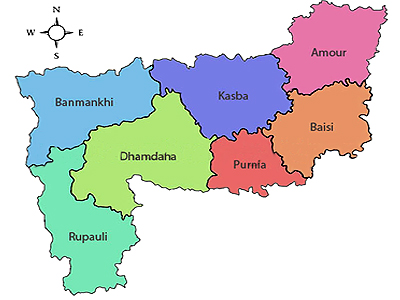
Purnia District in Bihar
Purnia District is located in Bihar and extends from River Ganga to Nepal. The district has a rich Hindu history and glorious past.
Hooghly district
Hooghly District along the bank of the river Hooghly is one of the principal trading ports of West Bengal.
Geography Of Chittoor District
Geography of Chittoor district is spread along the topography of the land which is divided into two natural divisions; Chittoor has a dry and healthy...
Districts of West Bihar
Districts of West Bihar is comprised of medieval monuments that were built by the different governors of Mughal era.