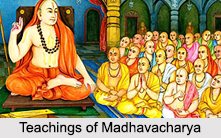
 Teachings of Madhavacharya describes that one should have a firm belief in the "Panchabheda" or the five real distinctions. The school of theology that was founded is known as the "Dvaita School". It is known as Tattva Vada or the doctrine of categories. His Tattva Vada philosophy eventually inspired the Haridasa cult who heralded the Bhakti movement.
Principles of Madhavacharya
According to Dvaita view, reality consists of only two major principles: the independent and the dependent. The independent reality is God. Others like soul (Jiva), matter (Prakriti), time (kala) and action (karma) are dependent realities. These dependent realities are eternal and distinct in their own right exist through the consent and sanction of God.
According to Madhavacharya, reality constitutes three basic categories (tattvas): God, soul (jiva) and matter (prakriti). These three are real and distinct. Two orders of reality, independent and the dependent and the real differences that exist between the various categories of reality are the trademarks of Madhva"s Dvaita.
Madhavacharya describes five basic differences:
i. Difference between soul and God
ii. Difference between matter and God
iii. Difference between one soul and another
iv. Difference between matter and soul and finally
v. Difference between one element of matter and another
Another notable feature of his theology is his three classifications of souls. According to Madhavacharya, there are endless numbers of souls that can be divided into three groups.
A gist of his teachings is given below:
•The soul is bound in samsara and experiences sorrow due to ignorance
•One can escape from sorrows if they receive the grace of Lord Vishnu. One should strive to earn Lord Vishnu`s grace.
•The major cause of liberation is Lord Vishnu`s grace. Vishnu will be pleased by Bhakti only.
•Bhakti is incessant flow of love that supersedes all other objects and which does not retreat in spite of several obstacles. It is coupled with the knowledge that Lord Vishnu possesses unrestrained, endless, blemish less and auspicious attributes.
•Bhakti will not develop until Lord Vishnu is seen
•Lord Vishnu is obscure by nature, can`t be seen by any means except through his blessings.
•Meditation is possible only if one undertakes a self-study of the textual instructions received.
Madhvacharya is said to have mysteriously disappeared from his seat, while teaching the Attareya Upanishad to his disciples.