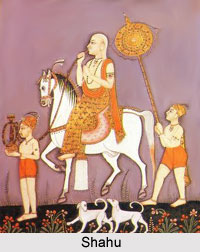
 Aurangzeb`s death in 1707 definitely made the situation conducive for Maratha prosperity and unity, but certain circumstances warded off the desired development. Azam or Bahadur Shah released the grandson of Shivaji and son of Shambhuji, Shahu in 1707, complying to the recommendation of Zulfikar Khan. The malicious psychology of Zulfikar Khan could foresee that Shahu`s return to his own land would invoke an uproar among the other claimants to the Maratha throne. This will suspend the Maratha insurgence from aggravating into the worst. Events rolled in the manner , that the Mughals had coveted. Shahu`s demand of the throne was seriously resented by the Tarabai, who had decided to abdicate her son for succession. This culminated into an upsetting civil war between the relatives. Shahu marched his way to the throne , directed by the advice and aid of the Chitpavan Brahmana from Konkan , called Balaji Vishwanath.
Balaji who had worked in the office of Dhanaji Jadav and his son, Chandra Sena Jadav, joined Shahu`s team as a the "Senapati" or the commander -in -chief . Balaji`s expertise demonstrated in the field of civil government and military organization , won him the elevated promotion to the dignified position of the "Peshwa" or Prime Minister on November,1713. Gradually with time the "Chhatrapati" or the King lost his aura of utmost importance as the head of the state. Rather it was the Peshwa Balaji Vishwanath , and his deserving successor, Baji Rao, who cast a halo of pre-eminence round them to signify the gravity of their status. They appeared as the actual head of the Maratha Confederacy.
Shahu , however with the help of the Peshwas, assembled the dispersed Marathas into the solidified synthesis of an integrated kingdom. He took abundant advantage of the internal conflict in the Mughal Empire. The influential Sayyid brothers of the Mughal aristrocracy, voted for the yearning of the opponent Farrukhsiyar to seat on the throne. They perpetrated against the sovereignty of the Mughal Emperor, Bahadur Shah. One of the brothers, Sayyid Hussain Ali came down to the Deccan to win over the Maratha support. Hussain Ali entered into a significant aggreement with the Maratha Confederacy in 1714. It promised the Marathas the handover of the territorial acquisitions , they had lost to Mughal invasion in the past. They would also be privileged by the additional procurements of Khandesh, Gondwana and Berar. Shahu would even obtain the ransom tax-payment of "Chauth" and "Sardeshmukh" from the six "Subhas" in the Deccan zone. In exchange , Shahu was urged to preserve 15,000 horses for imperial service, to offer a tribute of 10 Lac rupees, and to maintain peace and order in the Deccan. Shahu immediately accepted the conditions written in the beneficial treaty, although it implied the compromise of bowing down to the Mughal royalty.
The Sayyids assigned power to Farrukhsiyar ,and later displaced him according to their will. The next puppet ruler conceded to the Sayyid`s wish of affirming the Mughal-Maratha alliance. The advance of the Marathas to Delhi was a landmark of Maratha History.
This attainment of honour and prestige as the imperial allies, paved the path of Balaji Vishwanath`s dream of escalation to the pinnacle of lordship.