
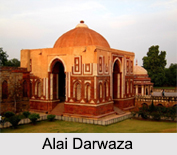
 The southern gateway of the Quwwatu`l-Islam mosque is known as the Ala-i-Darwaza. Quwwatu`l-Islam mosque is situated just next to the Qutub Minar in Delhi. Alai Darwaza was constructed by the second Khalji Sultan of Delhi Ala-ud-Din Khalji in 1311 A.D. Alai Darwaza of Delhi is the first building employing the perfect Islamic architecture on it.
Alai Darwaza
Alai Darwaza is the main gateway of the Quwwatu`l-Islam mosque from the southern side; Quwwatu`l-Islam mosque stands next to the Qutub Minar.
Introduction
The southern gateway of the Quwwatu`l-Islam mosque is known as the Ala-i-Darwaza. Quwwatu`l-Islam mosque is situated just next to the Qutub Minar in Delhi. Alai Darwaza was constructed by the second Khalji Sultan of Delhi Ala-ud-Din Khalji in 1311 A.D. Alai Darwaza of Delhi is the first building employing the perfect Islamic architecture on it.Architecture of Alai Darwaza
Alai Darwaza is decorated with red sandstone and white marble with Naskh inscriptions and latticed stone screens on it. The architecture of Alai Darwaza showcases the Turkish craftsmanship. It is surmounted by a wide but shallow dome on an octagonal base achieved through squinches with concentric series of arches. The underside of the arches is fringed with lotus-bud embellishment, not merely in the openings, but also in the perforated side-windows. Alai Darwaza is considered to be the true example of perfect arches and domes of India.
Sculpture of Alai Darwaza
The sculpture of Alai Darwaza was commissioned by Ala-ud-Din. The architecture of Alai Darwaza was completely different from its predecessors. In fact this kind of architecture was unknown in India before.
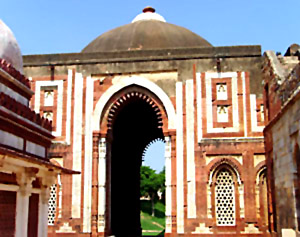 One of the noted features of Alai Darwaza, a gateway, is its system of walling. There are two courses of stretchers that appear alternatively on the walls. While one end of the longer stone laid portion faces outwards, the other penetrates deep into the wall. The walling penetrated into rubble core and this made it stronger. Such method of walling was followed in the later years as well and became a popular feature of Mughal architecture.
The second important feature was the arch. This architectural element is also to be found in the later era in most of the Sultanate tombs. As far as the structure of the Alai Darwaza is concerned it is a rectangular building that is built on a high plinth. Steps have been cut into plinth to reach the interior. The plinth has been carved in bands and the surface of the wall has been divided into two stories. Each story is, in turn, further divided into rectangular panels. There are recessed arches on the lower panels but the upper panels are merely square shaped. Mixtures of sandstone, marble arabesque and decorative carvings have been used to decorate the Alai Darwaza.
The most interesting feature of Alai Darwaza is its central arch. The colossal height of this arch is nearly as much as the monument itself. It is in a rare shape of a horse-shoe. It can also be termed as a keel arch. Inscriptions on white marble have been etched out on its outer rim. On the pother hand the inner rim displays a beautiful sculpture of lotus-bud. The inner facade that faces the mosque and Qutab Minar is completely different. Te sensual and plastic sculptures have been widely used here.
The interior sculpture of Alai Darwaza is as splendid as its outer designs. The huge dome was transferred to its position with the help of a squinch. In that era this was an innovation in the field of the technology. The sculpture of Alai Darwaza thus brings forth both the artistry and the technical aptitude of its contemporary era.
One of the noted features of Alai Darwaza, a gateway, is its system of walling. There are two courses of stretchers that appear alternatively on the walls. While one end of the longer stone laid portion faces outwards, the other penetrates deep into the wall. The walling penetrated into rubble core and this made it stronger. Such method of walling was followed in the later years as well and became a popular feature of Mughal architecture.
The second important feature was the arch. This architectural element is also to be found in the later era in most of the Sultanate tombs. As far as the structure of the Alai Darwaza is concerned it is a rectangular building that is built on a high plinth. Steps have been cut into plinth to reach the interior. The plinth has been carved in bands and the surface of the wall has been divided into two stories. Each story is, in turn, further divided into rectangular panels. There are recessed arches on the lower panels but the upper panels are merely square shaped. Mixtures of sandstone, marble arabesque and decorative carvings have been used to decorate the Alai Darwaza.
The most interesting feature of Alai Darwaza is its central arch. The colossal height of this arch is nearly as much as the monument itself. It is in a rare shape of a horse-shoe. It can also be termed as a keel arch. Inscriptions on white marble have been etched out on its outer rim. On the pother hand the inner rim displays a beautiful sculpture of lotus-bud. The inner facade that faces the mosque and Qutab Minar is completely different. Te sensual and plastic sculptures have been widely used here.
The interior sculpture of Alai Darwaza is as splendid as its outer designs. The huge dome was transferred to its position with the help of a squinch. In that era this was an innovation in the field of the technology. The sculpture of Alai Darwaza thus brings forth both the artistry and the technical aptitude of its contemporary era.
Visiting Information on Alai Darwaza
To visit the Alai Darwaza, people have to come to Qutub Minar, which can be reached from anywhere from the city of Delhi. Indira Gandhi International Airport and New Delhi railway station connect this city to other parts of India.
Recently updated articles in Indian Monuments
Badshahpur Fort
Badshahpur Fort is a historic defensive structure reflecting the architectural traditions of its era. Built with granite and red sandstone, the fort w...
Sitabenga and Jogimara Caves
Sitabenga and Jogimara Caves in Chhattisgarh are ancient rock-cut monuments dating to the early historic period. Known for their Brahmi inscriptions,...
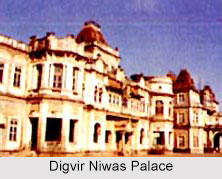
Digvir Niwas Palace
Digvir Niwas Palace in Vansda, Gujarat is one of the popular heritage buildings that reflect the majestic architecture of the early 20th century.
Historical Monuments of Satara
Among the historical monuments of Satara the fort at Satara is the most famous. Most of the constructions here belong to the Marathas.
Architecture Of Bihar
Architecture of Bihar consists of Buddhist and Mughal style of architecture.
Related articles in Indian Monuments
Monuments of Lakshwadeep
Monuments of Lakshwadeep are famous for their ancient religious feel and historical value.
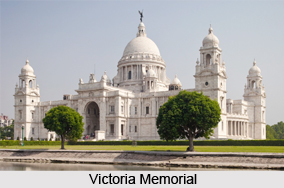
Monuments of West Bengal
Monuments of West Bengal, mainly from the British era, are considered as priceless heritage of the state and attracts many tourists to the state.
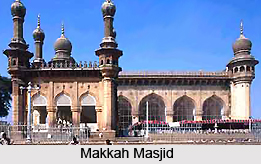
Monuments of Telangana
Monuments of Telangana covers the ancient, medieval and modern historical structures illustrating the architectural grandeur and attracting thousands...
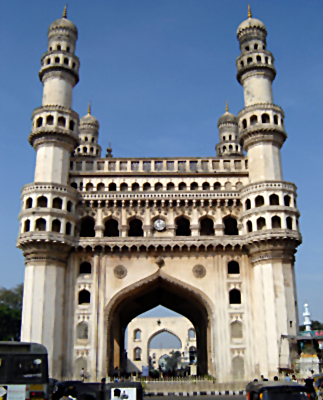
Architecture Of Andhra Pradesh
Architecture of Andhra Pradesh is an illustration of diverse types of Hindu, Buddhist and Islamic architectural styles.
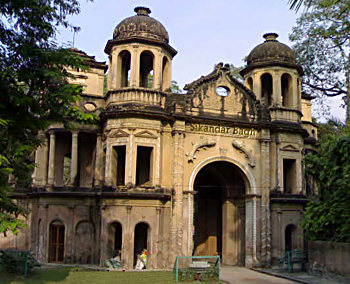
Architecture of Lucknow
Architecture of Lucknow is mostly Islamic in nature. It is representative of 18th and 19th century Indian architecture. The architecture is broadly di...