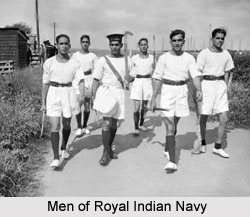
The development of Royal Indian Navy commenced from its inception as an Armed Force of the
British East India Company in the year 1612. The Royal Indian Navy was the naval force of the British
government of India. The Royal
Indian Navy (RIN) was amongst the major Armed Forces of the
British Empire in India, along with the Presidency armies, the British
Indian Army and the
Indian Air Force from the year 1932. The Royal Indian Navy was established as the Marine of the British East India Company, which was formed in the year 1599 and it created a fleet of combating ships in 1612, after the Portuguese were defeated at the Battle of Swally by Captain Thomas Best. As a result the British constructed a port and established a small naval base at Suvali near Surat in Gujarat, in order to protect the various trade routes. The force was named as Honourable East India Company`s Marine by the British East India Company. On 5th September 1612, the first combating ships arrived at the port. The Honourable East India Company`s Marine protected merchant shipping in the
Narmada and
Tapti rivers and off the Gulf of Cambay. The marine fleet also helped map the coastlines of India, Arabia and Persia.
Later in 1686, as most of British commerce shifted to Bombay (now
Mumbai), the navy was renamed as the Bombay Marine. The Navy fought against the Maratha forces and the Sidis and also participated in the Anglo Burmese Wars. This force extensively recruited sailors of Indian origin but contained no Indian commissioned officers. Commodore William James became the Commanding Officer of the Navy in the year 1751. He commanded the Bombay Marine Ship Protector and on 2nd April 1755, he attacked the Tulaji Angre fortress of the Maratha, located at Severndroog between Goa and Bombay. The Honourable East India Company`s Marine supported the capture of Gheriah in February 1756. It was captured by Admiral Watson and
Robert Clive. The Marine also participated in combats against the French, aiding to strengthen the position of the British Empire in India.
In the year 1830, the Bombay Marine was renamed as the Indian Navy. The capture of Aden by the British improved its commitments, which led to the formation of the Indus Flotilla. The Indian Navy also participated in the First Opium War in the year 1840. During the commencement of the Second Anglo Burmese War in 1852, ships of Indian Navy were included in a Royal Navy force under the command of Admiral Charles Austen in order to assist General Godwin for the capture of Rangoon and Martaban. After the culmination of the rule of the British East India Company in India as a consequence of the
Sepoy Mutiny in 1857, the Navy came under the administrative control of the British government of India. It was again formally renamed as Her Majesty`s Indian Navy.
From 1863 to 1877, Her Majesty`s Indian Navy recommenced the name Bombay Marine, after which it was renamed as Her Majesty`s Indian Marine (HMIM). At that time, the Royal Indian Navy comprised of 2 distict divisions, a Western Division at Bombay and an Eastern Division at Calcutta (now
Kolkata). Her Majesty`s Indian Marine was bestowed the name of Royal Indian Marine in the year 1892, in recognition of its combating services. The Navy included 50 vessels at this time.
After the detection of mines off the coasts of Bombay during World War I, the Royal Indian Marine went with a fleet of minesweepers, patrol vessels and troop carriers. Further more, the Navy the Marine ferried troops and carried stores to East Africa, Egypt and Mesopotamia from India. Engineer Sub-Lieutenant D. N. Mukherjee became the first Indian who was granted a commission. He had joined the Royal Indian Marine as an officer on 6 January 1923.
In the year 1934, the Royal Indian Marine changed its name, with the enactment of the Indian Navy (Discipline) Act of 1934. On 2 October, 1934, the Royal Indian Navy was officially inaugurated at Bombay. The ships contained the prefix HMIS, for His Majesty`s Indian Ship. During the beginning of World War II, the Royal Indian Navy was rather small in strength and consisted of only 8 warships. The inception of the war led to massive expansion in vessels and personnel. The Women`s Royal Indian Naval Service was also formed during the War, which provided women a role in the navy. The sloops HMIS Jumna and HMIS Sutlej also played a key role in Operation Husky, the Allied invasion of Sicily.
In February 1946, several native sailors initiated the Royal Indian Navy Mutiny on board more than 50 ships, as well as in shore establishments. It aimed to protest against the supposed discrimination against Indian sailors and officers by the British authorities during the war.
After the Indian independence, the Royal Indian Navy was divided between the newly formed
Union of India and Dominion of Pakistan.

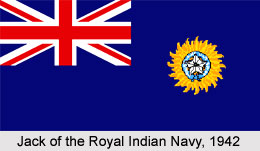 The Royal Indian Navy was the naval force of the British government of India. The Royal Indian Navy (RIN) was amongst the Armed Forces of the British Empire in India, along with the Presidency armies, the British Indian Army and the Indian Air Force from the year 1932. The Royal Indian Navy was established as the Marine of the British East India Company in the year 1612. The Navy gradually experienced several changes and developed to a great extent. The name was also changed a few times, such as the Bombay Marine, Her Majesty`s Indian Marine, Her Majesty`s Indian Navy and the Royal Indian Marine. Finally in the year 1934, it was renamed as the Royal Indian Navy. But until advent of World War II, the Royal Indian Navy remained a relatively small force, but later it expanded to a great extent.
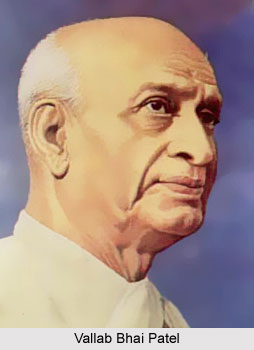 The Royal Indian Navy Mutiny or the Bombay Mutiny was the revolt of the Indian sailors. The sailors who belonged to the Royal Indian Navy on board ship and shore establishments at Bombay harbour went for a strike and organised a mutiny on 18th February 1946. The whole mutiny involved 78 ships, 20 shore establishments and 20,000 sailors. This revolt subsequently came to be known as the RIN revolt. It started as a protest against their general conditions.