
According to Vishnu Purana, Pushpagiri is said to be the mountain of flowers. Pushpagiri is the residence of Varuna. Varuna was the god of the sky, of rain and of the celestial ocean, as well as a god of law and of the underworld.
Pushpagiri
Pushpagiri is said to the mountain of flowers and the residence of Varuna.
Introduction
Pushpagiri Wildlife Sanctuary
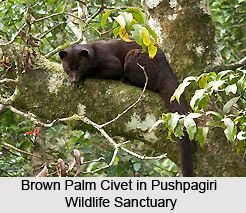 Pushpagiri Wildlife Sanctuary is located in Somwarpet taluk of Kodagu district in Karnataka. It is one of 21 Wildlife Sanctuaries of India`s Karnataka state. Pushpagiri Wildlife Sanctuary is spread over 102 sq km. It is situated in the Western Ghats and is bounded by thick evergreen and semi-evergreen forests. The shola grassland has their habitat in the higher areas.
The altitude of the sanctuary varies from 160 to 1712 m, the highest point being the Pushpagiri Peak in the north of the sanctuary. The Kumaraparvatha is the other peak that lies within it. The sanctuary adjoins Bisle reserve forest to north and Kukke Subramanya forest range to the west. The sanctuary is home to rare and endangered birdlife and is designated as one of the important bird areas of the world.
Flora and Fauna of Pushpagiri Wildlife Sanctuary
The Pushpagiri Wildlife Sanctuary houses a variety of animals and birds species. Indian Wild Dog, Brown Palm Civet, Indian Giant Squirrel, Indian Hare, Spotted Deer, Sambar, Indian Muntjac, Gaur, Asian Elephant, Wild Pig, Giant Flying Squirrel, Travancore Flying, Otter species, Stripe-necked mongoose and mouse deer are some of the animal species found here. The sanctuary is also rich in vegetation. Albizia lebbeck, Artocarpus lakoocha, Dysoxylum malabaricum and Mesua ferrea` are some of the species of flora found here. The Pushpagiri Wildlife Sancutuary has been proposed as a World Heritage Site.
Excavations in Pushpagiri
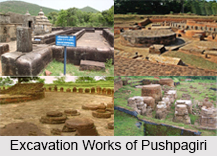 Excavations in Pushpagiri include the works of Harish Chandra Prusty, who discovered his Buddhist sites and definitely became the pride of Odisha.
It was 1990, a college lecturer Harish Chandra Prusty discovered a Buddhist site on the Langudi Hill in Jajpur district. This place is known as Pushpagiri. In 1993, Harish Chandra Prusty and Pradeep Mohanty described the site in an article published in the Bulletin of the Deccan College Research Institute. In 1996, the Orissa Institute of Maritime and South East Asia Studies and the Archaeology department of the Government of Odisha started exploring the site of Puphagiri. Between 1996 and 2006, the Institute carried out excavations of an area stretching over 143 acres.
Inscriptions found from Pushpagiri
A fragmented Brahmi inscription discovered at the site names the site as Pushpagiri, identified by the excavators as Pushpagiri. In 2000, an excavation conducted by the Institute, under the supervision of archaeologist Debraj Pradhan, resulted in the discovery of a large stupa as well as several other archaeological artefacts. The artefacts included pillars, a fragmentary Brahmi inscription, terracotta seals and Northern Black Polished Ware. Debraj Pradhan believed the stupa to have been erected by the Mauryan emperor Ashoka (304-232 BCE). Although Chinese traveller Hiuen Tsang suggests that Odra had 10 stupas erected by Emperor Ashoka, this is the only one to have been discovered so far. According to B. N. Mukherjee of Calcutta University, who deciphered the Brahmi inscription, the stupa may have been erected by "a lay Buddhist worshipper called Ashoka".
Rock Cut Stupas of Pushpagiri
There are 34 rock-cut stupas discovered in 2007. These stupas are of various sizes had been discovered on the northern part of the hill. A number of Buddhist rock-cut sculptures were discovered on the southern spur of the hill, including sculptures of Dhyani Buddhas in various postures. According to D. K. Dimri, the superintendent of the ASI`s Orissa circle, the archaeological finds at the site cover a period between 1st century CE and 9th century CE, and suggest the existence of a major Buddhist monastic establishment. In 2007, the Archaeological Survey of India took over the excavated site of Pushpagiri.
Pushpagiri College of Dental Sciences
Pushpagiri College of Dental Sciences is one of the most developing medical institutions in Kerala. The college started its journey in the year 2006, with an annual admission capacity of 50 students. The college is recognised by the Department of Health & Family Welfare, Government of India, through the Dental Council of India (DCI). The College is currently affiliated to the Mahatma Gandhi University, Kottayam, Kerala. The college is being run and managed by the Pushpagiri Medical Society and it is situated in the district of Pathanamthitta in Kerala.
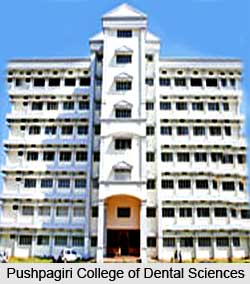 The Pushpagiri Medical Society is a society registered under the Travancore-Cochin Literary Scientific & Charitable Societies Registration Act of 1955. The society established the Dental College with a view to offer dental education to the students of the state and also to provide quality dental treatment to the people of Kerala. Apart from the Pushpagiri College of Dental Sciences (PCDS), Pathanamthitta, there are some other medical institutions that are being run and managed by the Pushpagiri Medical Society. These institutions include the Pushpagiri College of Medicine, the Pushpagiri College of Pharmacy, the Pushpagiri College of Nursing, and the Pushpagiri School of Nursing etc.
There are a large number of courses being offered in the medical institutions under the Pushpagiri Medical Society and the course include the medical science courses like MBBS, DNB in General Medicine, General Surgery, Paediatrics, Radio-diagnosis, Orthopaedics; the Pharmacy course of B.Pharm, the Nursing course of B.Sc Nursing etc. The Pushpagiri College of Dental Sciences (PCDS), Pathanamthitta mainly offers the undergraduate course of BDS. The college admits a total of 100 students in the course, every year. The course has been approved by the Dental Council of India (DCI) and is affiliated to the Mahatma Gandhi University, Kottayam, Kerala. For getting admitted in the BDS course, the candidates are required to have passed the 10+2 examination with a 50% aggregate of marks.
The Pushpagiri College of Dental Sciences (PCDS), Pathanamthitta has a large number of departments that help the college in providing dental education to the students. The departments also help in providing quality treatment to the people of the state. Some of the major departments of the college include the department of Oral Medicine and Radio-Diagnosis, Oral & Maxillofacial Pathology & Microbiology, Oral and Maxillofacial Surgery, Conservative and Endodontics, Periodontics, Orthodontics & Dentofacial Orthopedics, Prosthodontics, Pedodontics & Preventive Dentistry, Department Of Prosthodontics and Crown, Bridge & Implantology and the department of Preventive & Community Dentistry.
The Pushpagiri Medical Society is a society registered under the Travancore-Cochin Literary Scientific & Charitable Societies Registration Act of 1955. The society established the Dental College with a view to offer dental education to the students of the state and also to provide quality dental treatment to the people of Kerala. Apart from the Pushpagiri College of Dental Sciences (PCDS), Pathanamthitta, there are some other medical institutions that are being run and managed by the Pushpagiri Medical Society. These institutions include the Pushpagiri College of Medicine, the Pushpagiri College of Pharmacy, the Pushpagiri College of Nursing, and the Pushpagiri School of Nursing etc.
There are a large number of courses being offered in the medical institutions under the Pushpagiri Medical Society and the course include the medical science courses like MBBS, DNB in General Medicine, General Surgery, Paediatrics, Radio-diagnosis, Orthopaedics; the Pharmacy course of B.Pharm, the Nursing course of B.Sc Nursing etc. The Pushpagiri College of Dental Sciences (PCDS), Pathanamthitta mainly offers the undergraduate course of BDS. The college admits a total of 100 students in the course, every year. The course has been approved by the Dental Council of India (DCI) and is affiliated to the Mahatma Gandhi University, Kottayam, Kerala. For getting admitted in the BDS course, the candidates are required to have passed the 10+2 examination with a 50% aggregate of marks.
The Pushpagiri College of Dental Sciences (PCDS), Pathanamthitta has a large number of departments that help the college in providing dental education to the students. The departments also help in providing quality treatment to the people of the state. Some of the major departments of the college include the department of Oral Medicine and Radio-Diagnosis, Oral & Maxillofacial Pathology & Microbiology, Oral and Maxillofacial Surgery, Conservative and Endodontics, Periodontics, Orthodontics & Dentofacial Orthopedics, Prosthodontics, Pedodontics & Preventive Dentistry, Department Of Prosthodontics and Crown, Bridge & Implantology and the department of Preventive & Community Dentistry.
Recently updated articles in Indian Puranas
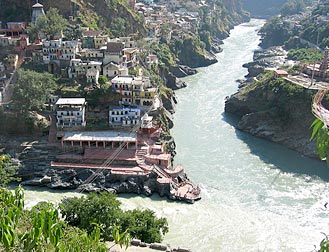
Mandakini, Holy River
Mandakini River is a significant Himalayan river in Uttarakhand, renowned for its ecological, cultural, and religious importance. Originating near the...
Kausika, Son of Vasudeva
Kausika is a minor figure in Hindu mythology and is identified in the Vishnu Purana as the only son of Vasudeva and his wife Vaishali. He is recognize...
Tandu, Attendant of Lord Shiva
Tandu is revered as the divine attendant of Lord Shiva and the foremost exponent of the Tandava dance. According to the Natya Shastra, he instructed S...
Niramitra, Mahabharata
Niramitra was a son of Nakula and Kareṇumati in the Mahabharata. A descendant of the Pandavas and the Kuru dynasty, he fought on the Pandava side duri...
Mahodara, Ramayana
Mahodara was a prominent Rakshasa warrior, minister, and army chief who served under Rāvaṇa during the Battle of Lanka in the Ramayana. Celebrated for...
Related articles in Indian Puranas

Adhyayas in Agni Purana
Adhyayas in Agni Purana are all encompassing. The chapters have dealt with a variety of subjects related to human lives. A large number of chapters ha...
Indian Puranic Tribes
The existence of Indian Puranic tribes is often mixed with mythology and fiction that depict them as superhuman or sub.

Puranic Texts
Puranic Texts are vital according to Hindu, Jain or Buddhist religion; they describe the history of the Universe.

Puranic Shaivism
Puranic Shaivism established during the Gupta Dynasty. This puranic religion developed and expanded, and was accompanied by the development of Brahman...

Nilamata Purana
Nilamata Purana is a Kashmiri Purana that is referred by Kalhana. It is considered as one of the sources of ancient history of Kashmir.