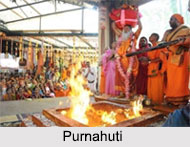
 Purnahuti ceremony offers the significance of "ahuti" to an individual"s life. It means, "Absolute offering away of oneself". The word "purna" means filled or complete, as perfect as God. It includes the offering of nine types of grains and ghee into the fire while chanting specified mantras. As per the Vedas, these mantras have the power of creating special vibrations, which creates a divine atmosphere around to fulfil one"s wish.
Rituals of Purnahuti
The "ahuti" to be used in "Purnahuti" is mixed and offered to the fire by everyone present in the ceremony. The priest of the ceremony recites the particular mantra and says "Swaaha", which means, "we offer". Everybody chant "Swaaha" in harmony and offers the oblation. The giving of "ahuti" in the "Agni Kunda" symbolises putting of one"s abilities into a field of activity in a spirit of dedication.
If the "ahuti" is given in the right spirit, then the higher power will definitely bless by providing success in the attempted work. The "Purnahuti" is symbolised by the final "ahuti", which comprises dry coconut, nine grains, five metals such as Silver, Gold, Copper, Zinc and Brass, betel leaves, betel nuts, dry fruits, medicinal herbs, sandal wood sticks, saffron and other offerings up in a silk cloth. The colour of the cloth depends on the type of "Havan". For example, in "Gayatri Havans", "Sudarshana Havans" and "Durga Havans" red colour is used and for "Vidya Havan" and "Kubera Homa", the white colour is used. All the above-mentioned offerings are drenched in ghee, while Vedic mantras are chanted and then offered to the "Havan Kunda". This marks the end of the "Purnahuti" ceremony.
Purnahuti Shloka
The people present in the ceremony should surrender themselves to the divine will. The "Purnahuti Shloka" is sung at the end of any "ghar sabha" and "satsang meeting". The meaning of this “Purnahuti Shloka†is;
"I offer worship to Bhagwan Swaminarayan, also known as Nilkanth Varni. As Shrihari, together with Aksharbrahma, He is glorious. He is the God of all gods, the son of Bhakti and Dharma and has the supreme divine form".
This article is a stub. You can enrich by adding more information to it. Send your Write Up to content@indianetzone.com.