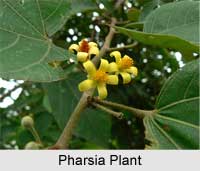
 Pharsia is common in the open grasslands from the sub-Himalayan tract from Kumaon eastwards to Myanmar (Burma) and southwards through the peninsular India. The Pharsia plant is usually seen growing in the scrub forests and village thickets. The Pharsia belongs to the family of "Tiliaceae".
Different Names of Pharsia
Pharsia is a small deciduous shrub and its botanical name is "Grewia Scabrophylla Roxb". It is also known as "Bankajana" in Telugu language. This shrub is called "Khatkhati" and "Pandharidhaman" in Marathi language; in Tamil language it is called "Kattuk-kadali" and "Punaippidukkan" and in Kannada language it is known as "Darsuk" and "Kadukadele". Pharsia is also known as "Padekhado" in Gujarati language and in Bengali language it is called "Phalsa".
Characteristic Features of Pharsia
Pharsia is a small-sized deciduous shrub with a woody rootstock about 0.6 to 1.5 m tall with branches arising from the base and the young parts are rough, stellate tomentose. The leaves of this shrub are broadly elliptic or sub-orbicular, sometimes slightly lobed, about 8 to 10 cm long and 7.5 to 15 cm wide, margins irregularly serrate, the larger teeth glandular-tipped, apex shortly acuminate, base normally oblique, cuneate, rounded or slightly cordate, 3 to 5 nerved, scabrid above, densely stellate-pubescent and usually white or greyish beneath. Petiole is 0.5 to 1.5 cm long, very stout, generally with several pairs of large glands near the top and on the leaf margin; stipules linear. The flowers are white, 2.5 cm in diameter, 2 to 3 flowers are seen together on each peduncle, axillary; peduncles are 1 to 4 together, 1.2 cm long, tomentose; sepals pubescent, yellowish inside. The edible fruits are globose, crustaceous, 1.7-2.5 cm in diameter, depressed at the top, 2 lobed, slightly hairy, purple or brown when ripe, 4 seeded. Flowering season is mainly in the months of July and August and fruits in the month of October and November in central Indian deciduous forest regions.
Medicinal Values of Pharsia
The root of this shrub is prescribed for cough and to treat irritable conditions of the intestines and bladder. Its decoction is used as an emollient enema and as a remedy for leprosy. Extract of aerial parts possesses anti-cancer properties.