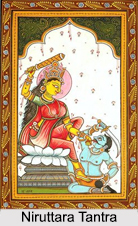
 Niruttara Tantra is a short work of fifteen chapters that belongs to the Kula tradition and has been written in simple Sanskrit language. This composition of Tantra has a liberal outlook regarding women"s lifestyle and sexual freedom, a life far less ruled and regulated than Indian society would normally permit.
Origin of Niruttara Tantra
The word "Niruttara" means "having no better". However the exact date of composition is unknown. Most of the Kula-works originated during the 9th to 12th century.
Contents of Niruttara Tantra
The life described is less ruled and regulated than Indian society would normally allow. The woman is depicted as roaming about freely and enjoying themselves like Goddess Kali does. Here the seven different types of "Veshya" or ritual prostitutes who are at times employed as participants in sexual rituals have been described. Several rituals like "Mahachakra" and "Rajachakra" have been vividly given in details. The woman is also given the same sexual freedom as given to male devotees.
The text openly says that a woman has no fault in being united with a person other than her husband. It also says that young girls depending on a social context practice sexual union.
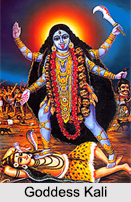 The text states that a woman who practices Kularcana should choose Lord Shiva as her husband. Young woman are associated with several powerful goddesses. For example; a girl of age of twelve is Bhairavi, age thirteen is Unmukhi, age fourteen is Sodasi, age fifteen is Tara and age sixteen is Kali.
Chapters in Niruttara Tantra
The text contains various modes of worship that have been directed towards several goddesses. The main focus is on Kali, the great "Black Mother of Time, Life, Sexuality and Death".
•The 1st chapter deals with three temperaments of a tantric.
•The 2nd chapter deals with Dakshini Kali, her mantra and the preparatory acts.
•Chapter 3 speaks of armour of Dakshina Kali.
•In the 4th chapter Purascharana is dealt in detail.
•Chapter 5 speaks of Rajani or the dark female.
•Chapter 6 speaks of the Siddhi which results from worship of the Rajani.
•Chapter 7 deals with different types of Abhisheka.
•Chapter 8 starts with the speech of Shiva regarding arghya and Purascharana.
•Chapter 9 is regarding the mantras.
•The 10th chapter speaks about the different chakras in the Kula tradition, here meaning assemblies of the Kaula folk.
•In chapter 11 speaks about the Sadhana of the yoni.
•These are dealt in more detailed manner in chapter 12.
•In chapter 13, the female mantras have been described.
•Chapter 14 opens with Devi asking Shiva about the Veshyas.
•The 15th chapter deals with the "Panchamakara" or the "Five M"s".