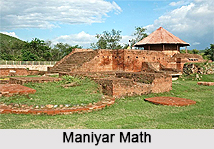
 Maniyar Math occupies a prominent position inside the valley of Rajgir. Situated almost in the centre of the enclosure of the inner city on the way to the Sone Bhandar caves, there is this cylindrical well-like structure of archaeological importance. It is situated 1km from the Warm Water Spring. This well is covered by a small temple of the Jains. It is not dedicated to a Jain Tirthankara but to Naga Salibhadra who is said amongst the Jains buried his treasure inside the well. Jains offer their worship at this place to the presiding deity.
History of Maniyar Math
Maniyar Math is also called the "Nirman Koop" of Queen Chelanna and Sheelbhadra in Jain literature. Ajatshatru"s mother Chelanna was the princess of Videh (Vaishali). Maniyar Math is also believed to be the place of Yagna of Buddhist era. It is constructed of cylindrical bricks. It is an amazing example of art of Gupta period (320 - 550 AD). This place was built in the memory of Naga Salibhadra. It is said that he got his treasure buried in this well. In 1861-62, General Cunningham got this place excavated. In the excavation, many statues were found at the depth of 19 feet. Historians believe that these statues were of the period from 1st - 6th Century AD. Pali Scripture, "Sanyukta Nikay" has it described as "Manimaal-Chaitya", where Lord Buddha had a dialogue with Manibhadra Yaksha.
Indian Puran, "Mahabharata" has the description of Rajgir as the "Holy residence of Mani Naga". The word Maniyar has been developed from the ancient word "Manimaal" (Mani Naga). Due to statues of Lord Shiva and Nagas found at different times, it is believed that this place was an important place of Naga Worshipers in the Shaiva period.
Importance of Maniyar Math
Maniyar Math is one of the most important archaeological sites and also a site with which multiple layers of religious legends are associated. This structure has been created in the shape of a stupa and has been provided shelter through a conical corrugated iron shade. It has been named after a small shrine that was discovered here in an excavation held at the site.
The architectural feature of which has a rare kind of association of the local pantheon of cult of Naga. The name "Mani Naga" was found inscribed over a deified Naga sculpture found in this site.
Structure of Maniyar Math
The structure of Maniyar Math is a hollow stupa having stucco of Buddha photos on its outer walls. The unique structure of this site reveals 2 segments with one cylindrical well like structure at the centre and a walled platform structure built around it. The stucco badly damaged images on the wall space have become difficult to recognize properly. It appears from the excavated remains that through the passage of time different religious sects like the Nagas, Hindus, Buddhists and Jains have made this a significant place of worship.
The place is also considered to have remained a Hindu temple dedicated to snakes, as several statues of Snake Goddess Manasa are also seen here. Rajgir has also been referred to as the abode of Mani Naga, in the epic of Mahabharata. The exterior provides niches containing 0.6m high stucco images of a linga decorated with garland, Four-Armed Vishnu, Nagi-image, Ganesha twisted with snakes around his body and Six-Armed dancing Shiva - Nataraja.