 Pali primarily implies " texts" or "sacred texts", emerged as deviation from the commentaries, but gradually developed as the literary tradition of the Theravada Buddhism.
The foundation of the Pali Literature dates back to the 1st century B.C. The religious and philosophical texts in ancient India were composed in Pali, the most important of which is the Tripitaka of the Theravada cult. As the history recounts, the Theravada Buddhists mentions the language as the Magadhi (a dialectic of the Prakrit).
Pali Literature can be classified into two main categories- Canonical texts, consisting of three Pitakas (Vinaypitaka, Suttapitaka and Abhidhammapitaka) and Non-canonical texts, consisting the commentaries and sub commentaries and some chronicle stories, besides the classical works including Milinda- Panha. Pali canonical literature has 9 limbs or "angas"- Sutta (teachings of Lord Buddha mostly in prose), Geyya (Sermons in mixed prose and metric forms), Veyyakarana (expositions), Gatha (stanzas), Udana (ecstatic utterances), Ittivuttakar (brief sayings), Jatakas (stories of former birth of Buddha), Abbhuta dhamma (description of supernatural power), Vedalla (solutions of problems in questions & answers).
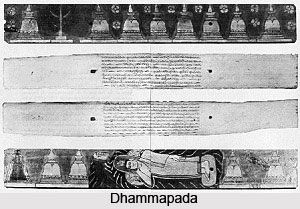
As the eminent historians have opined, Pali canons were primarily originated in India but continued to concentrate in Ceylon (modern Sri Lanka) after the death of Buddha. Ceylon became the center of operation of the Theravada for centuries; consequently the major part of the Pali Literature was composed in Ceylon. Besides the canonical & non-canonical texts, several Buddhist poetry & grammatical texts are also there. Jataka Tales. Dhammapada, Atthakatha, Mahavamsa etc are celebrated works in Pali.
Pali left a grand legacy of "secular" literature, which emulates the contemporary socio- cultural situation of India, including Myanmar, Thailand, Sri Lanka & other neighboring countries. Visuddhimagna and Vimuttimagga, by the scholar- monk Buddhaghosa are the best-known commentaries in the 4th century. Chronicle Histories were mainly composed in the island of Ceylon, which dealt with the records of certain stupas, relics & temples.
There are several handbooks, which were the synopsis of Tripitaka & Theravada teachings. Suttanta texts are the sub commentaries of Abhidhamma, many of which were composed by Dharmapala & the monk Ananda. Cosmology covers rather a small part in Pali secular literature, which are entirely of texts of Burmese tradition. These texts illustrate the traditional Buddhist worldview, five (six) realm of existence: god (deva), human, asura, animal, hungry ghosts (peta) and hell. Some of these texts also appear to be a compilation of astrology. Several prose texts describing the legal & medical (ayurveda) procedures were also there.