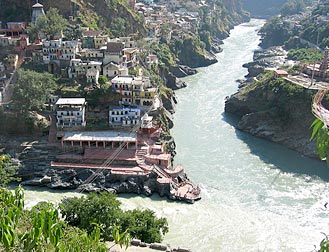
 Mahatmyas are basically the glorifications of sacred places, i.e., places of pilgrimage and tirthas. They are certain works of literature which arose in connection with or included in the Indian Puranas and the Upapuranas. They emerged as handbooks for the Purohitas of the Tirthas praised in them. The Mahatmyas tell of the legends which in part belong to tradition, and in part are inventions, with the purpose of proving the holiness of these places of pilgrimage. They also describe the ceremonies which the pilgrims are to perform and the route they are to follow. For this reason they are not unimportant from the point of view of the topography of India.
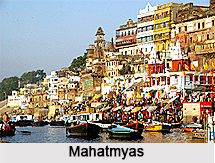
Essentially, a Mahamatya is a laud or a eulogy. It focusses on a place or a god or a ritual activity singing its praises and describing its great benefits. For instance, the Mahamatyas of Kasi are devoted to the greatness of this Tirtha and the fruits to be gained by coming to it on pilgrimage. The literary genre of the Mahatmyas is found prominently throughout the epics as well as the Puranas. In the Mahatmya, each place, each God and each ritual observance is praised as if it were the greatest of all. Each Mahatmya deals with one subject at a time and whatever is being praised occupies full centrestage for the time being.
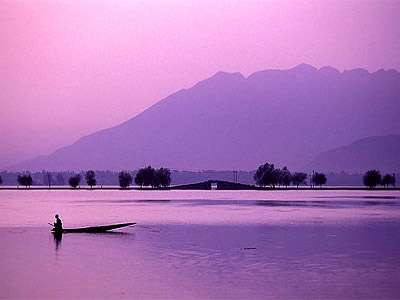
One of the most important among the Mahatmyas is the Nila Mata, the Kashmir Mahatmya. It is an important work from the point of view of the history, legendary lore and topography of Kashmir. The Naga king Nila is a kind of cultural hero of Kashmir, and the work contains "the doctrines of Nila" which he imparted to the Brahmin Chandradeva. It tells the legends of the primeval history of Kashmir (verses 1-481), whereupon there is a description of the ceremonies and festivals prescribed by Nila. Many of these are the usual Brahmanical and Puranic rites, but we find some which are peculiar to Kashmir. Thus joyous festivals are celebrated with singing, music and drinking bouts at the New Year, on the first of the month Kartika, on which Kashmir is said to have arisen, and then again on the occasion of the first fall of snow. On the fifteenth day of the bright half of the month Vaisakha, the birthday of Lord Buddha as an incarnation of Lord Vishnu is solemnly celebrated by the Brahmins; a statue of Buddha is erected, Buddhist speeches are made and Buddhist monks are honoured. The historian Kalhana (about 1148 A.D.) drew on the Nila Mata in his Rajatarangini for the ancient history of Kashmir; and he regarded it as a venerable "Purana."
Most of the Puranas have Mahamatyas contained in them. The Kasi Mahatmya is found in most of the Puranas, the most important being teh Kasi khanda in the Skanda Purana and the Brahmavaivarta Purana. Among the Mahatmyas which claim to be parts of the Garuda Purana, especial mention should be made of a Gaya Mahatmya in praise of Gaya, the place of pilgrimage, where it is particularly meritorious to perform Sraddhas. Very numerous are the Mahatmyas and other modern texts which claim to be parts of the Bhavisya and especially of the Bhavisyottara Purana. Among the offshoots of the Purana literature mention should also be made of the Nepalese Vamsavalis ( Genealogies),which are partly Brahmanical and partly Buddhist, the Nepala Mahatmya and the Vagvati Mahatmya, which claims to be part of a Pasupati Purana.