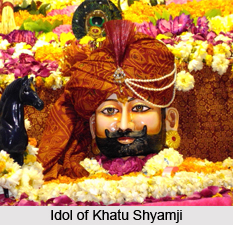
Khatu Shyamji Temple

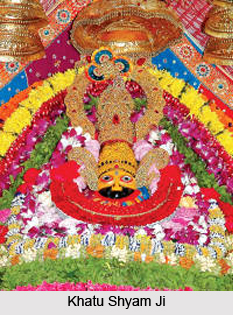
Khatu Shyamji Temple is a popular pilgrimage site in Rajasthan and is known for the annual fair that takes place in the month of either February or March.

Introduction

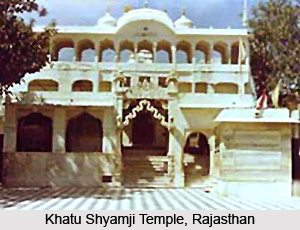
Khatu Shyamji Temple, RajasthanKhatu Shyamji Temple is an important pilgrimage site in Rajasthan. However it is more popular for the annual fair that takes in the month of either February or March. The shrine is located at a distance of 48 kilometers from district of Sikar. From Jaipur this site is easily accessible. The mela or fair takes place on the occasion of Phalgun Sudi Dashmi and lasts till Dwadashi. It lasts for three days and a large number of devotees flock the fair.

As is the case with Indian ceremonies this ceremony too is related to legends. It is said that when the battle of Kurukshetra (Mahabharata) was about to commence the grandson of Bhima (one of the Pandavas) expressed his desire to participate in the battle. Lord Krishna realized that if he took part in the battle the Pandavas would easily win because of his valor and justice will remain undelivered. So Krishna appeared in the disguise of a Brahmin and asked for Barbarik`s (Bhima`s grandson) head. Without any qualms he complied. Krishna was greatly moved by this sacrifice.

In return of this sacrifice he was blessed with 2 boons by the lord. He was able to witness the battle of Kurukshetra from a hilltop. He was also to be worshipped as Shyam. The name Shyam belongs to Lord Krishna himself. It was the result of the boon that even today people worship Khatu Shyamji.

Indian fairs are characterized by vitality, crowd and resplendence. Khatu Shyamji fair is no exception in this regard. Well-decorated shops, several kinds of shows and sweet tidbits are available for the visitors. Joy rides are also part of Khatu Shyamji fair in Rajasthan.

Architecture of Khatu Shyamji Temple

This temple is very rich in its architectural galore. Marble and lime motors have been extensively used in the constructing the structure. The shutter of sanctum sanctorum is very serenely covered with silver sheet, just outside the prayer hall known as the Jagmohan. The measurement of the hall is 12.3 m x 4.7 m and the wall is meticulously painted symbolizing the mythological scenes. The entrance gate and exit gate are made of marble; their brackets are also of marble and feature ornamental floral designs.

Legends of Khatu Shyamji Temple

Legends of Khatu Shyamji TempleLegends of Khatu Shyamji Temple form a major part of the history of the temple. Barbareek, also known as Shayamji, was a great and brave warrior who was the son of Bhima and Nag Kanya- Ahilawati. He learned the art of fighting from his mother. Lord Shiva pleased with him three infallible arrows and Lord Agni gave him the bow which actually made him victorious in the three worlds (air, water and land). The great battle of Mahabharata was inevitable between Kauravas and Pandavas and Shayam alias Barbareek wanted to be a part of the battle having promised to be on the side of the losing side.

So when he set out for the battle field on his Blue Horse (Leela Ghora) well equipped with his bow and three arrows, he was stopped in the middle of his journey by Lord Krishna, who has disguised himself as a Brahmin, with a motive to examine the strength. Lord Krishna started to mock the boy saying he will not be able to win a big battle as this with just three arrows, to which the boy said that he had enough to create havoc in all three worlds. Lord Krishna challenged him to tie all the leaves of the peepul tree under which he was standing, with one arrow. Barbareek accepted the challenge, removed one arrow from his quiver and released it from his bow. The arrow tied all the leaves together within moments. But Lord Krishna had one leaf under his foot.

Lord Krishna knew it very well that the loss of Kauravas was inevitable and if this boy joined them then the battle will be very easily won. But when Barbareek did not relent, the Brahmin wanted charity from the boy. Shocked Barbareek wanted to know who the Brahmin was to which Lord Krishna disclosed his identity and showed him his divine form. Lord Krishna explained that according to the rule of battle a head of a brave Kshatriya needs to be sacrificed in order to worship the battlefield.

Barbareek agreed to sacrifice his head, but wanted to see the battle right till the end. His wish was granted, and so on the the12th day of Shukla Paksha of Falgun month, he gave his head to Lord Krishna (SHISH DAAN). The head was placed atop a hill near the battlefield from where Barbareek could watch the whole battle. After the battle was won by the Pandavas, the main question that needed to be answered was the main person behind the victory. So then Lord Krishna suggested Barbareek`s name saying he was the right person to judge as he witnessed the battle right through for 12 days. Barbareek`s head named Lord Krishna as the pioneering force behind the victory. His strategy, game plan and advice were very crucial for the win. Having pleased with the reply and his great sacrifice, Lord Krishna granted Barbareek with a boon that when kaliyug descends he would be worshipped by the name of Shyam in his form, and his followers would be blessed simply by taking his name.

Later his head was buried in Khatu. And one day when a cow reached that spot, milk started to flow out of her udder. So the place was dug up and the head appeared, then it was handed over to a Brahmin who worshipped it for many days. The King of Khatu, after a dream that he had, was inspired to construct a temple and the head or "SHISH" was installed on the 11th day of Shukla Pakha of Karthik month.

Worships of Khatu Shyamji Temple

Barbarika is worshipped as Shyam, being Krishna himself. So the effect of festivity reflects the vibrant and playful nature of Krishna. The festivals of Jhool Jhulani Ekadashi, Krishna Janmaashtami, Holi and Vasant Panchami are celebrated with full vigour and gusto. Types of Aarti performed in Khatu Shyamji Temple
Mangala Aarti: performed when the temple is open, in the early morning.
Shringaar Aarti: performed at the time of make-up of Baba Shyam. The idol is grandly ornamented for this Aarti.

- Bhog Aarti : performed at noon when bhog (Prasadam) is served to the Lord.
- Sandhya Aarti : performed in the evening, at sunset.
- Sayana Aarti
: performed when the temples is closed, at night.

Two special hymns, the Shri Shyam Aarti and the Shri Shyam Vinati, are chanted on all these occasions. The Shri Shyam mantra is another litany of the Lord`s names that is chanted by devotees.

Shukla Ekadashi and Dwadashi : The 11th and 12th days of the bright half of every month has a special significance in the Hindu calendar. This is simply because of the fact that Barbarika was born on 11th day of the month of phagaan. Night long gazal sessions are also organized where devotees gather to sing and praise the Lord.

Bathing in the Shyam Kund : This is actually the holy pond from where the idols were retrieved. Legends have it that a dip in this pious water can help in curing all types of health ailments.

Nishan Yatra : It is said that often your wish will be realized if you offer a Nishan at the temple. A Nishan is actually a triangular shaped flag, made of cloth that is hoisted on a bamboo stick.

Festivals of Khatu Shyamji Temple

Festivals of Khatu Shyamji TempleDevotees from across the nation participate in the festivals of Khatu Shyamji Temple. Shyamji is worshipped in the form of Lord Krishna. The energy, enthusiasm and vigour in the festivity derive its essence from the colourful and fickle nature of Lord Krishna. There are many types of festivals that are celebrated in the temple and some of the names are as follows;
Ekadashi and Dwadashi is a celebration that has gained importance because of the fact that Shree Shyamji was born on 11th day of the Sukhla Paksh in the Kartik month. Dwadashi is a celebration where Shree Shyamji donated his head "shish" to Lord Krishna during the epic battle of Mahabharata- SHISHDAAN.

Darshan is an important aspect where devotees come regularly from all parts of the country. The temple remains open all through the night of Ekadashi for Darshan. Devotees engage themselves in Kritan-Bhajan on Ekadashi night (Jaagran). Renowned bhajan singers from all around the country sing for their deity in various dharamsalas throughout Khatu.

Nishan Yatra is believed that wishes are granted and it comes true if you offer a Nishan at a temple. Nishan is a triangular flag of a certain size, made of a cloth, which is hoisted on a bamboo stick. It is usually carried in one`s hands while the route from Ringas to Khatu (generally 17 km) on foot. The Nishans, which is a site to see, are actually offered in millions during Falgun Mela.

Falgun Mela is the biggest festival of Rajasthan. The SHISH appeared on Falgun Sudi Ekadashi, so the fair is actually organized from 9th to the 12th of the same month.

A million devotees, from one corner of the country to anther, throng the temple during the four days of celebration. Many stalls are put throughout the towns selling food stuffs, sweets, music cassettes, books etc. Special arrangements are made for feeding all devotees in almost all the Vishram Grihas and Dharamshalas. The festive mood is very much evident among the devotees who eagerly wait in the queue for a moment glance of the deity. Special trains and buses also ply during the mela when the entire town is illuminated in a cheerful mood.

Recently updated articles in Temples of India

Rathnapureeswarar Temple
Rathnapureeswarar Temple Thumbnail

Rathnapureeswarar Temple

Rathnapureeswarar Temple in Tiruvarur district, Tamil Nadu, is a revered Shaivite shrine among the Paadal Petra Sthalams. Dedicated to Lord Shiva, it...

Gayatri Temple, Sirmaur
Gayatri Temple, Sirmaur Thumbnail

Gayatri Temple, Sirmaur

Gayatri Temple is located in Sirmaur district, Himachal Pradesh. Gayatri Temple is a sacred shrine that belongs to the medieval age.

Thousand Pillars Temple
Thousand Pillars Temple Thumbnail

Thousand Pillars Temple

Thousand Pillars Temple, Andhra Pradesh possesses 1000 pillars built by the Kakatiya ruler Rudra Deva during 1163 AD and is adorned with beautiful scu...

Triloknath Temple, Mandi District
Triloknath Temple, Mandi District Thumbnail

Triloknath Temple, Mandi District

Triloknath Temple is built in the Shikhara style of architecture, situated in Mandi, HP.