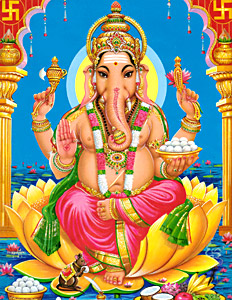
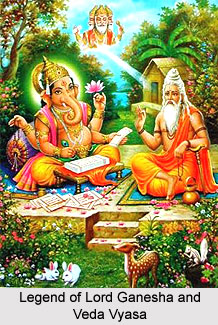
 The Legend of Lord Ganesha and Veda Vyasa is related to the scripting of the Mahabharata, one of the main ancient Sanskrit epics of India. Lord Ganesha, also known as Vakratunda, Lambodara, Ekadanta, Vighnaraja, Vinayaka and Ganapati, is the son of Lord Shiva and Goddess Parvati. He is considered to be the Lord of learning and the destroyer of pride and selfishness. Ganesha is the Remover of Obstacles and Lord of Beginnings. He is worshipped by Hindus, Jains and Buddhists before the beginning of any new rituals or ventures. Veda Vyasa (Ved Vyas), also known as Krishna Dvaipayana, is the author and a character in the epic Mahabharata. He is also believed to be one of the 7 Chiranjivis or immortal humans who remain alive throughout the present Kali Yuga according to the Hindu belief.
The legend states that Ganesha acted as the scribe who scripted the Mahabharata, which is an epic tale of the Kurukshetra War and the lives of the Pandavas and the Kauravas. The Mahabharata also consists of many devotional and philosophical materials and also includes the Bhagavad Gita. Veda Vyasa worshipped and prayed to Lord Brahma, who advised Vyasa to request Lord Ganesha to act as the scribe. The Sage would dictate the Sanskrit epic in verse form. Ganesha obliged the wish of Lord Brahma decided to write the Mahabharata but with one condition. The condition stated that Veda Vyasa would dictate the epic constantly and continuously without any pause. The sage agreed but with his own condition that the elephant headed deity would write the epic only after understanding each and every word and thought and their implications.
Whenever Veda Vyasa realized that Lord Ganesha had finished scripting a verse, the sage dictated a very complex verse with complicated meanings, so that the deity had to take some time to think and understand its meaning before writing. This process helped Vyasa to gather some time in order to compose the next few stanzas in his mind and dictate the verses when the lord was prepared.
The legend also states that Lord Ganesha utilized his broken tusk to script the Sanskrit Mahabharata, which is considered as the longest epic in the world. It is also mentioned that the Mahabharata should not be read hurriedly. The epic should be listened to every day in small parts in order to understand the inner meanings of the tale.