Kunihar Valley
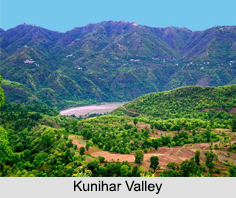
Kunihar Valley is a beautiful valley located between the mountains in Himachal Pradesh.

Share this Article:

Kunihar Valley, Himachal PradeshKunihar Valley is a valley situated between the mountains of Solan District of Himachal Pradesh. Kunihar is situated alongside Kuni Rivulet, a small river. The valley is located at a distance of 42 km from Shimla and 40 km from Solan. Kunihar is well known for the famous cave of Lord Shiva known as "Dyars". The cave is 25 km long. The valley is also famous for the Shri Devi Temple and Shri Dano Devta Temple, dedicated to Kulja Devi and Dano Devta, respectively. Kunihar Talab is another prime attraction of this town.

Etymology of Kunihar Valley
Kunihar is a historical town that has derived its name from a garland shaped rivulet, Kuni, which flows through the valley. Kunihar Valley is also known as "Choti Vilayat" and "Hatkot". The valley was named "Kunihar" by Rajiv Gandhi. During one of his visits, he found this small valley surrounded by a small river named as Kuni. This river was in the shape of garland (translated as Haar), so he named it "Kunihar".

History of Kunihar Valley
As per ancient records, Kunihar was founded in 1154 by Abhoj Dev, a Raghubansi Rajput from Akhnoor in Jammu and Kashmir. His descendants ruled the town for many centuries until the independence in the year 1947. The state was occupied by Nepal from 1803 to 1815. The rulers of the state adopted the title of "Thakur".

Rulers of Kunihar of Kunihar Valley The following are the Rulers or Thakurs of Kunihar Valley:

Mungri Das (1815 - 1816)
Kishen Singh (1816 - 1866)
Tegh Singh (1866 - 1905)
Hardev Singh (1905 - 15 Aug 1947)

Visiting Information of Kunihar Valley
The nearest airport from Kunihar Valley is located in Shimla at a distance of about 28 km. Chandigarh railway station which is located at a distance of about 75 km is the nearest railhead to Kunihar Valley. From both the airport and station, one can get a direct cab to Kunihar Valley. Kunihar has good road connectivity and hence, it can be easily approached by road.

Kunihar Valley is a tourist destination and also a perfect spot to learn about the history of Himachal Pradesh.
Share this Article:

Related Articles

More Articles in States of India


East Indian States
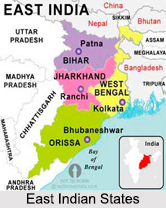
East Indian States comprises of Bihar, Jharkhand, West Bengal, Odisha and also the Union Territory of Andaman and Nicobar Islands. It defines the cultural heritage, rich historical background and the linguistic unity.
Erode District
Erode District is one of the districts in the state of Tamil Nadu. The district of Erode is having a land-locked area with no sea coast.
Purnia District in Bihar
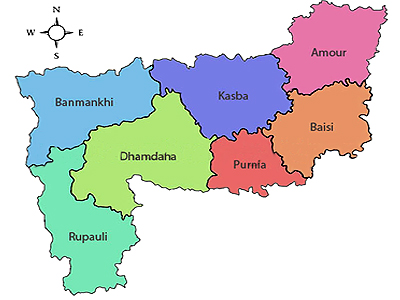
Purnia District is located in Bihar and extends from River Ganga to Nepal. The district has a rich Hindu history and glorious past.
South Delhi District
South Delhi District is the third largest district of Delhi as far as its area is concerned. South Delhi District is known for its economic, historical, cultural and social significance.
North Indian States
North Indian States formed the cultural and religious unity in spite of having many foreign invasion and the political disturbances from the early era till the British gained supremacy in Indian sub continent.
Kendujhar District
Kendujhar District, spread over an area of 8,240 sq kms, is as varied as the whole of Orissa with waterfalls roaring gorges, mountains and minerals. The manifold expressions of nature in Kendujhar District are considered as unique.
Hooghly district
Hooghly District along the bank of the river Hooghly is one of the principal trading ports of West Bengal.
Districts of South Tamil Nadu
Districts of South Tamil Nadu consist of many tourism destinations like archaeological sites and the history of Pandyas and Cholas. Considering their proximity to the sea, many districts also boast of serene beaches and coastal beauty.
Flora of Arunachal Pradesh
Flora of Arunachal Pradesh includes infinite species and is a subject of great interests for the botanists.
Districts of South Gujarat
Districts of South Gujarat are the epicenter of Jain pilgrimages and the early Hindu kingdoms.
North West States of India
North West States of India consist of three states, which are Rajasthan, Punjab and Haryana. All of them are culturally and traditionally diverse and they have been ruled by different dynasties in historical time.
Geography Of Chittoor District
Geography of Chittoor district is spread along the topography of the land which is divided into two natural divisions; Chittoor has a dry and healthy climate.
Districts of North Rajasthan
District of Northern part of Rajasthan is dotted with ancient forts and medieval villages.
Districts of North Odisha
District of North Odisha has Bengal boundary and shares the same culture. These are reachable if one pays a weekend visit to Digha.
Districts of West Bihar
Districts of West Bihar is comprised of medieval monuments that were built by the different governors of Mughal era.
Districts of South Haryana
Districts of South Haryana consists of many cities of industrial excellence. These districts are dotted with popular tourism destinations.
Medieval History of Assam
Medieval history of Assam narrates the advent and rule of a number of kingdoms in the region. The prominent dynasties of the kingdom left an everlasting imprint on the socio cultural heritage of India.
Geography of Meghalaya
The suitable climate, highland plateaus, rivers and the flora and fauna together forms the geography of Meghalaya.
Districts of Rayalaseema
Districts of Rayalaseema in Andhra Pradesh state has urban population and rural settlements as well.
Districts of South Punjab
Districts of Southern part of Punjab depict medieval history of Punjab and the rise of Sikhs.