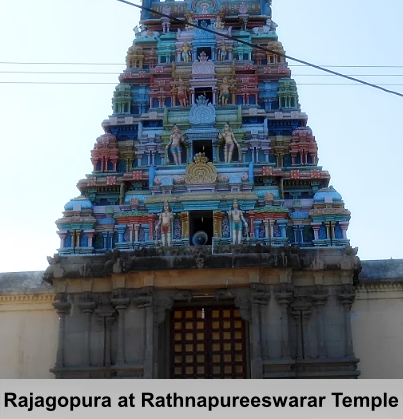
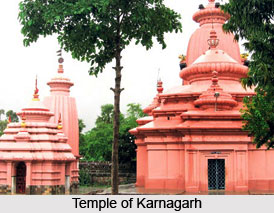
 Karnagarh is a miniscule town that is in 10 Km. distance from Medinipur town and the remains of an old fort from the time of its establishment still attracts the tourists. This fort started its stretch 7 k.m. north of Medinipur and ended after a 3 k.m. run. Remnants of rampart, castle, temples, barracks, and lakes are still traceable. On the south of this fort, temple of Anadilinga `Dandeswar` Mahadev still stands with its glory and Mahamaya temple is just beside it. These two temples stand unhurt and excellent in thin structure. Tourists and devotees come here with special feeling for these temples. A gateway of these temples is also well decorated. `Raghubaba`, this holy person once came here and contributed half of his life, almost 30-35 years as a devotee and priest of these temples. Karnagarh became famous as a holy place for his contribution.
This place is famous for its pastoral-view, ancientness and nostalgia of by-gone days. According to a here say, this fort was built by Raja Karna, epic hero of the Mahabharata. In Bengali-almanac (Panjika) Karnagarh was narrated as a place of pilgrimage. According to `Bhabisya Brahama Khanda`, a Sanskrit Text, existence of Karnagarh prevailed even in 14th century. Temples of Karnagarh are akin to Odissi School of temple structures. Hara Prasad Shastri, the famous scholar opined that, these two temples should be considered as to Odissi art town.
In some opinion, Karnagarh was established as before 500 years ago and Raja Mahabir Singha is the founder of this fort, castle, lakes etc. Jaswant Singha was the grand son of Mahabir Singha, a cenotaph was built on the funeral pyre of Jaswant Singh Rajput. Some other temples ruins are also seen in this place. After observing the Karnagarh ruin it can be judged that Karnagarh had a stretch of almost 3 k.m.s and divided into two sections, namely, `Sadar Mahal (outer portion) and `Andar Mahal`(inner Portion). Sadar Mahal was for the royal officials and soldiers and Andar Mahal was for guardian deity (Kuladevata) and royal members.
In British period, it became the nerve centre of a local revolt, `Chuar Bidroha` which became famous in history (1798). `Chuar` means in-civilized and obstinate, in its popular usage. This revolt was started in Ghatsila on 1767. British rulers over powered them temporarily but on 1798, it appeared with its new potentiality under the leadership of Rani Shiromani and this place became the new nerve centre. The British force was failed to suppress this revolters. In 1799, this revolt was overpowered by British with their force, deployed from outer sources. Rani Shiromoni was arrested and killed. She was attributed a tile of `Laxmibai of Medinipur`. After her death this revolt was weakened. British initiated new rules of collecting taxes. On 1799, `Chuar Revolt` came to its end, but Karnagarh became famous in sharing and witnessing this historical movement.